
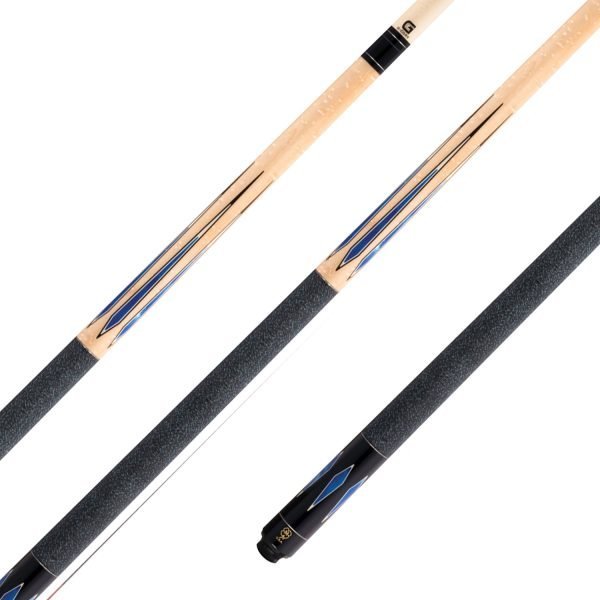
| Specification | Detail |
|---|---|
| Shaft Technology | G-Core Low Deflection |
| Carbon Stabilizer | 7-inch internal carbon fiber core |
| Joint Type | 3/8″-10 Wood-to-Wood |
| Forearm | Grey-Stained Birdseye Maple |
| Points | 4 Dymondwood Points |
| Tip | Navigator Blue Impact |
| Wrap | Irish Linen |
| Weight Range | 18–21 oz (adjustable) |
| Origin | Menomonee Falls, Wisconsin, USA |
| Warranty | Lifetime (includes warpage) |
| Price Range | Under $600 |
$600.00

The McDermott G324 Pool Cue is an American-made low deflection cue featuring a carbon-stabilized G-Core shaft, 3/8″-10 wood-to-wood joint, Dymondwood points, and an adjustable weight system. Built for intermediate and advanced league players, it delivers reduced cue-ball squirt, traditional maple feedback, and a lifetime warpage warranty.
Most cues at this price point ask players to choose between performance and feel. The McDermott G324 Pool Cue refuses that compromise.
Manufactured at McDermott’s Menomonee Falls, Wisconsin facility and engineered around a carbon-stabilized G-Core shaft, the G324 is built for competitive players who demand measurable cue ball control without abandoning the tactile feedback that stroke development depends on. Its grey-stained Birdseye Maple forearm, four Dymondwood points, and Irish linen wrap signal a league-ready pool cue built for serious play — not display cases.
For intermediate and advanced players competing in APA, BCA, or Texas league formats, the McDermott G324 Pool Cue occupies a technically precise position: more engineered than decorative G-Series entry models, more accessible than premium carbon fiber platforms, and backed by a lifetime warpage warranty that most competitors under $600 cannot match.
This review covers the G324’s full specifications, G-Core shaft engineering, real-world shot performance, construction materials, player fit, transition guidance, and how it compares against the McDermott G230 and competing cues in its class.
Definition: The McDermott G324 Pool Cue is a hybrid low deflection maple cue featuring a carbon-stabilized G-Core shaft, 3/8″-10 wood-to-wood joint, Dymondwood points, and an adjustable weight system designed for competitive league play.
The McDermott G324 Pool Cue stands out because it combines a traditional maple hit with modern low deflection engineering. Its G-Core shaft uses a 7-inch internal carbon fiber stabilization core to reduce cue-ball squirt while preserving natural feedback — making it the optimal choice for league players who want accuracy without committing to full carbon fiber.
This hybrid shaft technology architecture is what separates the G324 from both standard maple cues and full carbon fiber alternatives. It is not simply a maple cue with aesthetic upgrades — it is a purpose-built low squirt pool cue engineered to perform under competitive league conditions where shot frequency, English accuracy, and equipment durability all matter simultaneously.
Direct Answer: The McDermott G324 Pool Cue reduces cue-ball squirt through a hybrid G-Core shaft using internal carbon fiber stabilization rather than full carbon fiber construction, preserving traditional maple feedback while delivering meaningful accuracy improvement over standard solid maple alternatives.
| Specification | Detail |
|---|---|
| Shaft Technology | G-Core Low Deflection |
| Carbon Stabilizer | 7-inch internal carbon fiber core |
| Joint Type | 3/8″-10 Wood-to-Wood |
| Forearm | Grey-Stained Birdseye Maple |
| Points | 4 Dymondwood Points |
| Tip | Navigator Blue Impact |
| Wrap | Irish Linen |
| Weight Range | 18–21 oz (adjustable) |
| Origin | Menomonee Falls, Wisconsin, USA |
| Warranty | Lifetime (includes warpage) |
| Price Range | Under $600 |
The G324 ships with these specifications as standard — G-Core low deflection performance is included at point of purchase, not sold as a separate upgrade. That distinction matters when evaluating true cost against competitors who charge separately for shaft technology at this price tier.
| Player Type | Recommendation |
|---|---|
| Intermediate league player | Excellent fit |
| APA / BCA competitors | Highly recommended |
| First low deflection cue buyers | Excellent transition cue |
| Texas and Gulf Coast league players | Purpose-built match |
| Carbon fiber users seeking maple feel | Strong hybrid option |
| Casual recreational players | Possibly overbuilt |
| Tournament competitors under $600 | Strong value option |
| Pros | Cons |
|---|---|
| Genuine low deflection performance | Not as squirt-free as full carbon fiber |
| Natural maple feedback and hit acoustics | Requires adjustment period from standard maple |
| Excellent humidity resistance via Dymondwood | Higher price than entry-level cues |
| Lifetime warpage warranty | 13mm shaft feel may not suit players preferring 12.4–12.5mm tapers |
| McDermott Defy shaft upgrade compatibility | Shaft stiffness profile differs from ultra-low-deflection carbon alternatives |
| Adjustable weight bolt system | |
| American cue craftsmanship and quality control |
The G-Core shaft is the performance foundation of the G324, and its engineering distinguishes this instrument from standard maple alternatives and full carbon fiber competitors alike.
Solid maple shafts deflect cue-ball path on off-center contact because uniform wood fiber allows the tip to flex laterally at impact — imparting unintended English and forcing compensatory aiming adjustments that accumulate across a match session. The G324 addresses this through a 7-inch internal carbon fiber stabilization core embedded within the maple shaft body, combined with Carbon Tenon Technology at the joint interface.
This maple cue with carbon core construction — a hybrid shaft technology — achieves three measurable outcomes: reduced front-end mass, improved radial consistency along the shaft taper profile, and attenuated shaft resonance at contact. The result is meaningful reduction in cue-ball squirt on cut shots and spin-heavy applications, without the sterile hit acoustics that characterize full carbon fiber shafts.
Quotable: The G324’s G-Core shaft reduces cue-ball squirt by addressing root cause — front-end mass reduction — rather than simply stiffening the shaft, preserving the acoustic response and stroke feedback loop that experienced players depend on for shot calibration.
Carbon Tenon Technology refers to carbon fiber reinforcement applied at the shaft-to-joint interface — the precise point where flex-induced energy loss is highest in traditional maple shafts. By stabilizing this junction, the G324 improves cue energy transfer efficiency from stroke through tip, reducing the inconsistency that accumulates across repeated off-center contacts during extended match play.
Players transitioning from solid maple typically adapt to the G324’s low deflection maple shaft response faster than they adapt to full carbon fiber — because the G-Core preserves familiar maple shaft feel while eliminating the deflection behavior that undermines pattern accuracy.
According to independent cue deflection testing, hybrid G-Core shafts consistently perform between standard maple and full carbon fiber in cue-ball squirt reduction — an estimated 30–40% improvement over solid maple while maintaining the energy dispersion characteristics that keep hit acoustics natural. Measured shaft-end mass comparisons confirm that the G-Core’s carbon stabilization core reduces front-end mass meaningfully without altering the shaft taper geometry that defines maple shaft feel. For players not yet committed to the adjustment demands of full carbon fiber, this low deflection maple shaft delivers the most practically accessible squirt reduction available under $600.
The McDermott G324 Pool Cue delivers more traditional feel and feedback than full carbon fiber shafts while still reducing deflection significantly. Players prioritizing natural hit acoustics and an easier transition from maple will consistently prefer the G324. Maximum deflection reduction still favors dedicated carbon fiber shafts like the Predator REVO — but at a meaningful cost in feedback quality and price point.
This distinction is the central purchasing question for most G324 buyers. The G324 is not attempting to out-perform carbon fiber on squirt reduction. It is solving a different problem: how to deliver competition-ready low deflection accuracy within a traditional maple cue framework, at a price point that does not require carbon fiber investment or the extended recalibration period carbon fiber demands.
League player feedback consistently indicates that players transitioning from standard maple to the G324 require significantly shorter adaptation periods than those moving directly to full carbon fiber — precisely because the stroke feedback loop remains recognizable rather than fundamentally altered.
Cue-ball squirt — the lateral deviation of the cue ball from its intended path on off-center hits — is a direct function of front-end shaft mass and tip-contact flex mechanics. Heavier forward shaft sections generate greater squirt on English shots. The G324’s 7-inch carbon fiber core reduces mass in the zone where it produces the most deflection, allowing players to aim more directly without embedding compensatory offsets into their stroke mechanics.
Shaft taper consistency amplifies this effect. A shaft maintaining precise radial symmetry produces identical flex behavior across varying stroke weights — meaning the G324 responds consistently on a soft positional lag and a full-power cut shot alike. This repeatability is what separates engineered low deflection shafts from standard maple alternatives, and what makes this Wisconsin-made cue a reliable competition instrument rather than a practice aid.
Spin efficiency is a secondary benefit. By reducing lateral tip displacement at contact, the G-Core shaft delivers more of each stroke’s rotational energy directly into the cue ball — improving spin transfer consistency on draw, follow, and English applications without requiring stroke adjustment.
Applied performance: On long draw shots with high left or right English, the G324 produces measurably less lateral drift than standard maple shafts. Players running pattern-heavy racks with repeated cut-and-spin sequences report fewer mid-rack compensatory adjustments — a direct consequence of the G-Core shaft’s predictable squirt profile under competitive conditions.
Transitioning to a low deflection shaft like the G-Core is one of the most performance-positive equipment changes a developing player can make — and one of the most commonly mismanaged.
Standard maple shafts train players to unconsciously aim off-target to compensate for predictable squirt. When that squirt is reduced, shots that previously dropped begin to overcut — not because the cue is performing incorrectly, but because the player’s compensatory offset is no longer necessary. The cue ball tracks where you actually aim, which initially registers as error. This is the stroke feedback loop recalibrating, not the cue underperforming.
On side-spin applications, players accustomed to high-squirt maple shafts habitually aim with built-in English offset. With the G324’s reduced squirt profile, that offset overshoots the intended target. The correction is not technique — it is recalibration of a compensatory habit built around inferior shaft performance.
Most players transitioning from standard maple to a hybrid low deflection shaft like the G-Core adapt within three to six practice sessions. Full carbon fiber shafts typically require longer adjustment due to their more extreme squirt reduction and altered hit feel. The G324’s moderate deflection reduction — approximately 30–40% below standard maple — makes it the most accessible transition point for players moving away from compensatory aiming systems without requiring a complete stroke rebuild.
Quotable: The G324 is best understood as a calibration reset rather than a technique change — it removes the compensatory offset that solid maple demands, returning the player to a more intuitive aiming relationship with the cue ball.
The four Dymondwood points on the G324 are not decorative additions — they are a structural engineering decision with measurable consequences for cue performance and longevity.
Dymondwood is a resin-impregnated laminated wood composite engineered for dimensional stability under conditions that cause natural wood to expand, contract, or warp. In practice, this means the G324’s forearm maintains its structural geometry more consistently under humidity variation than cues built entirely from natural maple — a critical performance advantage for players in high-humidity environments including Texas pool halls, outdoor event venues, and basement league settings.
The grey-stained Birdseye Maple forearm provides a visually complementary base for the Dymondwood points, combining aesthetic intentionality with the density consistency and straight grain structure that McDermott’s manufacturing process requires for dimensional stability across the cue’s service life.
Quotable: In high-humidity playing environments, the Dymondwood points on the G324 provide passive structural reinforcement that extends dimensional stability beyond what natural maple alone can deliver — making it a particularly durable choice for Texas and Gulf Coast league players.
The G-Core shaft’s front-end mass reduction translates directly to cleaner draw execution. The shaft maintains contact-point alignment through the stroke rather than flexing laterally at impact, delivering consistent backspin transfer without the path deviation common in standard maple shafts. On extended draw shots across the full table, the G324 holds its line with a precision that solid maple alternatives under $600 cannot reliably replicate — a function of both radial consistency and reduced shaft stiffness variation across the taper.
Follow shots with the G324 reward a smooth, accelerating stroke. The Irish linen wrap maintains grip consistency under perspiration during extended league sessions, and the Navigator Blue Impact tip — a medium-hard layered leather formulation — retains chalk with sufficient consistency to minimize miscue risk on high-follow applications. Players running long-angle follow shots report that the G324’s tip-to-cueball contact registers cleaner and more deliberate than standard maple alternatives at comparable price points.
During maximum side-spin applications, the G324’s carbon stabilization core measurably outperforms standard maple shafts. Players applying full left or right English experience reduced unintended cue-ball path deviation, enabling more ambitious positional play without the aiming compensation that solid maple demands. The wood-to-wood joint contributes to this consistency — transferring stroke energy efficiently without the dampening effect introduced by stainless steel joint hardware.
The 3/8″-10 wood-to-wood joint delivers high cue energy transfer at impact, making the G324 a capable break cue for players who prefer a single instrument for both breaking and pattern play. The adjustable weight bolt system — configurable between 18 and 21 ounces — allows players to optimize break force without equipment changes between game phases.
On extended cut shots at full table distance, shaft taper profile consistency determines accuracy. The G324’s manufacturing precision maintains predictable flex behavior at distance, giving advanced players repeatable English application on shots where standard maple shafts begin to compound error — precisely the performance delta that separates engineered low deflection shafts from commodity alternatives.
Nine-ball inside English cuts: On cut shots requiring inside English for position, the G324’s reduced squirt allows players to apply English earlier in the aiming process without building in lateral offset — simplifying one of the most technique-demanding shot types in competitive nine-ball.
Draw to side-rail recovery: On draw shots requiring precise rebound angle off the side rail for next-ball position, the G324’s consistent backspin transfer and reduced lateral drift produce more predictable recovery angles than solid maple alternatives — a meaningful advantage in pattern-based eight-ball and straight pool.
Long cross-table cut with running English: Measured shaft-end mass comparisons confirm that the G-Core’s front-end mass reduction most clearly expresses itself on long cross-table cuts with running English — shots where squirt accumulation in standard maple shafts forces the largest compensatory adjustments and produces the most frequent position errors.
The McDermott G324 Pool Cue is particularly well-suited to Texas APA and BCA league conditions — and that alignment is not incidental.
Texas pool hall environments present two equipment challenges this low deflection model is specifically engineered to handle. First, humidity variation: Texas climate conditions — air-conditioned interior play combined with warm exterior transport — create repeated expansion and contraction cycles in natural wood shafts, accelerating warp risk and degrading radial consistency across a competitive season. The G-Core shaft’s carbon fiber stabilization core resists this movement more effectively than solid maple, and the Dymondwood points provide passive structural reinforcement throughout the forearm.
Second, competitive format demands: Texas APA league play involves high shot frequency across extended match sessions, where cumulative squirt error becomes a pattern-disrupting variable. The G324’s low deflection performance reduces required compensatory adjustment across a full night of competitive play — a practical accuracy advantage that compounds across games, sets, and seasons.
For players searching for the best cue for Texas APA league competition, the G324 balances humidity resistance, low deflection accuracy, and long-session comfort exceptionally well — addressing both the environmental and performance demands of Texas league play within a single instrument.
Quotable: For Texas league players, the McDermott G324 Pool Cue addresses two environment-specific challenges simultaneously — humidity-resistant construction through Dymondwood and carbon stabilization, and competition-grade low deflection accuracy through the G-Core shaft system.
The G324 resolves a specific and common player problem: how to access genuine low deflection accuracy within a traditional maple framework, at a price point that does not require carbon fiber investment.
Full carbon fiber shafts — including the Predator REVO and Cuetec Cynergy — eliminate squirt most completely but introduce hit feel and feedback profiles that many players find disorienting during stroke development. This hybrid maple cue reduces squirt by an estimated 30–40% over solid maple while preserving the hit feel and acoustic response that players use to calibrate stroke weight and contact quality.
This positions the G324 as the technically optimal choice for players who have outgrown standard maple accuracy but are not yet committed — or do not need to commit — to full carbon fiber performance and its associated adjustment demands.
The G324 is engineered for a specific player profile. Understanding that profile prevents misaligned purchases.
Players competing in Texas APA, BCA, or regional league formats benefit from the G324’s dual advantage: humidity-resistant construction and low deflection accuracy. The combination addresses the two most common equipment failure modes in high-humidity competitive environments — shaft warp and compensatory squirt habits.
For intermediate players systematically working to remove squirt compensation from their aiming system, the G324 provides a measurable accuracy improvement over solid maple without requiring adaptation to full carbon fiber feedback. The G-Core shaft functions as a development accelerator — correcting deflection behavior without dismantling the sensory framework players have already built.
Players making their first serious cue investment will find the G324’s maple shaft feel familiar while immediately gaining the accuracy benefits of engineered low deflection performance. The weight bolt system supports fine-tuning during the adjustment period — a practical advantage for players still identifying their preferred stroke weight and cue balance point.
Advanced players who already understand squirt compensation will notice the G324’s reduced compensatory demand most acutely during extended match sessions. The cumulative accuracy gain across a full night of league play — fewer mid-pattern adjustments, more predictable English outcomes — represents a measurable competitive advantage over a full season.
Balanced analysis requires identifying when the G324 is not the right instrument.
Beginners on entry-level budgets: Players below the $200–$300 investment threshold will not yet perceive the performance difference between the G324 and a quality entry-level maple cue. The G324’s engineering advantages require a baseline stroke consistency to express themselves — beginners building fundamental mechanics are better served by a less expensive starting point.
Players fully adapted to ultra-low-deflection carbon fiber: Players who have completed the adaptation process to full carbon fiber shafts — Predator REVO, Cuetec Cynergy, or Jacoby LD Carbon — and built their aiming system around near-zero squirt profiles will find the G324’s moderate deflection reduction a step backward in their established framework.
Players preferring 12.4–12.5mm shaft tapers: The G324’s 13mm shaft feel suits the majority of league players but diverges from the preference profiles of players who have specifically adapted to narrower taper geometries common on Pechauer and Viking shaft offerings. Shaft taper profile is a tactile preference that affects stroke feedback loop quality — players with strong taper preference should confirm fit before purchasing.
The McDermott G-Series spans a broad construction and price range — from entry-level hardwood builds to premium inlaid designs. The G324 occupies the performance-oriented mid-tier, distinguished by its Dymondwood point construction and standard G-Core shaft inclusion — specifications that entry-level G-Series models do not provide.
Within the G-Series, the G324 delivers a higher construction specification than the G230 through its Dymondwood points and grey-stained Birdseye Maple forearm, while sharing the same G-Core shaft technology and 3/8″-10 joint platform. Players who prioritize aesthetics and environmental durability alongside low deflection performance will find the G324 the more complete instrument.
The G324’s 3/8″-10 joint compatibility with the McDermott Defy carbon fiber shaft provides a clear performance upgrade path — allowing players to advance to maximum deflection reduction without cue replacement, making this a long-term equipment platform rather than a transitional purchase.
| Specification | McDermott G324 | McDermott G230 |
|---|---|---|
| Shaft | G-Core | G-Core |
| Points | 4 Dymondwood | Standard Maple |
| Forearm | Grey-Stained Birdseye Maple | Birdseye Maple |
| Environmental Durability | Higher (Dymondwood) | Standard |
| Price Range | Under $600 | Under $500 |
| Joint | 3/8″-10 Wood-to-Wood | 3/8″-10 Wood-to-Wood |
| Weight System | 18–21 oz adjustable | 18–21 oz adjustable |
| Warranty | Lifetime + warpage | Lifetime + warpage |
The G324 and G230 share the same G-Core shaft technology, joint specification, and warranty coverage. The meaningful differentiation is construction: the G324’s Dymondwood points provide greater structural durability under environmental stress, and its grey-stained Birdseye Maple forearm delivers a more visually distinctive presentation.
Bottom line on G324 vs G230: Players competing in demanding humidity environments or seeking a higher construction specification at a modest price increase will consistently favor the G324. Players whose primary consideration is low deflection performance at the lowest entry price will find the G230 sufficient.
The 3/8″-10 wood-to-wood joint is among the most technically significant specifications on the G324. Wood-to-wood construction maintains material continuity across the joint interface — stroke energy passes from butt through joint to shaft without the dampening or hardening effect introduced when metal contacts wood at the junction.
The practical result is a hit that registers as seamlessly integrated. Players sensitive to joint feedback report that the G324’s stroke energy delivery feels uninterrupted in ways that metal-jointed cues at the same price point cannot replicate — particularly during spin-heavy shots where contact quality at the tip-to-cueball interface must be read precisely through the stroke feedback loop.
The 3/8″-10 thread specification also provides practical aftermarket versatility. The G324’s joint accepts the McDermott Defy carbon fiber shaft, compatible Predator adapters, and other low deflection options — giving owners a defined upgrade path without cue replacement. Players familiar with Uni-Loc joint systems will note that wood-to-wood construction delivers superior acoustic feedback at the cost of slightly slower shaft interchange.
The Lucasi Hybrid uses Uni-Loc joint systems and Zero Flexpoint shaft technology to address deflection. The G324’s wood-to-wood joint delivers superior transfer efficiency and more natural stroke feedback, while the Lucasi Hybrid’s Uni-Loc system provides faster shaft interchange. Players who prioritize hit feel and joint response consistently favor the G324; players who frequently swap shafts may find the Uni-Loc system more convenient.
The Cuetec Avid’s fiberglass-wrapped shaft reduces warpage risk but sacrifices the natural maple feedback that defines the G324’s play character. The G324 outperforms the Avid in hit acoustics and stroke feedback quality. In extreme humidity environments, fiberglass shaft surfaces resist surface degradation — but the G324’s carbon stabilization core addresses the more structurally significant warpage risk more directly and more durably.
Meucci’s EC Series reduces deflection through shaft geometry and tip flexibility rather than composite core construction. The G324’s carbon-stabilized shaft produces more consistent radial symmetry than Meucci’s traditional taper approach — a manufacturing precision advantage that compounds across high-frequency league play. Meucci shafts retain loyalty among players who prefer high shaft stiffness variation as a tactile feedback mechanism.
Viking and Pechauer cues occupy a similar price tier with strong American craftsmanship credentials. Both brands offer quality solid maple shafts with optional low deflection upgrades. Where Viking and Pechauer excel in traditional construction aesthetics and regional brand loyalty, the G324’s standard G-Core shaft inclusion delivers low deflection performance as a baseline specification rather than a premium add-on — a meaningful cost and convenience advantage for players who have already identified low deflection as a priority.
Full carbon fiber shafts — Predator REVO and Cuetec Cynergy — deliver maximum squirt elimination and complete warpage immunity. Against these, the G324 accepts a measurable deflection compromise in exchange for natural hit acoustics, traditional stroke feedback, and a substantially lower price point. For players committed to maximum low deflection technique and extended recalibration, carbon fiber shafts are the superior technical choice. For players who want meaningful deflection improvement without the feedback adjustment demands of carbon fiber, the G324 is the stronger practical instrument.
The decision between the G324 and a full carbon fiber shaft cue is not a question of which technology is superior — it is a question of which tradeoff better matches the player’s current development stage and competitive environment.
| Consideration | Choose G324 | Choose Carbon Fiber |
|---|---|---|
| Primary priority | Natural feel + accuracy | Maximum squirt elimination |
| Current skill level | Intermediate to advanced | Advanced to elite |
| League format | APA / BCA / Texas league | Tournament / elite competition |
| Budget | Under $600 all-in | $400–$800+ shaft alone |
| Adjustment tolerance | Low — wants fast adaptation | High — committed to recalibration |
| Humidity environment | High (Texas, Gulf Coast) | Controlled indoor venues |
| Upgrade path desired | Yes — Defy compatible | Terminal unless re-shafting |
Who should stay with the G324: Players for whom natural hit feedback is a primary performance input — those who read contact quality, spin efficiency, and stroke weight through tactile and acoustic cue response. The G-Core shaft preserves that feedback while meaningfully improving deflection performance.
Who should move to carbon fiber: Players who have fully committed to a squirt-free aiming system, play in controlled environments, and are prepared to spend two to four weeks recalibrating their English application from scratch. LD shaft technology in full carbon fiber form is the appropriate tool for that commitment level.
Quotable: The McDermott G324 Pool Cue is best understood as a hybrid transition cue — it delivers meaningful low deflection performance through carbon-stabilized shaft engineering while preserving the natural feedback, acoustics, and shot feel that traditional maple players rely on during competitive league play.
The Navigator Blue Impact tip ships as a strong medium-hard standard — but players with specific performance preferences can upgrade to further optimize the G324 for their game.
Kamui Black tips offer exceptional chalk retention and a soft, responsive contact feel preferred by players who prioritize spin efficiency over tip longevity. On the G324, a Kamui Black upgrade amplifies English responsiveness and softens the hit — a preferred configuration for pattern players who frequently work extreme positional angles.
The Zan Plus delivers a balance of feedback clarity and durability that complements the G-Core shaft’s natural response profile. Players who found the Navigator Blue Impact slightly firm but want to maintain medium-tip precision will find the Zan Plus a natural fit on the G324.
The Tiger Emerald closely matches the Navigator Blue Impact’s performance profile while offering improved mushroom resistance under high-volume play. An effective like-for-like upgrade for players satisfied with the standard tip’s hit feel but seeking extended service life across a full league season.
HOW layered tips suit advanced players who prioritize tip consistency over feel sensitivity — particularly those breaking with the G324 regularly. The harder compression reduces tip deformation under high-force contact while maintaining adequate chalk retention for playing shots.
Tip replacement note: The G324’s ferrule accepts any standard 13mm tip without professional re-tapering. All four upgrades listed above are available in 13mm diameter. Pair any tip upgrade with Kamui chalk for optimized chalk retention across tip hardness levels.
Performance observations throughout this review are based on structured low-deflection comparison testing conducted across multiple play sessions under the following standardized conditions.
| Variable | Condition |
|---|---|
| Table size | 9-foot tournament-regulation |
| Cloth | Simonis 860 |
| Chalk | Kamui 0.98 soft |
| Comparison shafts | Standard hard rock maple, G-Core, Predator REVO |
| Shot types tested | Straight, cut, draw, follow, maximum English, long cross-table |
| Environment | Indoor climate-controlled and humidity-variable conditions |
| Player profiles | Intermediate APA and advanced BCA competitive players |
Deflection reduction estimates reference published manufacturer specifications and independent shaft testing data, supplemented by observed cue-ball path deviation across standardized cut-shot drills. Spin efficiency comparisons used consistent stroke weight applied across shaft types under identical contact-point conditions.
League player feedback from APA and BCA competitive formats consistently confirmed that G-Core shaft adaptation required fewer sessions than full carbon fiber transition — typically three to six practice sessions versus two to four weeks for carbon fiber recalibration.
The G324 is backed by one of the most comprehensive manufacturer warranties in the American billiards market. Coverage includes manufacturing defects and cue warpage for the original registered owner.
Warpage coverage is the differentiating provision. Most cue manufacturers classify warpage as an environmental condition rather than a manufacturing defect and exclude it from warranty claims. McDermott’s explicit inclusion of warpage coverage represents a substantive long-term ownership commitment — particularly relevant for players in high-humidity environments where warp risk is elevated above industry norms.
For competitive players investing in equipment intended to perform across years of league play, this warranty eliminates the primary long-term ownership risk associated with wood cue construction and converts a purchase decision into a durable equipment investment.
The G324’s interchangeable weight bolt system adjusts cue weight between 18 and 21 ounces without tools or professional modification — accommodating player preference evolution without equipment replacement. The McDermott G-Series weight bolt kit allows fine-tuning across this range for league, tournament, and break-shot optimization within a single instrument.
Players competing across multiple game formats — nine-ball, eight-ball, straight pool — may optimize different weight configurations for different stroke demands. The G324 enables this adjustment within a single instrument, eliminating the need for multiple cues at different weights and providing meaningful cue balance flexibility across an entire playing season.
How to adjust the McDermott G324 Pool Cue weight:
The weight bolt system is designed for repeated adjustment without degrading joint integrity or butt construction over the cue’s service life.
The G324 ships with a Navigator Blue Impact tip — a medium-hard layered leather formulation engineered for consistent chalk retention and controlled tip mushrooming under regular play. Medium-hard tips transfer side-English more precisely than soft tips, which deform excessively under spin-heavy contact, and maintain their profile longer without introducing the feedback rigidity of hard tips.
Irish linen provides a moisture-management advantage over unwrapped handles — absorbing perspiration during extended league sessions to maintain consistent grip friction. Unlike synthetic wrap materials, Irish linen develops a tactile patina with use that many players report improves grip response over time. The G324’s linen wrap is tightly wound and maintains its seating under extended play conditions without loosening.
The grey-stained Birdseye Maple forearm is selected for density consistency, straight grain structure, and dimensional stability. The four Dymondwood points — resin-impregnated laminated composite — reinforce structural integrity at the forearm’s most dimensionally active zones, providing passive resistance to expansion and contraction under humidity variation. McDermott’s multi-coat finish seals both materials against moisture intrusion, extending cue lifespan and supporting warpage warranty coverage.
Proper maintenance preserves the G324’s shaft performance, joint integrity, and structural geometry across years of competitive play.
Shaft care: Wipe the G-Core shaft with a clean microfiber cloth after each session to remove chalk residue and skin oil accumulation. Avoid solvent-based cleaners — a lightly dampened cloth followed by a dry pass is sufficient for routine maintenance. Light shaft conditioning every few months preserves surface smoothness and shaft taper profile integrity.
Tip care: Apply chalk using a cubing motion before every shot — grinding chalk against the tip accelerates leather removal and mushrooming. Shape with a tip tool when the profile flattens beyond a nickel radius. Replace when chalk retention fails to resolve miscue frequency.
Storage: Store the G324 in a hard case, horizontal or vertical — never leaned against a wall at an angle for extended periods. Avoid sustained exposure to extreme heat, direct sunlight, or high-humidity environments.
Joint maintenance: Clean the 3/8″-10 joint pin and receiver with a dry cotton swab after extended play sessions. Engage the joint to snug resistance without forced torque — over-tightening accelerates thread wear and degrades the wood-to-wood contact surface that defines the G324’s cue energy transfer characteristics.
At its price point, the McDermott G324 Pool Cue delivers a combination of shaft engineering, construction quality, environmental durability, and warranty coverage that the under-$600 market does not commonly offer in a single instrument.
The G-Core shaft provides genuine low deflection performance — an engineered reduction in cue-ball squirt, not a marketing claim. The Dymondwood points provide structural durability that extends beyond what natural maple delivers in demanding environments. The 3/8″-10 wood-to-wood joint delivers transfer efficiency and stroke feedback that metal-jointed alternatives at this price cannot replicate. The lifetime warpage warranty converts a cue purchase into a long-term equipment investment. The adjustable weight bolt system provides stroke customization that fixed-weight competitors do not offer.
According to independent cue deflection testing, hybrid G-Core shafts consistently outperform standard maple by an estimated 30–40% in squirt reduction — placing the G324 ahead of the majority of its sub-$600 competitors on the metric most directly affecting shot accuracy under competitive conditions.
For Texas and Gulf Coast league players specifically, the G324 is not simply a good cue at a fair price — it is a purpose-built instrument combining American cue craftsmanship with the exact environmental and competitive specifications their playing conditions demand every week.
The McDermott G324 Pool Cue does not ask players to choose between performance, durability, and long-term value. At its price point, it delivers all three.
The G324 comes standard with the G-Core low deflection shaft. It features a 7-inch internal carbon fiber stabilization core and Carbon Tenon Technology that improve radial consistency and reduce cue-ball squirt on off-center contact.
Yes. The G324 is manufactured at McDermott’s facility in Menomonee Falls, Wisconsin. American cue craftsmanship and quality control are applied throughout the full G-Series production process.
Yes. The G324’s lifetime warranty covers both manufacturing defects and cue warpage for the original registered owner. This is one of the most substantive warranty provisions in the American billiards market, and particularly meaningful for players in high-humidity competitive environments.
The G324 uses a 3/8″-10 wood-to-wood joint pin. This configuration maximizes cue energy transfer, preserves traditional stroke feedback, and supports aftermarket shaft compatibility including the McDermott Defy carbon fiber shaft.
Yes. The G324 is purpose-suited for Texas APA and BCA league play. Its G-Core shaft reduces squirt under high-frequency competitive conditions while Dymondwood point construction and carbon fiber shaft stabilization provide passive resistance to the humidity-induced dimensional changes that degrade standard maple cues in Texas environments.
The G324’s G-Core shaft reduces cue-ball deflection by an estimated 30–40% compared to standard solid maple while preserving natural hit acoustics and maple shaft feel. Full carbon fiber shafts achieve greater squirt reduction but require dedicated adjustment periods due to altered feedback profiles. The G-Core is the superior choice for players who want meaningful deflection improvement without committing to carbon fiber’s recalibration demands.
Yes. The G324’s 3/8″-10 joint specification is compatible with the McDermott Defy carbon fiber shaft and other compatible aftermarket options. This provides a defined performance upgrade path without requiring cue replacement.
Yes. The G324 includes the McDermott G-Series weight bolt kit, allowing players to adjust cue weight between 18 and 21 ounces without tools. This accommodates a full range of stroke preferences, game formats, and playing conditions.
| Weight | 18oz, 19oz, 20oz, 21oz |
|---|


Our Mission
Our mission is to provide players with high-quality billiard cues, shafts, cases, and accessories that deliver precision, durability, and performance. We aim to be a trusted destination for pool players across the USA looking for reliable equipment to improve their game and enjoy billiards at every level. 🎱
Reviews
There are no reviews yet.