
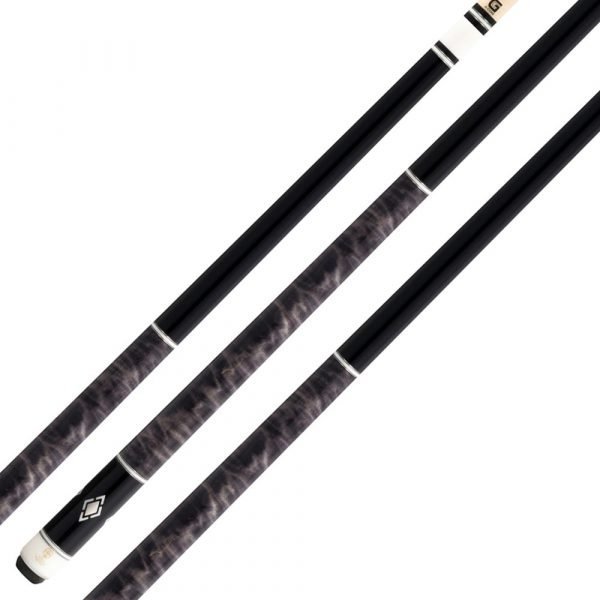
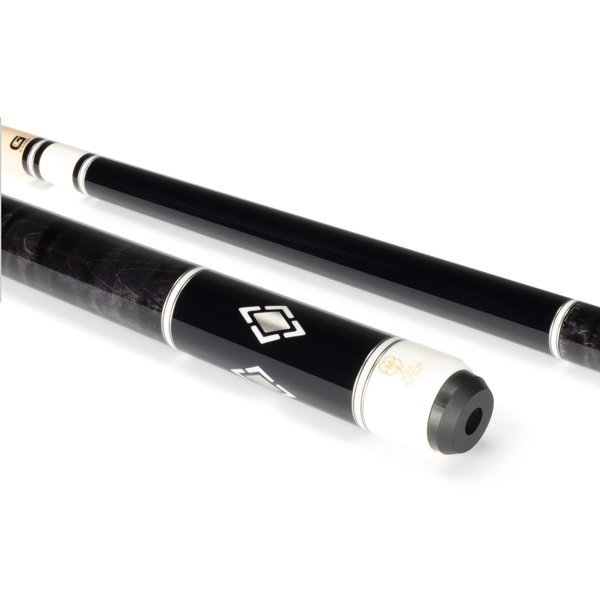
| Specification | Detail |
|---|---|
| Cue Model | McDermott H753 |
| Series | H-Series (Adjustable Balance) |
| Construction | Birdseye maple |
| Inlays | Turquoise, recon ebony |
| Joint Type | 3/8″-10 wood-to-wood |
| Shaft | G-Core low-deflection, 29″ |
| Tip | Navigator Blue Impact, 12.75mm |
| Weight Range | ~18–21 oz (VBP adjustable) |
| Balance System | Variable Balance Point (VBP) |
| Wrap | Irish linen |
| Origin | Menomonee Falls, Wisconsin, USA |
| Warranty | Lifetime (including warpage) |
| Shaft Compatibility | McDermott Defy, i-3, other 3/8″-10 shafts |
$580.00

The McDermott H753 pool cue represents one of the most technically deliberate entries in McDermott’s premium production lineup. Built around the patented Variable Balance Point (VBP) system — an internal weight architecture that allows players to shift balance forward or backward along the cue butt without external tools — the H753 is engineered for advanced players who treat cue feel as a performance variable, not a fixed condition.
This review covers everything a serious buyer needs to evaluate the H753: VBP system mechanics, G-Core shaft performance, specs, balance tuning range, shaft compatibility, warranty terms, real-world playability, and how it compares to competing premium cues at the same price point. Whether you’re researching the McDermott H753 price, evaluating it against the Predator 5K Series, or deciding whether the VBP system will translate to measurable improvement in your game — this guide delivers the technical depth to make that call with confidence.
The McDermott H753 is an American-made, adjustable-balance pool cue manufactured at McDermott’s facility in Menomonee Falls, Wisconsin — the same facility where the company has produced cues since 1975. It belongs to McDermott’s H-Series line, the brand’s dedicated adjustable-balance production tier, which distinguishes itself from McDermott’s standard lineup through the inclusion of the Variable Balance Point system as a core mechanical feature rather than an optional upgrade.
Structurally, the H753 is built from premium Birdseye maple with turquoise and recon ebony inlays, joined at a 3/8″-10 wood-to-wood joint, and paired with a 29-inch G-Core low-deflection shaft tipped with a Navigator Blue Impact tip at 12.75mm diameter. The result is a cue that combines premium American craftsmanship with a level of mechanical customization typically associated with custom cue makers rather than production manufacturers.
One-Sentence Definition: The McDermott H753 is an American-made adjustable-balance pool cue featuring the patented Variable Balance Point system, a G-Core low-deflection shaft, and Birdseye maple construction — engineered for advanced players requiring precision deflection control, customizable stroke weight, and lifetime warranty protection against warpage.
| Specification | Detail |
|---|---|
| Cue Model | McDermott H753 |
| Series | H-Series (Adjustable Balance) |
| Construction | Birdseye maple |
| Inlays | Turquoise, recon ebony |
| Joint Type | 3/8″-10 wood-to-wood |
| Shaft | G-Core low-deflection, 29″ |
| Tip | Navigator Blue Impact, 12.75mm |
| Weight Range | ~18–21 oz (VBP adjustable) |
| Balance System | Variable Balance Point (VBP) |
| Wrap | Irish linen |
| Origin | Menomonee Falls, Wisconsin, USA |
| Warranty | Lifetime (including warpage) |
| Shaft Compatibility | McDermott Defy, i-3, other 3/8″-10 shafts |
The McDermott Variable Balance Point system is the defining technical feature of the H-Series line and the primary reason the H753 commands attention in the premium production cue segment. Understanding how it works — and what it actually changes about how a cue performs — is essential to evaluating whether the H753 is the right cue for your game.
The VBP system consists of repositionable weight cartridges housed within a precision-machined cavity inside the cue butt. By moving these cartridges forward or backward along the cavity’s length, players shift the cue’s balance point — the physical location along the cue where it rests in equilibrium — without altering the cue’s external dimensions, taper geometry, or joint alignment.
This matters because balance point location directly influences stroke mechanics. A forward balance point places more mass ahead of the grip hand, producing a cue that feels heavier at delivery and generates more momentum through contact. A rearward balance point reduces perceived forward mass, creating a lighter, faster stroke feel that some players find more responsive for spin-heavy shot execution.
The balance point also functions as the cue’s stroke pivot point — the fulcrum around which the cue rotates during the delivery phase of a stroke. Shifting this point forward or backward changes the mechanical leverage ratio between the bridge hand and grip hand, which alters both the arc of the tip at impact and the cue’s natural deflection behavior on off-center hits.
For players who have developed a consistent stroke and can detect subtle changes in cue feel, this level of mechanical control is genuinely meaningful. Repositioning the balance point by even a centimeter can shift the pivot dynamic enough to affect English efficiency and cue ball path on cut shots — particularly at higher speeds where deflection penalties are amplified.
A common failure point in adjustable-weight cue systems is internal rattle — the audible vibration produced when weight components are not fully secured during play. McDermott addresses this through a dual-locking stabilization mechanism that immobilizes cartridges within the butt cavity once positioned. The result is a system that delivers the functional benefits of adjustable weight in a structurally silent package, without the feedback degradation that affects lower-tier adjustable cue designs.
Weight adjustment on the H753 is performed with the cue disassembled. With the butt separated from the shaft, the VBP weight cartridge system is accessible within the butt cavity. Cartridges are repositioned according to the player’s balance preference, then the dual-locking mechanism is fully re-engaged before reassembly. McDermott includes specific adjustment instructions with each H-Series cue. Adjustments should never be made with the cue assembled or during active play.
The McDermott G-Core shaft is the standard paired shaft for the H753 and one of the most widely used low-deflection shafts in the production cue market. Its performance characteristics are central to the H753’s overall playability profile, particularly for players transitioning from standard maple shafts or evaluating it against carbon fiber alternatives.
The G-Core shaft uses a carbon fiber and fiberglass composite core bonded concentrically within a maple sleeve. This hybrid construction is engineered to reduce cue ball squirt — the lateral deflection that occurs when the cue tip contacts the cue ball off-center — by stiffening the shaft’s forward section without eliminating the natural flex and tactile feedback associated with wood shafts.
The practical result is a shaft that delivers meaningfully lower deflection than a solid maple shaft while preserving the feel that players accustomed to wood prefer. For players who use significant English and require accurate aim compensation on cut shots, this represents a functional performance advantage over standard shafts.
The G-Core shaft is manufactured to tight radial consistency tolerances, meaning the shaft’s spine and flex characteristics are designed to be uniform across its full rotational profile. This matters for competitive players who rotate their shaft between shots — radial consistency ensures that the cue behaves identically regardless of shaft orientation at address.
The standard H753 configuration pairs the G-Core shaft with a Navigator Blue Impact tip at 12.75mm. The Navigator Blue Impact is a medium-hard tip designed to balance spin transfer efficiency, durability under heavy play, and consistent cue ball contact. Players can replace the tip with any compatible 12.75mm tip to match personal preference without affecting shaft performance.
For players considering the H753 platform, the choice between the standard G-Core shaft and an upgraded McDermott Defy carbon fiber shaft is a meaningful one. The G-Core delivers low deflection with wood feel — the preferred combination for players who value tactile feedback and are not seeking the absolute minimum deflection available. The Defy carbon fiber shaft reduces deflection further and adds structural consistency that wood cannot match, but does so at a higher price point and with a different feel profile — harder, stiffer, and less forgiving for players who rely on shaft flex as part of their stroke.
Expert Take: The G-Core shaft is the correct default choice for most H753 buyers. Its deflection reduction is sufficient for competitive play at league and tournament level, and its wood feel preserves the stroke feedback that makes balance adjustment through the VBP system perceptible and actionable. Players who have already mastered aim compensation for the G-Core and are seeking incremental deflection reduction should then evaluate the Defy upgrade through the H753’s compatible joint system.
The performance value of the VBP system is not theoretical — but it is conditional. The H753’s adjustable balance delivers its greatest return for players who already possess consistent stroke mechanics and can detect and respond to changes in cue feel. For those players, the ability to tune balance across an approximately 18 to 21-ounce range represents a meaningful competitive tool.
The H753’s ~18–21 oz adjustable range covers the full spectrum of competitive player preference in pool. Lighter configurations in the 18–19 oz range favor players who prioritize faster stroke mechanics, higher spin efficiency, and responsive cue ball control on finesse shots. Heavier configurations in the 20–21 oz range suit players who rely on cue ball momentum, prefer a more deliberate stroke tempo, and play frequently on heavier equipment or slower cloth.
Forward balance configuration: Suited to players who prefer the cue to feel front-heavy at delivery. This configuration adds perceived mass at the tip end, which can improve cue ball momentum on power shots and add stability to the stroke on long-distance position plays.
Rearward balance configuration: Suited to players who prefer a lighter tip feel and faster stroke response. This configuration reduces forward mass perception, which can improve spin transfer efficiency on English-heavy shots and reduce fatigue during extended play sessions.
Neutral configuration: For players who prefer a traditional balanced feel without mechanical bias in either direction, the VBP system can be set to a centered position that approximates the balance characteristics of a high-quality fixed-weight cue.
Players who benefit most from the VBP system share a common characteristic: they have played enough to know what their preferred cue feel is, and they have experienced the performance cost of using a cue that does not match it. Intermediate-to-advanced players transitioning between playing styles, players who compete on different table and cloth conditions regularly, and players recovering from stroke mechanics adjustments are all strong candidates for the performance return the VBP system delivers.
The McDermott H753 and Predator 5K Series are the two most commonly compared premium production cues in the $400–$600 price range, and for good reason — they target the same advanced-player segment while representing meaningfully different design philosophies.
| Factor | McDermott H753 | Predator 5K Series |
|---|---|---|
| Balance System | VBP adjustable (18–21 oz) | Fixed weight |
| Shaft Type | G-Core (low-deflection wood hybrid) | Predator low-deflection |
| Joint | 3/8″-10 wood-to-wood | Radial pin |
| Construction | Birdseye maple, USA-made | Maple, USA-made |
| Warranty | Lifetime (including warpage) | Limited |
| Carbon Fiber Upgrade | McDermott Defy compatible | Predator REVO compatible |
| Primary Advantage | Balance customization + feedback | Shaft-driven deflection minimization |
Choose the McDermott H753 if: Your primary performance priority is mechanical customization of balance and stroke feel, you value a wood-to-wood joint for natural feedback, you want lifetime warpage coverage, and you want a platform cue that supports long-term shaft upgrades within one manufacturer’s ecosystem.
Choose the Predator 5K Series if: Your primary performance priority is shaft-driven deflection minimization, you prefer a radial joint system, and you are willing to accept fixed-weight performance in exchange for Predator’s specific shaft engineering characteristics.
Expert Take: The decision between these two cues ultimately comes down to where each player locates the source of their performance limitations. Players whose inconsistency originates in stroke mechanics and cue feel will find more actionable value in the H753’s VBP system. Players whose inconsistency originates in aim compensation for deflection will find more targeted value in Predator’s shaft engineering. Neither is the objectively superior cue — they are optimized for different performance priorities.
Honest evaluation requires identifying who the H753 is not built for.
Beginners and developing players will not extract meaningful value from the VBP system. Adjustable balance rewards players with established, repeatable stroke mechanics who can detect subtle changes in cue feel. Players still developing fundamental stroke consistency will not perceive the difference between balance configurations with enough precision to use the system as a performance tool.
Players seeking maximum deflection reduction should evaluate the McDermott Defy carbon fiber shaft independently. The G-Core shaft delivers competitive low-deflection performance, but does not match the deflection reduction achievable with a full carbon fiber shaft. If absolute deflection minimization is the primary objective, the Defy shaft on a compatible butt is a more direct solution.
Budget-conscious players will find competitive performance at lower price points within McDermott’s own lineup — the Star and Lucky series offer solid construction and reliable play without the VBP system’s premium. The H753’s price reflects its mechanical complexity, materials, and lifetime warranty; players who do not require adjustable balance are paying for a feature they will not use.
Players who dislike mechanical complexity may find the adjustable weight system more burden than benefit. The VBP system requires intentional configuration decisions — players who prefer to pick up a cue and play without mechanical consideration will be better served by a premium fixed-weight cue.
McDermott’s lifetime warranty is one of the most substantive manufacturer guarantees in the production cue market, and it is a meaningful factor in the H753’s long-term value proposition.
The warranty covers the original purchaser against defects in materials and workmanship for the life of the cue — including, critically, warpage. Warpage protection is the warranty’s most significant differentiator. Most production cue manufacturers, including several that compete directly with McDermott at the same price tier, explicitly exclude warpage from warranty coverage on the grounds that it can result from environmental factors such as humidity and temperature. McDermott’s inclusion of warpage coverage reflects documented confidence in its maple selection criteria, multi-stage wood drying process, and finishing protocol.
What the warranty covers:
What the warranty requires:
Practical note: Purchasing the H753 through an unauthorized reseller — including some third-party marketplace listings — may void warranty eligibility. Verify authorized dealer status before purchase, particularly when buying online.
The McDermott H753 is positioned firmly in the premium production cue segment. Pricing typically ranges from approximately $400 to $600 USD depending on configuration, authorized dealer, and whether an upgraded shaft is included. Standard configurations with the G-Core shaft represent the lower end of this range; configurations including the Defy carbon fiber shaft will reflect the additional shaft cost.
| Channel | Type | Notes |
|---|---|---|
| McDermott official website | Direct | Full warranty eligibility confirmed |
| Mueller Recreational Products | Authorized dealer | Major authorized distributor |
| Local authorized billiard retailers | Brick-and-mortar | Verify authorization before purchase |
| Authorized online dealers | Online retail | Confirm authorization for warranty validity |
Buying advice: The H753’s lifetime warpage warranty is only enforceable through authorized dealer purchases. The price premium over unauthorized resellers is rarely worth the warranty forfeiture, particularly given that the warranty’s warpage coverage represents real long-term monetary value on a $400–$600 cue.
Within the McDermott H-Series pool cue lineup, the H753 occupies a position that balances aesthetic complexity with technical performance. The H-Series spans multiple models at varying price points, with differences primarily in inlay materials, wood combinations, and decorative complexity rather than core mechanical architecture — the VBP system is standard across the line.
The H753 specifically is distinguished by its Birdseye maple foundation with turquoise and recon ebony inlays — a combination that positions it visually in the mid-to-upper tier of the H-Series aesthetic range without reaching the most elaborate decorative configurations available at the series’ top end. For players who want H-Series mechanical performance without the price premium of maximum decorative complexity, the H753 represents a strong value position within the lineup.
Players evaluating the full H-Series should understand that mechanical performance — VBP range, joint system, shaft compatibility — is consistent across the line. The decision between H-Series models is primarily an aesthetic and budget decision, not a performance differentiation decision.
Performance evaluation of the H753 under real playing conditions reveals several characteristics that specifications alone do not capture.
Stroke feedback: The 3/8″-10 wood-to-wood joint delivers a notably clean, direct feedback signal at contact — a characteristic that distinguishes wood joints from piloted or phenolic joint systems. Players transitioning from piloted joint cues may initially find the feedback more pronounced; most report that the wood joint’s feedback improves their ability to evaluate contact quality and adjust stroke mechanics accordingly.
Balance perception in play: The difference between forward and rearward VBP configurations is perceptible at the table, but not dramatic. Players expecting a transformation in stroke feel from balance adjustment alone will be calibrating their expectations — the system produces meaningful refinements to stroke dynamics, not wholesale changes in cue character.
English response: The G-Core shaft’s deflection reduction produces a measurable improvement in English accuracy compared to standard maple shafts, particularly on cut shots requiring significant inside or outside English at moderate-to-high speed. The improvement is most pronounced for players who have previously struggled with aim compensation for deflection on bank and kick shots.
Extended play comfort: The Irish linen wrap provides consistent grip across extended play sessions, with moisture management characteristics that outperform rubber or synthetic wraps under high-humidity playing conditions. Players who compete in venues with variable climate control — common in league play — will find the linen wrap a practical performance asset.
Stability across table conditions: The H753’s balance customization range makes it one of the most adaptable production cues across varying table and cloth conditions. Players who compete on both 7-foot bar tables and 9-foot competition tables can configure the VBP system to suit the specific stroke demands of each format rather than compromising on a single fixed configuration.
The McDermott H753 pool cue earns its position in the premium production segment through a combination of mechanical sophistication, material quality, and long-term warranty protection that few production cues at any price point can match as a complete package.
The Variable Balance Point system is its defining differentiator — not because adjustable balance is a novel concept, but because McDermott has implemented it with engineering precision that eliminates the failure modes common to lesser adjustable-weight systems. The dual-locking stabilization, the measurable balance range, and the system’s compatibility with the H753’s wood-to-wood joint feedback profile combine to make balance customization a genuinely usable performance tool rather than a marketing feature.
The G-Core shaft delivers competitive low-deflection performance for advanced-level play, with the option to upgrade to the Defy carbon fiber shaft through the same joint system — making the H753 a platform investment rather than a fixed-specification purchase.
The lifetime warranty against warpage is the most substantive manufacturer protection available in production cue manufacturing and represents real monetary value over the life of a $400–$600 cue.
The H753 is not the right cue for beginners, for players who will not use the VBP system, or for players whose primary objective is maximum deflection reduction at minimum cost. It is precisely the right cue for advanced players who want mechanical control over their equipment, a premium American-made construction standard, and a manufacturer warranty that reflects genuine confidence in the product’s long-term structural integrity.
For serious billiards players investing in a cue they intend to use and develop with over years — the McDermott H753 is among the most technically justified purchases available in the premium production market today.
The Variable Balance Point (VBP) system is McDermott’s patented internal weight architecture that allows players to reposition weighted cartridges forward or backward within the cue butt. This shifts the cue’s balance point along its length, producing measurable changes in stroke feel and pivot behavior without modifying external cue geometry or requiring aftermarket components. The system is stabilized by a dual-locking mechanism that eliminates internal movement during play.
Yes. The H753 is purpose-built for intermediate-to-advanced players who require performance beyond what fixed-weight cues deliver. Its adjustable balance system allows players to match cue feel to specific stroke mechanics — a documented advantage in competitive league and tournament environments where stroke consistency and deflection control directly affect positional accuracy and shot outcome.
The standard configuration includes a 29-inch G-Core low-deflection shaft fitted with a Navigator Blue Impact tip at 12.75mm. The G-Core shaft uses a carbon fiber and fiberglass composite core bonded within a maple sleeve — engineered to reduce cue ball squirt while maintaining the tactile feedback characteristics players expect from a wood shaft.
Yes. The H753’s 3/8″-10 joint system is fully compatible with McDermott’s Defy carbon fiber shaft and other 3/8″-10 specification shafts. This makes the H753 a long-term platform cue — players can upgrade shaft technology as performance needs evolve without replacing the butt or sacrificing VBP customization.
No. The VBP system incorporates a dual-locking stabilization mechanism that immobilizes internal weight cartridges during play, eliminating the vibration and audible rattle common in lower-tier adjustable cue designs.
The H753 is adjustable across approximately 18 to 21 ounces using the Variable Balance Point system — a range that covers the full spectrum of competitive player preference in pool.
Yes. The McDermott H753 is handcrafted in Menomonee Falls, Wisconsin, at the same facility where McDermott has manufactured American-made cues since 1975.
Yes. McDermott’s lifetime warranty explicitly covers warpage — a structural failure point excluded from most production cue warranties regardless of price tier. The warranty applies for the life of the original owner and requires purchase through an authorized McDermott dealer.
The H753 prioritizes mechanical balance customization through the VBP system, a wood-to-wood joint for natural feedback, and lifetime warpage coverage. The Predator 5K Series emphasizes shaft-driven deflection minimization with a different joint architecture. Players whose performance priority is cue feel and balance control typically favor the H753; players focused primarily on deflection minimization evaluate Predator’s shaft engineering as the primary differentiator. Both are legitimate premium options at comparable price points targeting the same advanced-player segment.
The H753 is not optimal for beginners who have not developed consistent stroke mechanics, players seeking maximum deflection reduction through carbon fiber shaft technology alone, or budget-conscious players who will not use the VBP system’s customization range. For those players, other McDermott lineup options — or a direct investment in the Defy shaft on a compatible entry-level butt — represent better value alignment.
The McDermott H753 typically retails between $400 and $600 USD depending on configuration and dealer. It is available through McDermott’s official website, Mueller Recreational Products, and authorized billiard retailers. Purchase through an authorized dealer is required for lifetime warranty eligibility. Upgraded Defy carbon fiber shaft configurations will be priced above the standard G-Core range.
| Weight | 18oz, 19oz, 20oz, 21oz |
|---|


Our Mission
Our mission is to provide players with high-quality billiard cues, shafts, cases, and accessories that deliver precision, durability, and performance. We aim to be a trusted destination for pool players across the USA looking for reliable equipment to improve their game and enjoy billiards at every level. 🎱
Reviews
There are no reviews yet.