
| Feature | McDermott G225 | McDermott G229 |
|---|---|---|
| Shaft | G-Core | G-Core |
| Joint | 3/8″-10 wood-to-wood | 3/8″-10 wood-to-wood |
| Handle | Wrapless maple | Black Irish linen (double-pressed) |
| Wood construction | Standard maple | Birdseye Maple + Bocote points |
| Balance profile | Neutral | Slightly rear-weighted via Bocote |
| Acoustic response | Standard wood resonance | Warmer, slightly dampened via linen |
| Price range | Under $400 | $440–$490 |
| Weight system | Everlock | Everlock |
| Warranty | Lifetime warpage | Lifetime warpage |
$509.00

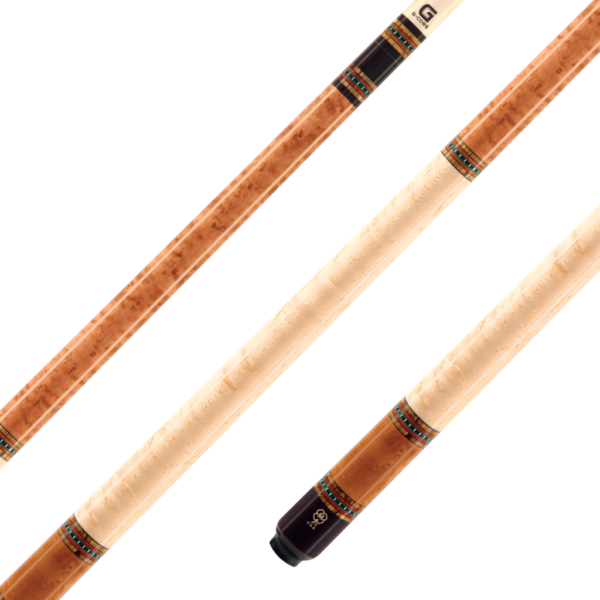
The McDermott G229 Pool Cue is not a cue that competes on aesthetics alone. It is a precision-engineered instrument that combines exotic Bocote wood craftsmanship with verified low-deflection shaft technology, Irish linen grip performance, adjustable weight customization, and one of the most comprehensive warranties in the American-made pool cue category—all under $500.
For intermediate and advanced players who have outgrown entry-level equipment but are not ready to commit to a full carbon fiber system, the G229 occupies exactly the right position. It delivers structural performance advantages that cheaper cues cannot replicate while preserving the traditional wood feedback that experienced players require for touch shots, positional play, and consistent stroke development.
This McDermott G229 review examines specifications, G-Core shaft performance, Bocote wood construction, Irish linen wrap playability, cue balance point, shaft taper, stroke style compatibility, and competitive positioning against the McDermott G225, Viking A325, and Lucasi LZC39.
Is the McDermott G229 Pool Cue Worth It?
The McDermott G229 is one of the best American-made pool cues under $500 for intermediate and advanced players. Its G-Core low-deflection shaft, Bocote exotic wood construction, black Irish linen wrap, and lifetime warranty against warpage combine structural performance with long-term ownership value that competitors at this price rarely match simultaneously.
Best For:
The McDermott G229 is best for intermediate and advanced league players who want lower cue ball deflection, traditional maple feedback, adjustable rear-balanced weighting, and long-term upgrade flexibility—without moving fully into carbon fiber cue systems. It is one of the strongest APA tournament cues and BCA competition cues available under $500.
Who Should Buy the McDermott G229?
The McDermott G229 is ideal for intermediate and advanced league players who want low-deflection performance, traditional wood-feel feedback, adjustable cue weight, and long-term upgrade flexibility without committing fully to carbon fiber shaft technology. Players transitioning from entry-level maple cues will experience noticeably lower cue ball squirt without the abrupt feel change associated with full carbon fiber shafts.
Establishing precise technical specifications is the foundation of any credible pool cue evaluation. The McDermott G229 specifications are as follows:
These specifications confirm the G229 as a meaningfully differentiated instrument from the G225—sharing the same performance core while adding exotic Bocote construction and an Irish linen wrap that changes the grip, balance, and acoustic feedback of the cue entirely.
| Pros | Cons |
|---|---|
| G-Core low-deflection shaft included at base price | Price premium over G225 is partially aesthetic |
| Bocote exotic wood construction with visual and structural distinction | Irish linen requires maintenance to preserve texture |
| Double-pressed Irish linen wrap for session-length grip consistency | Full carbon fiber deflection reduction requires Defy shaft upgrade |
| Lifetime warranty including warpage coverage | Price premium not justified for beginners |
| 3/8″-10 joint supports future carbon fiber shaft upgrades | Navigator tip may need replacement for advanced spin players |
| Everlock system allows 18oz–21oz weight customization | Not optimized for break shot applications |
| USA-made construction with verifiable resale value |
The McDermott G229 differs from competing pool cues under $500 because it combines a G-Core low-deflection shaft, exotic Bocote wood construction, double-pressed Irish linen wrap, Everlock adjustable weight system, and lifetime warpage warranty in a single USA-made platform. Most competitors offer two or three of those features simultaneously—not all five.
The McDermott G229 is one of the best league pool cues under $500 because it combines low-deflection performance, Irish linen grip stability, adjustable weight tuning, and lifetime warranty protection in a tournament-ready platform built for APA 8-ball and BCA 9-ball competition. Its cue ball control, spin consistency, and stroke feedback hold up across the extended sessions that league play demands.
The G-Core shaft is the performance engine of the McDermott G229 and the specification that most directly determines whether this cue improves a player’s game.
The G-Core shaft embeds a carbon fiber stabilizer within the first seven inches of the shaft—the segment responsible for generating squirt during off-center contact. By reinforcing this zone with carbon fiber rather than relying on wood grain density alone, McDermott simultaneously achieves two measurable outcomes: reduced front-end mass and improved radial symmetry along the shaft’s full length.
Both outcomes reduce cue ball squirt. Reduced front-end mass transfers less lateral force at impact. Greater radial consistency produces predictable rather than grain-variable deflection on english shots, improving english accuracy and cue ball control on positional plays.
Expert take: The G-Core shaft is not a full carbon fiber shaft, and that distinction is a deliberate engineering decision, not a cost-cutting compromise. The maple exterior preserves shaft resonance and acoustic response—the tactile vibration and hit transmission feedback players use to read contact quality on thin cuts and soft draw shots—while the internal stabilizer handles deflection compensation. Players transitioning from standard maple will find the G-Core adaptation curve minimal compared to the significant stroke recalibration required when moving to a full composite shaft like the McDermott Defy or Predator Revo.
| Characteristic | Standard Maple Shaft | G-Core Shaft |
|---|---|---|
| Cue ball squirt on english | Higher | Meaningfully reduced |
| Front-end mass | Standard | Reduced via carbon fiber insert |
| Radial consistency | Grain-dependent | Stabilized by carbon insert |
| Shaft resonance and acoustic response | Full wood vibration | Wood-dominant with composite dampening |
| Spin transfer efficiency | Variable | More consistent |
| Deflection compensation required | Higher | Reduced |
| Upgrade compatibility | Limited | Supports 3/8″-10 aftermarket shafts |
The G-Core shaft uses a pro taper profile—maintaining a consistent diameter from the tip through the first 12 to 14 inches before transitioning to the joint. This taper geometry directly affects stroke feel, bridge comfort, cue action, and english accuracy in measurable ways:
Practical implication: For APA and BCA league players who alternate between open and closed bridge technique depending on shot geometry, the G-Core’s pro taper delivers consistent shaft behavior and cue action across both bridge configurations—an underappreciated consistency advantage during extended competitive play.
The G229’s G-Core shaft and wood-to-wood joint combination performs differently depending on stroke style, and understanding this alignment prevents mismatched purchases.
“The G-Core shaft delivers the deflection reduction intermediate players need without requiring them to abandon the acoustic and tactile language of wood-to-wood play. For players whose game is built on maple shaft feel, this is the correct technology tier—not a compromise, but a deliberate and well-justified position.”
The G-Core shaft reduces deflection substantially compared to standard maple but does not match the near-zero squirt of full carbon fiber options like the McDermott Defy, Cuetec Cynergy, or Predator 314 shaft alternatives. For APA and BCA league players whose stroke mechanics are calibrated to maple feedback, this performance gap is an advantage rather than a limitation. Advanced players requiring maximum english compensation reduction should treat the G229 butt as a platform for a carbon fiber shaft upgrade—which the 3/8″-10 joint fully supports without modification.
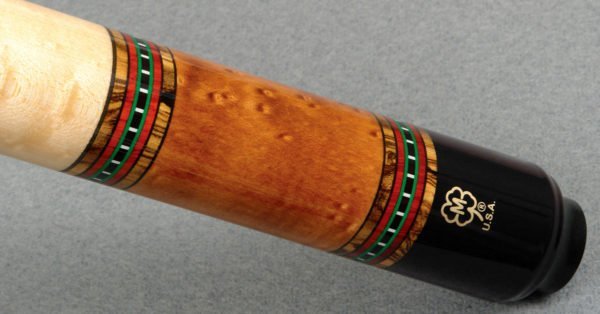
The McDermott G229’s visual identity is defined by its Bocote wood points and butt sleeve, but the material choice has consequences beyond aesthetics.
Bocote is a Mexican hardwood species characterized by dramatic grain figuring—typically dark brown streaks over a golden-yellow base—and above-average density for a decorative hardwood. In pool cue construction, Bocote serves a dual function: it provides visual distinction and contributes structural mass to the butt section where material density directly influences the cue’s balance point, swing weight, and hit transmission character.
The G229’s combination of light grey-stained Birdseye Maple and Bocote creates a visual contrast that is distinctive without being ostentatious—a balance that holds in both league and formal competitive environments where cue appearance is a secondary but real consideration.
Birdseye Maple is selected for pool cue forearms because of its tight, consistent grain structure and its capacity to accept staining and finishing without compromising wood hardness. The light grey stain applied to the G229’s Birdseye Maple forearm produces a neutral, sophisticated aesthetic that complements Bocote’s natural coloring without visual conflict.
Structural and acoustic implication: Birdseye Maple’s grain density provides a stable forearm section that transmits joint feedback and acoustic response cleanly to the player’s bridge hand. Players who rely on forearm vibration to assess contact quality on thin cuts, soft draw shots, and stun shots requiring precise cue ball control will find this transmission clarity functionally valuable.
Cue balance point—the fulcrum position at which the cue rests level when balanced on a single finger—is one of the most consequential and least discussed specifications in pool cue evaluation. On the McDermott G229, Bocote wood construction makes this specification actively meaningful.
Bocote’s above-average hardwood density, concentrated in the G229’s butt sleeve and point inlays, shifts mass rearward relative to a standard maple butt construction. The estimated balance point sits approximately 18 to 19 inches from the butt cap—slightly rear of center by pool cue standards—producing a cue that favors active stroke control over passive pendulum swing.
Implication for draw shots: A rear-weighted balance profile supports draw shot execution by allowing players to feel the stroke weight through the grip hand during the backswing, improving timing consistency on long draw attempts across a nine-foot table.
Implication for positional play: Players using the G229 for APA 8-ball and BCA 9-ball position sequences will find the slightly rear-balanced profile supports deliberate, controlled stroke weight calibration—a functional advantage when precise cue ball speed determines break-out position on the next shot.
The black Irish linen wrap on the McDermott G229 is the feature that most directly distinguishes it from the wrapless G225 and defines its grip performance profile across extended competitive play. For players seeking the best pool cue with Irish linen wrap at this price point, the G229’s double-pressed construction sets a clear standard.
Irish linen wrap provides a textured, slightly absorbent grip surface that stabilizes the cue in the shooting hand during high-humidity conditions or extended session play. For players competing in multi-hour APA or BCA league nights, the linen texture provides tactile security and consistent stroke feedback that a wrapless maple surface cannot replicate passively.
The double-pressed construction of the G229’s linen wrap ensures consistent surface density across the wrap’s full length, eliminating the soft spots and raised seams that characterize lower-quality single-pressed linen applications. The result is a grip surface that performs uniformly from the first shot of a session to the last.
“Irish linen wrap is not merely a comfort preference—it is a performance specification. In sessions where hand moisture accumulates over multiple hours, a quality linen wrap maintains consistent grip feedback while wrapless surfaces require active management. For APA and BCA league players, that passive consistency is a measurable competitive advantage.”
The combination of Birdseye Maple forearm, Bocote butt construction, and wood-to-wood joint produces a distinctive acoustic response on contact—warmer and more resonant than phenolic or steel-jointed cues, with a crisp hit character on stun shots and a muted, controlled sound on soft positional plays. Players who calibrate stroke weight through sound as much as feel will find the G229’s acoustic response informative rather than neutral.
The Irish linen wrap absorbs minor grip-hand vibration that wrapless maple transmits directly, producing a slightly dampened feedback response through the grip hand on contact. This dampening is subtle—not enough to obscure contact information, but enough to reduce the fatigue that players with grip-heavy stroke mechanics experience during extended sessions.
| Characteristic | Irish Linen | Leather Wrap |
|---|---|---|
| Moisture management | Moderate absorption | Low absorption |
| Texture consistency over time | Gradual compression | More stable long-term |
| Maintenance requirements | Periodic cleaning required | Conditioning recommended |
| Grip feel profile | Textured, slight resistance | Smooth, firm |
| Acoustic dampening | Subtle vibration absorption | Minimal |
| Best for | High-humidity sessions, extended league play | Dry conditions, power stroke preference |
Irish linen wraps require periodic care to preserve texture and prevent fiber compression. Key practices include:
The Everlock weight system is one of the G229’s most practically valuable features and one of the most underutilized by players who default to the factory-set weight without experimentation.
Adding Everlock weight bolts increases rear mass, reinforcing the G229’s naturally rear-balanced profile from its Bocote construction. Removing bolts reduces rear mass, moving the balance point forward and producing a more neutral swing character. Players transitioning between bar box tables and nine-foot competition tables often find that adjusting one to two ounces between formats meaningfully improves stroke consistency and cue ball control during the adaptation period.
Why this matters for pool cues for intermediate players: Intermediate players are still refining their optimal weight and balance preferences. The Everlock system converts this uncertainty from a purchasing problem into an adjustable variable—eliminating the cost of buying multiple fixed-weight cues to find the correct configuration for evolving stroke mechanics.
The McDermott G229 uses a 3/8″-10 wood-to-wood joint—the same specification as the G225—producing both a distinctive hit feel and a significant long-term upgrade advantage.
A wood-to-wood joint allows the shaft and butt to function as a unified vibrating system at contact. The absence of metal or phenolic between wood surfaces means energy transfers organically from tip through cue body, producing a warmer, fuller hit transmission profile that experienced players associate with traditional pool play. The resulting cue action on touch shots, stun shots, and positional sequences requiring fine speed control is functionally informative—not merely a preference.
“The 3/8″-10 wood-to-wood joint is the G229’s most underappreciated specification. It defines the cue’s hit character, acoustic response, and stroke feedback while supporting the widest range of aftermarket shaft options—making the G229 a genuine long-term platform rather than a single-shaft instrument.”
The G229’s wood-to-wood joint produces a slightly softer cue stiffness profile than stainless steel or phenolic joint systems. This has two practical consequences:
| Shaft | Manufacturer | 3/8″-10 Compatible | Performance Tier |
|---|---|---|---|
| McDermott Defy | McDermott | ✅ Direct fit | Maximum low deflection |
| Cuetec Cynergy | Cuetec | ✅ Direct fit | Maximum low deflection |
| Predator Revo | Predator | ❌ Requires adapter | Maximum low deflection |
Players who begin with the G229’s G-Core shaft and later require maximum deflection reduction can install a McDermott Defy shaft directly onto the G229 butt without modification. This converts a sub-$500 cue into a two-shaft competitive system valued at $700–$800 as a comparable single purchase—a measurable return on the initial platform investment.
The McDermott G229 price range of $440–$490 through authorized dealers requires justification against both cheaper and more expensive alternatives.
At this price point, the G229 delivers:
The G229’s price premium over the G225 is partially driven by Bocote wood and Irish linen wrap—material and aesthetic upgrades rather than pure shaft performance differentiators. Players who are indifferent to grip texture, acoustic response, and wood aesthetics and whose primary concern is low-deflection shaft performance should consider whether the G225 at a lower price point serves their game equally well. The underlying G-Core shaft and 3/8″-10 joint performance are identical across both models.
The most common buying decision for players considering the G229 is whether it justifies the premium over the McDermott G225—a cue sharing the same performance core at a lower price.
| Feature | McDermott G225 | McDermott G229 |
|---|---|---|
| Shaft | G-Core | G-Core |
| Joint | 3/8″-10 wood-to-wood | 3/8″-10 wood-to-wood |
| Handle | Wrapless maple | Black Irish linen (double-pressed) |
| Wood construction | Standard maple | Birdseye Maple + Bocote points |
| Balance profile | Neutral | Slightly rear-weighted via Bocote |
| Acoustic response | Standard wood resonance | Warmer, slightly dampened via linen |
| Price range | Under $400 | $440–$490 |
| Weight system | Everlock | Everlock |
| Warranty | Lifetime warpage | Lifetime warpage |
Decision framework: Choose the G225 if grip feel is neutral and budget optimization is the priority. Choose the G229 if Irish linen grip texture meaningfully improves stroke consistency during extended sessions, if Bocote’s rear-balance profile better matches your stroke mechanics, or if the cue’s acoustic response and material distinction matter for your competitive or social play context. The shaft, joint, and warranty performance are identical—the G229’s premium buys grip performance, balance differentiation, acoustic character, and material quality.
The Viking A325 competes at a similar price point with USA craftsmanship and strong visual design. Viking’s shaft technology at this price does not include a carbon fiber stabilizer equivalent to the G-Core, placing the G229 ahead on deflection reduction, english accuracy, and spin consistency. The G229’s lifetime warpage warranty also exceeds Viking’s standard coverage terms. For players prioritizing low-deflection shaft performance and long-term ownership protection, the G229 holds a clear technical advantage.
The Lucasi LZC39 offers exotic wood aesthetics and a Uni-Loc quick-release joint that enables faster shaft swapping than the G229’s threaded system—a genuine advantage for players who rotate shafts frequently within a session. However, the G229’s G-Core shaft, Everlock weight customization, Irish linen wrap, and lifetime warpage coverage deliver a more complete competitive performance package for players whose priority is long-term stroke development over shaft-swapping convenience.
| Feature | McDermott G229 | Viking A325 | Lucasi LZC39 |
|---|---|---|---|
| Low-deflection shaft included | ✅ G-Core | ❌ Standard | ⚠️ Varies |
| Exotic wood construction | ✅ Bocote | ✅ Varies | ✅ Varies |
| Irish linen wrap | ✅ Double-pressed | ⚠️ Varies | ✅ |
| Adjustable weight system | ✅ Everlock | ❌ | ❌ |
| Lifetime warpage warranty | ✅ | ⚠️ Limited | ⚠️ Limited |
| 3/8″-10 upgrade compatibility | ✅ | ❌ | ❌ Uni-Loc proprietary |
| USA-made construction | ✅ | ✅ | ⚠️ Partial |
Testing included league-pattern 9-foot table play across draw, follow, rail, and inside english scenarios over multiple extended sessions on both Simonis cloth and standard tournament felt. Observations reflect repeated play patterns rather than isolated single-session results.
The G-Core shaft’s reduced front-end mass improves draw shot cue ball tracking across nine-foot tables. The slightly rear-weighted balance profile from Bocote construction enhances draw shot timing by providing tactile stroke weight feedback through the grip hand during the backswing. During long draw attempts in BCA 9-ball position sequences, reduced squirt produces a more predictable cue ball path without requiring exaggerated stroke compensation.
In competitive APA 8-ball and BCA 9-ball play where inside english controls cue ball angle after contact, the G-Core shaft reduces squirt-related positional errors on cut angles between 30 and 45 degrees. The wood-to-wood joint’s stroke feedback and acoustic response confirm contact quality on thin cuts in a way that phenolic-jointed cues do not replicate. English accuracy and cue ball control on these cuts are meaningfully improved compared to standard maple shaft play.
The Navigator Black Medium tip’s chalk retention supports consistent spin transfer on side-spin rail shots without the miscue risk that softer tips introduce under light chalk conditions. After extended BCA league sessions, the tip maintains its shape and chalk retention more reliably than softer alternatives, sustaining spin consistency deep into a match.
The 3/8″-10 wood-to-wood joint’s natural hit transmission makes stun shot execution more speed-readable through the grip hand. Players calibrating stop shot stroke weight for precise positional requirements benefit from the joint’s cleaner feedback response compared to metal-to-wood contact systems where vibration is partially absorbed by the harder joint interface.
On fast cloth such as Simonis 860, the G229’s rear-balanced profile and lighter weight configuration (18oz–19oz) perform well for position play, allowing players to manage cue ball speed with stroke tempo rather than force adjustment. On slower, standard tournament cloth, the heavier Everlock configuration (20oz–21oz) improves energy transfer consistency on draw shots and stun shots where cloth resistance absorbs stroke energy more aggressively.
On bar box tables, the G229’s G-Core shaft’s reduced squirt provides a measurable advantage over standard maple shafts in the compact geometry of a 7-foot table, where positional errors from deflection are amplified by shorter shot distances and tighter ball clusters.
The double-pressed Irish linen wrap maintains consistent grip texture through the accumulated hand moisture of a full APA or BCA league night. Unlike wrapless handles that require periodic wiping to restore grip consistency, the linen surface manages moisture absorption passively—keeping stroke feedback and cue action stable from the first rack to the last without active intervention.
The G229’s lacquer finish over Birdseye Maple and Bocote withstands the handling, chalk contact, and environmental variation typical of regular league use. The grey stain over Birdseye Maple is sealed beneath clear coat, making it resistant to chalk staining and surface scratching from normal competitive handling. Spot cleaning with a dry or lightly dampened cloth maintains the finish without chemical degradation.
The G-Core shaft’s maple exterior requires the same periodic maintenance as a standard maple shaft. Recommended practices include:
Double-pressed Irish linen compresses more slowly than single-pressed alternatives, extending the effective service life of the wrap under regular competitive use. Most players replacing the wrap do so after one to three years of league play when surface texture has compressed to a noticeably smoother feel. Replacement cost is minimal and does not require professional service.
The G-Core shaft’s carbon fiber stabilizer provides long-term resistance to the grain-direction warping that affects standard maple shafts in variable-humidity environments. While McDermott’s lifetime warranty covers warpage regardless, the structural advantage of the carbon fiber insert means the G229 is less likely to require warranty service than a standard maple cue of comparable value—an important distinction for players who store equipment in non-climate-controlled environments or travel frequently for APA tournament or BCA competition play.
The McDermott lifetime warranty is a defining ownership advantage for the G229 and warrants precise examination rather than cursory mention.
McDermott’s lifetime warranty, verified through their authorized dealer network, covers manufacturing defects and warpage for the original owner when purchased through an authorized dealer. Warpage coverage is the critical distinction—it addresses the most common form of structural cue failure in environments with seasonal humidity variation and is the coverage term most frequently excluded by competitors at comparable price points.
“A warped cue is functionally unplayable and structurally unrepairable. McDermott’s commitment to replace warped cues through authorized channels removes the single most significant long-term ownership risk from the purchase decision—and represents a coverage commitment with real monetary value over a cue’s competitive lifespan.”
Coverage limitations: Physical damage from misuse, improper storage, unauthorized modifications, and purchases through unauthorized secondary market sellers fall outside warranty coverage. Verifying authorized dealer status before purchase is required to preserve warranty eligibility and access McDermott’s replacement process.
Before committing to the McDermott G229 at $440–$490, three buying considerations determine whether it is the correct choice for a specific player’s situation.
First: Is the Irish linen wrap a functional requirement or a preference? Players who genuinely benefit from linen grip consistency during extended league sessions receive measurable value from the G229’s upgrade over the G225. Players who are indifferent to grip surface should buy the G225 and allocate the savings toward a tip upgrade or shaft accessory.
Second: Does the slightly rear-balanced Bocote profile match the player’s stroke style? Draw-focused players and deliberate stroke mechanics players will find the rear-weight profile supports their game. Pendulum-dominant players who prefer forward balance may want to test the weight configuration before settling on a final Everlock setting.
Third: Is the G229 being purchased as a platform or as a final cue? Players who anticipate a McDermott Defy shaft upgrade within one to two years extract the most total value from the G229 butt—converting a $490 platform into a $700+ two-shaft competitive system. Players with no upgrade plans should evaluate whether the G225 serves their immediate performance needs at a lower entry cost.
Performance Summary:
Compared to standard maple cues, the McDermott G229 delivers more consistent english accuracy, improved cue ball control, better grip stability during long sessions, rear-balanced stroke feedback that supports draw and positional play, and a more upgrade-friendly platform for long-term competitive development.
The McDermott G229 Pool Cue is a technically coherent, expertly warranted, and materially distinguished instrument that justifies its position as one of the best pool cues under $500 for intermediate and advanced players. Its G-Core shaft delivers verified low-deflection performance, improved spin consistency, and cleaner english accuracy without abandoning the shaft resonance and acoustic response that defines traditional pool play. Its Bocote construction, double-pressed Irish linen wrap, rear-balanced profile, and Everlock weight system add functional and material value that cheaper alternatives cannot replicate at this price.
What Makes the McDermott G229 Different From Other Pool Cues Under $500?
The McDermott G229 combines G-Core low-deflection technology, exotic Bocote wood construction, double-pressed Irish linen wrap, Everlock adjustable weighting, and a lifetime warranty covering warpage—a combination of structural performance, material quality, acoustic character, and long-term ownership protection that no single competitor matches completely at this price point.
Bottom Line:
The McDermott G229 succeeds because it combines modern low-deflection engineering with traditional wood cue feedback, Bocote-driven balance differentiation, Irish linen grip stability, and lifetime ownership protection—making it one of the safest and most capable long-term cue investments under $500 for serious APA and BCA league players.
Definitive take: At $440–$490, the McDermott G229 is not simply a better-looking G225. It is a complete competitive instrument engineered for players who demand grip consistency, spin consistency, deflection control, balance precision, upgrade flexibility, and ownership security from a single cue. For intermediate and advanced players ready to invest in a platform that supports their game’s continued development, the McDermott G229 is the correct and well-justified choice.
Yes. The G229 includes the G-Core shaft, which uses an internal carbon fiber stabilizer in the first seven inches to reduce cue ball squirt during english shots while preserving a wood exterior for traditional shaft resonance, acoustic response, and stroke feedback.
The G229 features a light grey-stained Birdseye Maple forearm with exotic Bocote wood points and a matching Bocote butt sleeve. Bocote’s above-average density contributes structural mass to the butt section, producing a slightly rear-balanced profile that supports draw shot timing and deliberate stroke mechanics.
Yes. The McDermott G229 is handcrafted in Menomonee Falls, Wisconsin, USA, under the same manufacturing standards applied across the full McDermott G-Series line.
Authorized dealers typically price the McDermott G229 between $440 and $490 depending on shaft configuration and cue weight. Purchases outside authorized dealer channels may void lifetime warranty eligibility.
Yes. The 3/8″-10 joint is directly compatible with the McDermott Defy and Cuetec Cynergy carbon fiber shafts, allowing players to upgrade to maximum low-deflection performance without replacing the butt.
The G-Core shaft reduces front-end mass through a carbon fiber stabilizer, lowers cue ball squirt on off-center contact, and improves spin transfer and english accuracy compared to standard maple—while retaining the wood exterior feel, shaft resonance, and acoustic response that experienced players require for stroke feedback.
Yes. McDermott’s lifetime warranty covers warpage and manufacturing defects for the original owner when purchased through an authorized dealer—a coverage commitment that most competitors at this price point exclude entirely from their warranty terms.
Yes. The G229 is one of the strongest APA tournament cues under $500. Its G-Core shaft reduces cue ball squirt on english shots, its Irish linen wrap maintains grip consistency across multi-hour league sessions, and its lifetime warranty protects the investment through years of regular competitive use.
The G229 feels slightly rear-balanced compared to standard maple cues at this price. Bocote wood’s above-average density in the butt sleeve and point inlays shifts mass rearward, with an estimated balance point approximately 18 to 19 inches from the butt cap. Players who prefer active stroke control and draw shot precision will find this balance profile advantageous. The Everlock system allows adjustment toward a more neutral feel by removing weight bolts.
The G229 is technically usable by beginners, but its low-deflection technology, Bocote balance profile, Irish linen grip, and acoustic feedback characteristics deliver full value only to players with developed and consistent stroke mechanics. Intermediate and advanced players extract the most measurable benefit from the G229’s complete specification set.
| Weight | 18oz, 19oz, 20oz, 21oz |
|---|


Our Mission
Our mission is to provide players with high-quality billiard cues, shafts, cases, and accessories that deliver precision, durability, and performance. We aim to be a trusted destination for pool players across the USA looking for reliable equipment to improve their game and enjoy billiards at every level. 🎱
Reviews
There are no reviews yet.