Last updated: 2026 | Reviewed by a cue repair specialist with experience fitting leather, phenolic, and composite cue tips across recreational and competitive play contexts.
The best pool cue tip alternatives fall into three categories. Layered pigskin is the best choice for everyday play because it provides superior spin, chalk retention, and shot-to-shot consistency. Phenolic resin and G10 are engineered specifically for break and jump cues, where maximum energy transfer matters more than cue ball control. Synthetic polymer tips are the preferred option for players seeking long service life with minimal maintenance.
When evaluating the best pool cue tip alternatives, the optimal choice depends on playing style, cue function, shaft compatibility, and maintenance commitment. Every material category covered in this guide represents a distinct solution to a specific performance problem—and understanding those distinctions is what separates informed equipment decisions from expensive guesswork.
For most of billiards history, single-piece leather dominated the cue tip market by default. Players scuffed, burnished, and shaped their tips as a matter of routine—accepting mushrooming, moisture sensitivity, and inconsistent density as unavoidable realities of the game.
That calculus has fundamentally changed.
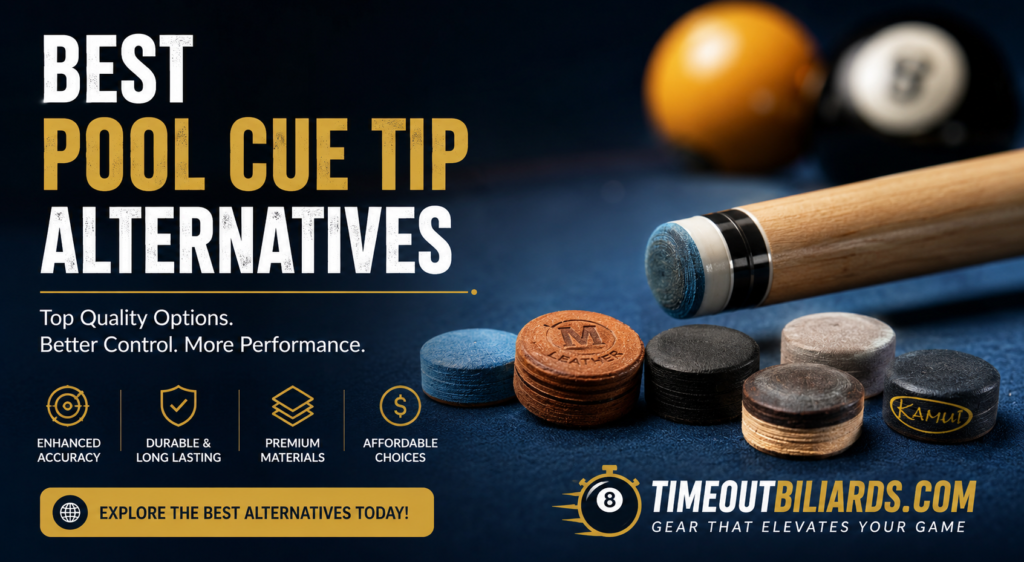
Material science, precision manufacturing, and competitive demand have together produced a new generation of pool cue tip alternatives that outperform standard leather across specific performance dimensions. Layered pigskin now sets the benchmark for spin and consistency in precision play. Phenolic resin and G10 glass epoxy deliver power transfer characteristics that no leather tip can match on a dedicated break or jump cue. Synthetic polymer tips have redefined what recreational players should expect from longevity and maintenance requirements.
Today, the best pool cue tip alternatives span five distinct material categories, each engineered for a different balance of hardness, chalk retention, energy transfer, and maintenance demand. Players who treat tip selection as a generic accessory decision consistently leave measurable performance on the table.
Understanding these materials—not just their names, but their mechanical properties and real-world performance trade-offs—is the foundation of every informed equipment decision. For a broader overview of how cue components interact, the Billiard Congress of America’s equipment standards documentation provides useful regulatory context for competitive play.
The leading pool cue tip alternatives are layered pigskin, phenolic resin, G10 glass epoxy, and synthetic polymer.
Layered pigskin delivers the strongest combination of chalk retention, English generation, and stroke consistency for everyday play. Phenolic and G10 tips are engineered for break and jump cues, where their extreme hardness maximizes energy transfer to the cue ball—but that same hardness significantly reduces chalk adhesion, cue ball contact time, and spin potential.
Synthetic tips provide exceptional shape retention with minimal maintenance, making them a practical choice for recreational players and home tables.
Selecting the right pool cue tip alternative requires evaluating the cue’s intended purpose, preferred hardness range, shaft material compatibility, applicable league regulations, installation method, and the player’s individual balance between performance ceiling and maintenance commitment.
| Material | Best For | Avoid If |
|---|---|---|
| Layered Pigskin | Precision play, English, competitive use | You want zero maintenance |
| Phenolic Resin | Break cues, maximum power | You need spin or playing cue control |
| G10 Glass Epoxy | Jump cues, extreme hardness | You rely on chalk retention |
| Synthetic Polymer | Recreational play, house cues | You need advanced spin generation |
| Single-Piece Leather | Entry-level play, budget builds | You want consistent density over time |
Choosing among the best pool cue tip alternatives starts with understanding what each material is engineered to do. The five primary categories—single-piece leather, layered pigskin, phenolic resin, G10 glass epoxy, and synthetic polymer—each serve distinct mechanical roles that make them more or less appropriate depending on the cue’s function and the player’s needs.
Single-piece leather—most commonly water buffalo hide—remains the default tip for mid-range and entry-level cues. Its porous surface accepts chalk readily, and its natural compliance absorbs impact feel at contact, providing familiar hit feedback that many players are conditioned to expect.
The material’s primary liabilities are density inconsistency across production batches, susceptibility to humidity-driven compression and swelling, and a tendency to mushroom under repeated impact when not maintained.
Leather absorbs atmospheric moisture, altering its compression characteristics in ways that produce measurable shot-to-shot variance—particularly in high-humidity environments or during extended sessions. This moisture sensitivity is one of the primary mechanical reasons players migrating to layered tips report immediate improvements in positional consistency.
Single-piece leather is the most widely available pool cue tip type, but it is increasingly the weakest performer in every category where alternatives have been purpose-engineered to exceed it.
The APA’s official equipment guidelines outline minimum tip standards relevant to sanctioned league play.
Performance profile: Moderate chalk retention, moderate spin potential, high maintenance frequency, variable longevity.
Layered pigskin tips are constructed from multiple thin sheets of compressed pigskin, bonded under controlled pressure to produce a tip with uniform density throughout its cross-section.
Unlike single-piece leather, which varies in hardness between the surface and core, a quality laminated pigskin tip performs identically at every depth of compression—delivering consistent impact feel and energy absorption characteristics from the first shot to the last.
This structural consistency is why brands such as Kamui, Tiger Everest, and Taom have displaced single-piece leather among serious and professional players. The layered construction resists mushrooming, maintains a consistent playing surface longer, and produces reproducible English across a session rather than degrading as the tip wears.
Among all pool cue tip alternatives for playing cues, layered pigskin consistently ranks as the highest-performing option for players who depend on spin, cue ball control, and shot-to-shot repeatability.
Kamui’s technical documentation on their official product pages provides detailed hardness grade comparisons across their tip lineup.
Performance profile: Superior chalk retention, excellent spin and cue ball control, low-to-moderate maintenance, extended longevity compared to single-piece leather.
Expert take: For players whose game depends on precise cue ball positioning and controlled English, layered pigskin is not merely a pool cue tip alternative to standard leather—it is a measurable upgrade in mechanical consistency and stroke reliability.
Phenolic resin tips are cast from thermosetting plastic compressed to extremely high density. They produce essentially no tip compression on contact, meaning nearly all cue energy transfers directly to the cue ball rather than being absorbed through tip deformation or energy absorption.
This physical property makes phenolic the preferred pool cue tip alternative for break cues, where maximizing rack penetration is the sole objective.
Phenolic and leather cue tips are engineered for different jobs. Leather maximizes friction and spin during controlled shots, while phenolic minimizes energy loss during high-impact breaks. Comparing them as direct substitutes ignores the purpose each material was designed to serve.
For players competing under World Pool-Billiard Association rules, verifying tip material compliance before tournament registration is strongly recommended.
Performance profile: Maximum power transfer, minimal tip compression, low chalk retention, very low maintenance, near-unlimited longevity, limited spin capability.
G10 is a thermoset composite fabricated from woven fiberglass cloth bonded with epoxy resin under heat and pressure. Originally developed for industrial and electrical applications requiring dimensional stability and high dielectric strength, G10 has been adopted in cue sports for break and jump tip applications where its extreme hardness and resistance to deformation are performance assets.
Independent testing and manufacturer specifications report Shore hardness values exceeding 90A for G10 materials, placing it beyond the measurable range of most leather and synthetic alternatives.
The material science behind G10’s hardness properties is well documented in NEMA’s laminated materials standards, which classify G10 within the FR-4 glass epoxy family used across precision industrial applications.
As a pool cue tip alternative for jump cues specifically, G10 is widely regarded as the superior choice over phenolic due to its dimensional stability and higher hardness ceiling.
Performance profile: Extreme hardness, maximum energy transfer, negligible maintenance, very low chalk retention, limited spin application.
Synthetic polymer tips are engineered from purpose-formulated plastics or composite materials designed to replicate the playing feel of medium-hardness leather while eliminating leather’s primary maintenance liabilities. They resist humidity, retain their molded shape without burnishing, and do not mushroom under normal use.
These tips are particularly well-suited to recreational players, house cues, and home billiards environments where regular tip maintenance is impractical.
Performance ceiling is lower than premium layered pigskin for advanced spin shots. For players whose priority is consistent baseline performance with minimal upkeep, synthetic polymer tips represent one of the most practical pool cue tip alternatives available at any price point.
Performance profile: Good shape retention, moderate chalk retention, low maintenance, moderate spin potential, strong longevity.
Some manufacturers have introduced tips incorporating carbon fiber elements or advanced composite matrices, often designed specifically for carbon fiber shaft systems from Predator, Cuetec Cynergy, and similar brands.
These tips are typically engineered to complement the low-deflection characteristics of carbon fiber shafts and maintain compatibility with their ferrule dimensions and impact dynamics.
Players using carbon fiber shafts from manufacturers such as Predator (Revo), Cuetec (Cynergy), McDermott, or Mezz should follow shaft-specific tip recommendations to preserve performance characteristics and avoid ferrule damage. Predator’s shaft technology documentation outlines approved tip specifications for their carbon fiber lineup.
Cue tip hardness is the single most consequential variable when comparing pool cue tip alternatives, governing every downstream performance characteristic including tip compression, cue ball contact time, energy transfer, and stroke consistency.
Hardness is measured on the Shore durometer scale, though manufacturers apply this scale inconsistently, making direct cross-brand comparisons unreliable without independent testing. The ASTM D2240 standard defines the Shore A and Shore D durometer testing methodology that underpins hardness classifications used across the cue tip industry.
| Hardness Category | Typical Shore Range | Best Application | Trade-offs |
|---|---|---|---|
| Extra Soft | Below 55A | Advanced spin shots, short-game finesse | Frequent maintenance, fast wear |
| Soft | 55–65A | Precision play, English generation | Regular maintenance required |
| Medium | 65–75A | All-around play, recreational use | Balanced performance across categories |
| Hard | 75–85A | Power play, low-spin environments | Reduced grip on off-center shots |
| Extra Hard / Phenolic | 85A+ | Break and jump cues | Minimal spin, high miscue risk |
Critical principle: Softer tips compress more at contact, increasing the friction window during which the tip grips the cue ball and transfers spin. Harder tips compress less, shortening cue ball contact time but delivering more direct energy transfer. No single hardness is universally optimal—the correct choice is always relative to shot type, playing style, and cue function.
The emergence of layered pigskin as the performance benchmark for precision play reflects a straightforward mechanical reality: laminated construction eliminates the density gradient that makes single-piece leather tips inconsistent.
In a single-piece leather tip, the outermost surface is typically denser than the interior. As the tip wears, the player shoots with a progressively softer contact surface, forcing continuous recalibration of English and power delivery across a session.
A quality layered pigskin tip presents a consistent density profile from new to fully worn. The shot that generates a specific amount of left English on day one should produce the same cue ball reaction on day forty.
Players searching for Kamui cue tip alternatives should compare Predator Victory, Tiger Everest, and Taom layered tips directly. While each differs slightly in feel, hardness grade, and impact feedback, all three occupy the same premium performance category as Kamui and represent the most functionally comparable pool cue tip alternatives across hardness grades.
Taom’s product comparison resources offer useful side-by-side hardness and retention data for players evaluating layered tip options.
Kamui Clear: Available in multiple hardness grades, Kamui Clear tips are recognized for exceptional chalk retention and low-deflection performance characteristics compatible with modern carbon fiber and maple shafts. They are widely used on competitive circuits and represent the upper tier of the layered pigskin category.
Tiger Everest: A high-compression layered tip with strong mushroom resistance and consistent mid-game performance. Preferred by players who prioritize durability alongside spin capability.
Taom and Taom Fusion Break: Taom tips feature a distinct layered construction optimized for chalk retention across extended sessions. The Taom Fusion Break applies similar laminated principles to a break-tip application, offering an unusual combination of power and surface grip.
Predator Victory: A strong layered alternative with broad shaft compatibility and consistent hardness across production batches, making it a reliable choice for players transitioning away from Kamui.
The comparison between phenolic and leather tips is not a question of which material is superior—it is a question of application appropriateness. Each is optimized for a different mechanical objective.
| Characteristic | Leather / Layered Pigskin | Phenolic Resin |
|---|---|---|
| Primary application | Playing cue | Break / jump cue |
| Chalk retention | High | Low |
| Spin potential | High | Low |
| Energy transfer | Moderate | Maximum |
| Tip compression | Moderate | Virtually none |
| Maintenance requirement | Moderate | Minimal |
| Miscue risk (off-center) | Low-moderate | High |
| League compliance | Universal | Verify by league |
Definitive guidance: Phenolic tips should not be used on a playing cue by any player whose game requires reliable English, draw, or positional play. Their appropriate domain is the break cue, where eliminating tip compression translates directly into measurable rack performance.
Break and jump cues impose demands that no leather tip is optimally designed to meet. The physics of a break shot require the tip to survive repeated high-force impacts without compressing, deforming, or degrading the ferrule—while delivering maximum energy to the rack.
For these applications, the best pool cue tip alternatives are G10 for jump cues and phenolic resin for break cues—full stop.
G10 glass epoxy is the preferred pool cue tip alternative for jump cue applications among serious players. Its extreme hardness and dimensional stability allow the cue to lift the cue ball cleanly with minimal tip deformation or energy absorption.
For jump shots specifically, G10 performs better than phenolic in many player assessments because its rigidity translates impact energy more efficiently on the sharp, downward stroke the shot requires.
Phenolic resin tips are the industry standard for dedicated break cues. Players seeking maximum break power—particularly on tight racks—will find that no leather alternative produces equivalent rack penetration.
The energy that a leather tip absorbs through compression is energy not delivered to the rack.
Phenolic tips are widely permitted on break and jump cues in APA and BCA league play, but regional tournament directors and local operators may apply additional restrictions. The BCA rulebook and APA official regulations should be consulted directly for current equipment compliance provisions before competition use.
The practical case for synthetic pool cue tips is straightforward: they deliver consistent performance without the maintenance discipline that leather demands.
Traditional leather tips require periodic scuffing to restore chalk adhesion, burnishing to prevent mushrooming, and reshaping to maintain consistent contact geometry. In competitive environments, experienced players perform these operations routinely.
In recreational contexts—home tables, bar-room house cues, casual league play—these steps are frequently neglected, producing degraded tip performance that players often misattribute to cue quality or technique.
Synthetic tips address this gap by engineering the maintenance requirement out of the material. A well-manufactured synthetic tip retains its shape, surface texture, and chalk adhesion without player intervention across a lifespan that typically exceeds comparable-grade leather.
As a pool cue tip alternative for recreational players, synthetic polymer outperforms single-piece leather on every practical metric except ultimate spin potential.
Primary use cases: Home billiards, house cues, recreational leagues, players transitioning to the game who want consistent baseline performance without a maintenance learning curve.
Performance ceiling: Synthetic tips do not match premium layered pigskin for advanced spin generation. For players whose game operates at the precision end of the performance spectrum, layered pigskin remains the superior pool cue tip alternative despite its higher maintenance requirement.
Carbon fiber shafts have introduced new compatibility variables into tip selection. Their low-deflection characteristics, reduced vibration transmission, and non-wood ferrule systems require tips engineered to perform within specific mechanical parameters.
Compatibility principles:
Players transitioning from maple to carbon fiber may find they prefer a slightly softer tip than their previous preference to maintain equivalent spin feel and cue ball reaction. The lower vibration transmission of carbon fiber makes hardness differences in impact feel more pronounced than on maple shafts.
When selecting pool cue tip alternatives for carbon fiber shafts, manufacturer compatibility documentation should take priority over general tip preference.
Cuetec’s Cynergy shaft technical overview addresses tip compatibility directly within their carbon fiber product documentation.
Installation method is a practical decision point that players frequently underestimate until they face a tip replacement under competitive time pressure.
Glue-on tips are the standard installation method for quality leather, pigskin, and phenolic tips. Proper installation requires tip trimmer tools, appropriate adhesive, and surface preparation of both the tip and ferrule face.
When installed correctly, a glued tip provides a secure bond that withstands competitive play without movement or separation.
Professional installation is recommended for: Phenolic and G10 tips, which require lathe precision for proper seating; any tip installation on a premium or custom cue where ferrule damage would be costly.
Home installation is feasible for: Leather and synthetic glue-on tips, provided the player uses appropriate tools and follows proper surface preparation and curing procedures.
Slip-on tips are designed to install over the existing ferrule without adhesive removal, offering rapid replacement without tools. They are primarily suited to house cues, training environments, and situations where speed of replacement outweighs performance optimization.
Trade-off: Slip-on tips cannot match the mechanical integrity of a properly glued installation and are not appropriate for competitive play or performance cues.
Chalk retention is the tip characteristic most directly responsible for shot-to-shot consistency on off-center strikes. A tip that sheds chalk quickly forces more frequent reapplication and produces greater variance in English delivery and cue ball reaction between applications.
Layered pigskin tips—particularly Kamui Clear and Taom—are engineered to maximize chalk retention through surface micro-texture and material composition. Their retention characteristics are measurably superior to single-piece leather and categorically superior to phenolic or G10.
Taom’s collaboration with professional-grade chalk formulations, documented on their official research pages, reflects the degree to which surface chemistry between tip and chalk affects retention at the competitive level.
This performance gap becomes most consequential during extended run sequences, where a player may execute eight to twelve off-center shots without chalking between them. A premium layered tip provides consistent grip and predictable cue ball contact time across that sequence. A phenolic tip will produce increasing miscue risk after the first few shots.
Practical guidance: When comparing pool cue tip alternatives on chalk retention, layered pigskin tips outperform every other category for players who chalk selectively rather than before every shot.
Knowing when to replace a cue tip is as important as knowing which pool cue tip alternative to install. Playing through a degraded tip introduces inconsistency that no amount of technique adjustment can fully compensate for.
| Player Type | Recommended Replacement Interval |
|---|---|
| Casual / recreational | Every 18–24 months |
| League player (APA, BCA) | Every 12–18 months |
| Competitive / tournament | Every 6–12 months |
| Break tip (phenolic / G10) | Every 3–5 years |
| Synthetic polymer | Every 2–4 years |
Tips that have mushroomed beyond the ferrule edge, lost surface texture, or developed cracks should be replaced immediately regardless of age.
| Tip Type | Typical Price Range |
|---|---|
| Single-piece leather | $2–10 |
| Synthetic polymer | $10–25 |
| Phenolic / G10 | $15–30 |
| Layered pigskin (standard) | $20–35 |
| Premium layered (Kamui, Taom) | $25–45 |
Higher price within a category generally reflects tighter manufacturing tolerances, more consistent hardness across production batches, and longer service life—not simply brand premium.
For competitive players, the performance return on a $35 layered tip versus a $5 leather tip is disproportionately large relative to the cost difference.
These errors account for the majority of tip-related performance problems reported by players at every skill level.
1. Using a phenolic tip for everyday play.
Phenolic tips are engineered for break and jump cues. Applying one to a playing cue eliminates the chalk retention and spin potential the material was never designed to provide.
2. Selecting hardness based on feel alone.
Hardness preference during a test stroke does not predict long-term spin performance. Harder tips feel more powerful but reduce chalk retention, English reliability, and cue ball contact time in ways that only become apparent during precision positional play.
3. Ignoring shaft compatibility.
Tip diameter, ferrule material, and shaft construction all affect which pool cue tip alternatives are appropriate. Carbon fiber shaft users in particular should follow manufacturer guidance rather than transferring maple-shaft tip preferences directly.
4. Replacing tips too late.
A mushroomed, glazed, or structurally compromised tip introduces inconsistency that players routinely misattribute to stroke problems. Regular inspection and timely replacement is more effective than technique adjustments made to compensate for degraded equipment.
5. Skipping proper shaping after installation.
A new tip installed without reshaping to match the cue’s ferrule radius produces inconsistent contact geometry that affects accuracy and English delivery from the first shot.
6. Choosing a tip based on brand recognition rather than hardness grade.
Brand names indicate manufacturer quality standards, not hardness. Two tips from the same brand in different hardness grades will perform more differently than two tips from different brands in the same hardness grade.
| Category | Recommended Tip |
|---|---|
| Best Overall | Layered Pigskin (Kamui Clear, Tiger Everest, Taom) |
| Best Break Tip | Phenolic Resin |
| Best Jump Tip | G10 Glass Epoxy |
| Best Budget Option | Synthetic Polymer |
| Best Low-Maintenance | Synthetic Polymer |
| Best for Spin | Premium Layered Pigskin |
| Best Kamui Alternative | Predator Victory / Tiger Everest / Taom |
| Best for Carbon Fiber Shafts | Manufacturer-approved layered pigskin |
The most effective pool cue tip alternatives to standard leather are layered pigskin for precision play, phenolic resin and G10 for break and jump cues, and synthetic polymer tips for players who prioritize durability with minimal maintenance. Each category serves a distinct performance function, and no single alternative is universally superior across all applications or playing styles.
Phenolic tips are generally permitted on break and jump cues under APA and BCA regulations, but regional tournament rules and local operator policies may impose additional restrictions. Players should consult the current APA rulebook and BCA equipment regulations directly to verify compliance for their specific competitive context before use.
G10 glass epoxy is generally regarded as the hardest commercially available pool cue tip material, with Shore hardness values reported above 90A. Phenolic resin follows closely behind. Both materials deliver maximum power transfer but significantly limit chalk retention, cue ball contact time, and English generation—restricting their appropriate application to break and jump cues.
Yes. Synthetic cue tips retain their molded shape without burnishing, resist humidity-driven compression and swelling, and require less frequent scuffing to maintain chalk adhesion than traditional single-piece leather tips. Their maintenance advantage over premium layered pigskin is less dramatic but still measurable, particularly in high-humidity environments.
Premium layered pigskin tips—particularly Kamui Clear, Tiger Everest, and Taom—produce the strongest combination of chalk retention, surface grip, and consistent cue ball contact during English shots. Their laminated construction maintains this performance advantage as the tip wears, unlike single-piece leather, which softens unpredictably and requires continuous recalibration.
Yes. Most experienced players use a layered pigskin tip on their playing cue for spin and positional control, and a phenolic or G10 tip on a dedicated break or jump cue for maximum power transfer. Using a phenolic tip on a playing cue, or a soft leather tip on a break cue, represents a functional compromise in both directions.
Leather and synthetic glue-on tips can be successfully installed at home with proper tools, adhesive, and surface preparation. Phenolic and G10 tips are best installed by a qualified cue repair professional using a lathe to ensure precise seating and avoid ferrule damage.
Yes. Carbon fiber shafts are compatible with most layered leather and pigskin tips, and with manufacturer-approved break tips specified for their ferrule system. Players should follow shaft manufacturer recommendations for tip selection and arrange professional installation for phenolic or G10 tips on any carbon fiber shaft.
G10 and phenolic tips generally last the longest because they experience virtually no compression during play—making structural degradation the primary failure mode rather than wear. For everyday playing cues, layered pigskin offers the best balance between durability and cue ball control, typically lasting 12–18 months under competitive play conditions.
Selecting among the best pool cue tip alternatives requires evaluating five variables in sequence. Skipping any one of them risks a mismatch between material properties and application requirements.
1. Cue function. Playing cue, break cue, and jump cue each have distinct tip requirements that should eliminate entire material categories before any other variable is assessed. A jump cue demands G10 or phenolic regardless of player preference.
2. Playing level and style. Recreational players benefit from synthetic or medium-hardness single-piece tips that tolerate maintenance gaps. Competitive players with developed English games benefit from premium layered pigskin. Power-oriented break players require phenolic or G10.
3. Maintenance commitment. If regular scuffing, burnishing, and reshaping are unrealistic given your playing frequency and environment, select a tip material whose longevity and chalk retention do not depend on those practices.
4. Shaft compatibility. Carbon fiber shaft users should consult manufacturer specifications before selecting any tip. Maple shaft users have broader compatibility across tip categories.
5. League and tournament compliance. Verify applicable regulations before purchasing any tip for competitive use, particularly phenolic and G10 materials, which carry the most variable league-level restrictions. The WPA equipment specification guidelines represent the most comprehensive international standard for tip compliance reference.
Buyer Decision Matrix:
The best pool cue tip alternatives are those that match the cue’s intended purpose rather than simply using the hardest or most expensive material available.
A phenolic tip on a playing cue sacrifices English and control. A soft leather tip on a break cue sacrifices power. A high-maintenance laminated tip in a low-maintenance environment underperforms through neglect rather than design failure.
The functional hierarchy among pool cue tip alternatives is clear: layered pigskin for precision and spin, phenolic and G10 for break and jump power, synthetic polymer for maintenance-free recreational play. Standard single-piece leather remains a competent baseline but no longer represents the optimal solution in any specific performance category.
Choosing the right pool cue tip alternative means matching material properties to cue purpose, player style, and maintenance reality—not chasing the most expensive brand or the hardest available compound.
Get the material-to-application match right, and the tip becomes one of the highest-leverage equipment decisions available at any skill level. Get it wrong, and no amount of technique adjustment will fully recover what the wrong material costs you on every shot.
For players who want to go deeper on equipment selection, the BCA’s instructional resources and WPA’s technical documentation offer authoritative reference points that extend well beyond tip selection into every dimension of competitive cue sports equipment.

Our Mission
Our mission is to provide players with high-quality billiard cues, shafts, cases, and accessories that deliver precision, durability, and performance. We aim to be a trusted destination for pool players across the USA looking for reliable equipment to improve their game and enjoy billiards at every level. 🎱


