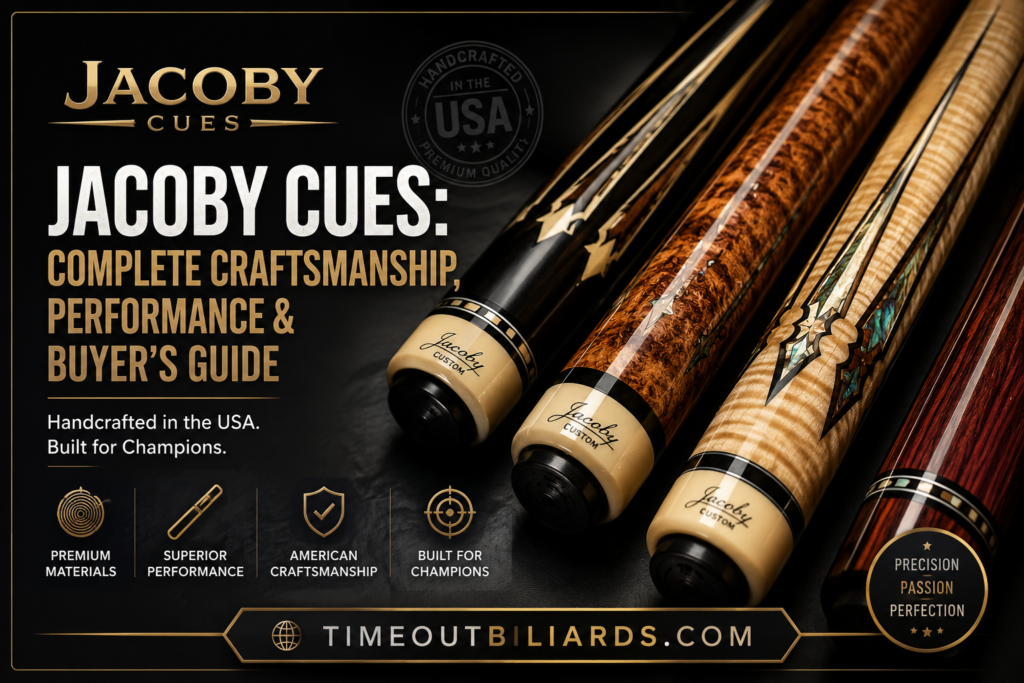
Few names carry as much weight in American cue making as Jacoby Custom Cues. Handcrafted in Nekoosa, Wisconsin, Jacoby has built its reputation through precision woodworking, consistent manufacturing, and a willingness to combine traditional craftsmanship with modern shaft technology. Whether you’re a league player looking for a dependable upgrade, a tournament competitor comparing low-deflection shafts, or a collector interested in custom American cues, this guide explains how Jacoby’s lineup is built, how it performs, and how to choose the right configuration for your game.
| Best For | League players, tournament competitors, cue collectors |
| Made In | Nekoosa, Wisconsin, USA |
| Best Shaft (Low Deflection) | Black V4 Carbon Fiber |
| Best Shaft (Traditional Feel) | Ultra Pro Laminated Maple |
| Customization | Excellent — full custom program available |
| Price Range | $$–$$$$ |
| Joint Standard | Radial Pin (verify per model) |
| Governing Body Standards | Billiard Congress of America |
Jacoby Cues are handcrafted American pool cues manufactured by Jacoby Custom Cues in Nekoosa, Wisconsin. Founded by David Jacoby and continued by his son Brandon Jacoby, the company produces playing cues, break cues, jump cues, and fully custom billiard cues using domestic and exotic hardwoods, carbon fiber shafts, and precision-machined joints — built to meet the standards of serious league and tournament players.
Jacoby Custom Cues is a family-run operation founded by David Jacoby and continued by his son Brandon Jacoby. The shop operates out of Nekoosa, Wisconsin, where every cue is built by hand on American soil. Jacoby holds membership in the American Cue Makers Association and produces cues that meet equipment standards recognized by the Billiard Congress of America — the governing body that oversees pool and billiard equipment specifications in the United States. Players competing in organized league formats through the APA (American Poolplayers Association) or USAPL will find Jacoby cues fully compliant with standard equipment rules. For players competing at the international level under World Pool-Billiard Association (WPA) formats, Jacoby cues meet the construction standards expected at that tier. What separates Jacoby from mass-produced brands isn’t just the craftsmanship — it’s the consistency. Each cue is built to tight tolerances, using woods and materials selected for their performance properties, not just their appearance.
The shaft is where a cue either earns its price or doesn’t. Jacoby offers two distinct shaft lines, each built for a different type of player.
The Black V4 is Jacoby’s flagship low-deflection shaft. Built from carbon fiber, it resists warping, holds its straightness across temperature and humidity changes, and delivers a predictable, consistent hit at contact. The physics behind this come down to end-mass reduction. Carbon fiber construction allows the shaft to be built with significantly less mass concentrated at the tip end. Lower end mass means less energy transferred laterally to the cue ball on off-center hits — which is what produces cue ball deflection (sometimes called “squirt”). Players competing in 8-ball, 9-ball, or straight pool at higher levels will notice the difference most on long cut shots and power draw shots where cue ball path accuracy matters most. The flexural modulus of carbon fiber — its resistance to bending under load — is substantially higher than maple. This stiffness contributes to a firmer, more direct hit and faster energy transfer to the cue ball. It also means the feedback feels different from wood: less vibration, less flex, more of a crisp, solid sensation at impact. Players who switch from maple to the Black V4 typically need a short adjustment period. Once dialed in, most find their shot-making becomes more repeatable. Available in multiple tip diameters and joint configurations.
The Ultra Pro is Jacoby’s answer for players who want improved performance without abandoning the feel of wood. Constructed from laminated hard rock maple, it offers better stability than a standard single-piece maple shaft — less warping, more consistent flex across temperature and humidity changes — while preserving the organic feedback that traditional players prefer. The laminated construction also improves radial consistency: the shaft behaves more uniformly regardless of which face is in contact during the stroke. Single-piece maple shafts can exhibit subtle performance differences depending on wood grain orientation. The Ultra Pro reduces that variable without introducing the learning curve of carbon fiber. It bridges the gap between old-school craftsmanship and modern playability. If you’ve resisted carbon fiber but want a shaft that performs beyond entry level, the Ultra Pro is the logical step up.
| Black V4 Carbon Fiber | Ultra Pro Laminated Maple | |
|---|---|---|
| Deflection | Lowest available | Reduced vs. standard maple |
| Feel at Contact | Firm, crisp, direct | Traditional wood feedback |
| Weather Resistance | Excellent | Good (better than single-piece) |
| Durability | Very high | High |
| Adjustment Period | Required | Minimal |
| Maintenance | Low | Moderate |
| Price | Higher | More accessible |
| Best For | Tournament competitors, control players | Traditional players, league shooters |
Understanding these performance variables helps you choose the right shaft for your stroke — not just the most expensive option on the shelf.
| Shaft | Deflection | Feedback | Stiffness | Forgiveness |
|---|---|---|---|---|
| Black V4 Carbon | Lowest | Minimal | Very High | High on off-center hits |
| Ultra Pro Maple | Low–Medium | Natural | Medium–High | Moderate |
| Standard Maple | Medium–High | Full | Medium | Lower |
Quick Answer: If your priority is minimizing cue ball deflection on cut shots, the Black V4 is the clear choice. If you want a shaft that feels like wood but performs better than a standard taper, the Ultra Pro is the more natural transition.
Many Jacoby cues use a Radial pin joint — a design that promotes solid contact between shaft and butt, improves energy transfer at impact, and contributes to a cleaner, more direct hit. The Radial joint is precision-machined for consistent mating across the cue, reducing vibration and dead spots that affect cheaper joint designs. Before purchasing a replacement shaft or upgrading, always verify joint compatibility. Not all Jacoby models share the same joint specification — some models use a 5/16 x 14 configuration — and mismatches affect both performance and fit.
Tip diameter affects how the cue contacts the cue ball and how much control you have over spin and deflection. Jacoby shafts are available in multiple diameters.
| Diameter | Best For | Feel |
|---|---|---|
| 11.8 mm | Maximum spin control, tournament players | Narrow, precise |
| 12.3 mm | Balanced control and feel | Versatile |
| 12.7 mm | Traditional feel, beginners and recreational players | Familiar, forgiving |
Smaller tip diameters allow more precise english application but leave less margin for off-center contact. Most competitive players gravitate toward the 12.0–12.5mm range. If you’re new to low-deflection shafts, starting at 12.3mm gives you control benefits without the extreme learning curve of the narrowest options.
Cue weight affects stroke speed, break power, and overall feel. Jacoby’s adjustable weight bolt system lets players tune their cue without tools.
| Weight | Best For |
|---|---|
| 18 oz | Fast stroke, spin players, finesse game |
| 19 oz | Balanced all-around play |
| 20 oz | Power break, slower deliberate stroke |
| 21 oz | Heavy breakers, physical players |
Most pool and billiard organizations, including those sanctioned by the Billiard Congress of America, allow cues in the 17–21 oz range for competitive play. When in doubt, start at 19 oz and adjust from there based on how your stroke feels over extended sessions.
Jacoby organizes its playing cues into distinct lines, each aimed at a specific player profile.
The MAG Series is built for serious league and tournament players who want performance without commissioning a full custom. These cues feature consistent construction, quality hardware, and Jacoby’s standard of fit and finish at a more accessible price point. They’re not entry-level sticks dressed up with a name — the MAG Series reflects the same manufacturing standards as Jacoby’s higher-end work.
The Elements Collection is where Jacoby lets the materials do the talking. These cues incorporate exotic hardwoods alongside decorative inlays, producing cues that function as both performance instruments and handcrafted art. Each cue in the Elements Collection is visually distinct. If you want a cue that stands apart at the table, this is the line to explore.
The Game Changer sits at the intersection of technical performance and premium construction. It’s designed for players who take their equipment seriously and want a cue built to compete at the highest levels of amateur and professional play.
The Raven is a limited-production cue for collectors and players who want something genuinely rare. Production numbers are restricted, and materials are selected for exceptional figure and quality. If availability matters to you, move quickly — these don’t stay in stock.
For players who want something that no one else has, Jacoby offers a full custom cue builder program. You choose the wood species, inlay materials, wrap style, joint type, shaft configuration, and weight. The result is a handcrafted cue stick built to your specifications from the ground up.
| Wood | Appearance | Density | Notes |
|---|---|---|---|
| Ebony | Dark, near-black | Very high | Dense, stable, premium look |
| Bocote | Brown with dark streaks | High | Distinctive figure, visually striking |
| Cocobolo | Orange-red, dark grain | High | Rich color, excellent stability |
| Birdseye Maple | Light with circular figure | Medium | Classic look, widely favored |
| Tiger Maple | Light with ribbon figure | Medium | Bold grain pattern, eye-catching |
| Hard Rock Maple | Light, tight grain | Medium | Standard shaft material, proven performer |
Inlay materials: Mother of pearl, charoite, malachite, juma Wrap options: Irish linen, leather (including bull hide and stacked leather options), no-wrap Joint options: Radial pin, 5/16 x 14, and select configurations Lead times on custom work vary. If you’re ordering a custom Jacoby cue, plan ahead — these are built by hand, one at a time. Contact Jacoby Custom Cues directly for current build times and pricing.
Breaking is a different discipline from playing. The physics are different, the demands on the cue are different, and the right tool matters.
The BlaCkOut is Jacoby’s dedicated break cue. Built to handle the violent energy transfer of a full-power break, it uses a phenolic ferrule and tip combination that maximizes energy delivery to the cue ball while protecting the shaft from the repeated stress of break shots. A phenolic tip is significantly harder than a standard playing tip — it compresses less at impact, which translates directly to more energy reaching the rack. Some players use the BlaCkOut for jump shots as well, giving them a single specialty cue that covers both situations.
Jacoby also offers the Monster Crush and Heavy Hitter as break cue options. Each is built around the same core principle — maximum energy transfer, durable construction — with slight differences in feel and balance. Players who generate break power through body weight and a slower stroke often prefer the Heavy Hitter. Those who break with speed and a faster stroke tend to favor the Monster Crush.
Jump shots reward a cue that’s light, stiff, and responsive. Jacoby’s jump cue lineup is built specifically for controlled elevation shots.
The Xtreme Jumper is engineered to lift the cue ball cleanly without sending it into an uncontrolled arc. Jump cues reward technique over power, and the Xtreme Jumper is designed to work with a skilled stroke. Legal jump shots under WPA and BCA rules require the cue to strike the cue ball above center — this cue’s construction supports that technique effectively.
Balance affects how a cue feels in the hand and how it moves through the stroke. Jacoby’s adjustable weight bolt system lets players dial in the butt weight without tools, adding or removing weight to shift the balance point and overall feel. A cue that’s slightly back-heavy can make long shots feel more stable and controlled. One that’s forward-balanced suits players who prefer the sensation of the tip leading the stroke. Neither is objectively correct — it’s a personal preference, and having the ability to adjust means you’re not locked into one setting for the life of the cue.
Jacoby competes in a crowded premium cue market that includes Predator, Meucci, Pechauer, McDermott, Viking, and Schön. Each brand has a distinct philosophy. Predator is widely recognized for its carbon fiber shaft technology and dominates the shaft aftermarket. Pechauer and McDermott are well-regarded for American craftsmanship and broad product lines. Meucci has a long history with professional players and a loyal following. Schön is known for its artistic custom work. Jacoby distinguishes itself by combining handcrafted cue construction in Wisconsin with extensive customization options and a choice between advanced carbon fiber and laminated maple shafts — all produced in-house. For players who want both modern performance and a personalized custom cue USA-built from the ground up, that combination is a notable advantage. Players who have used Predator shafts on other butts often find the Black V4 a direct competitor worth comparing. The low-deflection performance is similar in character, but the feel at contact and stiffness profile differ in ways that are genuinely subjective and worth testing before committing.
What best describes your situation?
│
├── League player on a budget
│   └── → MAG Series + Ultra Pro Shaft
│
├── Tournament competitor wanting lowest deflection
│   └── → Game Changer or Custom Build + Black V4 Carbon Shaft
│
├── Traditional player who prefers wood feel
│   └── → MAG Series or Elements Collection + Ultra Pro Shaft
│
├── Player who breaks hard and needs a specialty cue
│   └── → BlaCkOut or Heavy Hitter Break Cue
│
├── Player needing jump capability
│   └── → Xtreme Jumper
│
└── Collector or player wanting something one-of-a-kind
└── → Elements Collection, Raven Limited Edition, or Full Custom BuildEven experienced players make these errors when buying a high-end cue. Buying the wrong joint. A Radial pin shaft will not fit a 5/16 x 14 butt without an adapter. Always confirm joint compatibility before purchasing a shaft separately from a butt. Chasing the lowest deflection number. Low deflection is a real advantage, but only if your stroke mechanics can take advantage of it. Players with inconsistent technique often benefit more from a forgiving shaft than an extreme low-deflection model. Choosing aesthetics over performance. A beautiful cue that doesn’t fit your stroke is an expensive disappointment. Get the performance spec right first, then consider appearance. Ignoring cue weight. Many players buy at 19–20 oz by default without testing how different weights feel across a full session. Weight affects fatigue, stroke tempo, and break power in ways that vary by player. Ignoring shaft diameter. Moving from a 13mm shaft to an 11.8mm shaft is a significant change. Allow time to adjust, or choose a diameter closer to what you’ve been playing with. Skipping the custom option for budget reasons without comparing prices. Custom Jacoby builds are not always dramatically more expensive than premium production models, particularly when you factor in the materials and labor involved. Get a quote before assuming custom is out of reach.
A well-maintained Jacoby cue performs consistently for decades. A neglected one degrades faster than it should.
Wipe down carbon fiber shafts with a clean, slightly damp microfiber cloth after each session. Avoid alcohol-based cleaners, which can degrade the shaft finish over time. For the Ultra Pro and other maple shafts, a dedicated shaft conditioner or light burnishing with a shaft slicker keeps the surface smooth and prevents chalk buildup from affecting the stroke.
Irish linen wraps should be kept dry. Moisture causes discoloration and accelerates wear. If your hands sweat heavily during play, consider a leather wrap or no-wrap configuration for easier maintenance. Leather wraps (including bull hide and stacked leather) can be cleaned with a slightly damp cloth and conditioned occasionally with a leather-safe product. Avoid soaking the wrap or exposing it to prolonged humidity.
Pool cues — particularly those with maple shafts and wood butts — are sensitive to humidity changes. Store your cue in a hard case when not in use, and avoid leaving it in a car trunk, garage, or anywhere that experiences extreme temperature swings. A hard case with foam padding protects against physical damage and moderates exposure to environmental changes.
Cue tips wear down with use. A mushroomed, hardened, or glazed tip loses its ability to hold chalk and grip the cue ball effectively. Most players replace their tip every 6–12 months depending on play frequency. Signs you need a new tip: chalk won’t adhere, you’re miscuing more often, or the tip has flattened out beyond the curvature of a nickel. Tip hardness affects feel and spin transfer. Softer tips grip the cue ball longer at contact, making english easier to apply. Harder tips (including phenolic on break cues) transfer energy more efficiently. For playing cues, medium to medium-hard tips suit most players.
Invest in a hard case rated for the number of cues you carry. A two-by-four case (two butts, four shafts) is the standard choice for players who carry a playing cue and a break or jump cue. Soft cases offer portability but provide minimal protection against impacts.
As Jacoby’s reputation has grown, so has interest in both current production and older models. Here’s what to look for when authenticating a Jacoby cue. Logo and branding. Jacoby has used different logo treatments across different production eras. Familiarize yourself with the current branding and compare against photos of genuine cues from the same period. Build quality indicators. Genuine Jacoby cues show tight inlay work with no gaps, clean joint machining with no wobble, and consistent finish quality across the full cue length. Custom signatures. Some custom Jacoby cues carry maker signatures or markings. These can be verified through Jacoby directly. Raven and Elements authentication. For limited edition models, contact Jacoby Custom Cues with the cue’s serial number or photos for verification. The secondary market for Raven and Elements cues has grown, and authentication matters before purchasing at collector prices. Older models. Historical Jacoby production models used different joint standards and materials. If you’re buying an older cue to use with a modern shaft, joint compatibility is the first thing to verify.
Before you spend money on any high-end cue, get clear on a few things. What game do you play? 8-ball and 9-ball at competitive levels demand a different priority set than straight pool or one-pocket. Understand what your game actually requires. Do you need low maintenance? Carbon fiber shafts require less upkeep than maple, resist humidity, and don’t need periodic sanding or conditioning. If you travel frequently or store your cue in variable conditions, the Black V4 has a practical maintenance advantage. What shaft do you prefer? Carbon fiber delivers consistency and durability. Laminated maple preserves wood feel. Neither is universally better. What joint do you need? If you’re buying a shaft separately from a butt, confirm the joint pin specification before ordering. Are you buying to play or collect? If collecting is part of the equation, the Elements Collection and Raven Limited Edition hold their value and visual appeal better than production-line cues. What does a custom Jacoby cue cost? Pricing varies significantly based on materials, inlays, wrap selection, shaft choice, and customization level. Contact Jacoby Custom Cues or an authorized dealer for current pricing — it changes with material costs and availability.
Where are Jacoby Cues made? Jacoby Cues are handcrafted in Nekoosa, Wisconsin, USA by Jacoby Custom Cues. What joint pin do Jacoby cues use? Many current Jacoby cues use a Radial joint. Select models are available in other configurations, including 5/16 x 14. Always verify compatibility before purchasing a shaft separately. Are Jacoby Black V4 shafts low deflection? Yes. The Black V4 carbon fiber shaft is built specifically for low-deflection performance. Its carbon fiber construction reduces end mass, which minimizes cue ball deflection on angled shots. Can I use a Black V4 shaft on an older Jacoby cue? It depends on the joint specification of your existing butt. Older Jacoby models may use different joint standards. Verify the pin type before purchasing. Contact Jacoby or an authorized dealer if you’re unsure. How long do Jacoby custom builds usually take? Build times vary depending on the complexity of the order and current production schedule. Contact Jacoby Custom Cues directly for an accurate lead time estimate before ordering. What cue weight should I choose? Most players start at 19 oz and adjust based on feel. Lighter cues (18 oz) suit fast stroke players. Heavier cues (20–21 oz) work for power breakers and players with a slower, more deliberate stroke. Which shaft diameter is best? It depends on your playing style and what you’re transitioning from. 12.3mm is a versatile starting point. Competitive players often prefer 11.8–12.0mm for maximum cue ball control. How do I clean a carbon fiber shaft? Wipe it down with a clean, slightly damp microfiber cloth after each session. Avoid alcohol-based cleaners. No sanding or conditioning is required. Are Jacoby cues good for beginners? The MAG Series is an appropriate entry point for players who are serious about improving. True beginners may want to start with a lower-cost cue before investing at the Jacoby level, but there’s no performance reason a beginner can’t use one. How often should I replace my cue tip? Most players replace their tip every 6–12 months depending on play frequency. Replace it when chalk stops adhering, miscues increase, or the tip has flattened or hardened beyond normal wear. How do I identify a genuine Jacoby cue? Look for tight inlay work, clean joint machining, consistent finish quality, and correct logo branding for the production era. For limited edition or collector models, contact Jacoby Custom Cues directly with photos or a serial number for verification. How much does a custom Jacoby cue cost? Pricing depends on materials, inlays, wrap selection, shaft choice, and customization level. Contact Jacoby Custom Cues or an authorized dealer for accurate current pricing.
Jacoby Custom Cues has established a long-standing reputation by focusing on consistent craftsmanship rather than chasing trends. From the value-oriented MAG Series to fully custom builds and the Black V4 carbon fiber shaft, the lineup offers options for players with different preferences and budgets. Before making a purchase, compare shaft technologies using the deflection and feedback matrix above, confirm joint compatibility for your existing setup, and consider how cue weight, balance point, and wrap material fit your stroke. If you’re investing in a custom build, take the time to understand wood characteristics and inlay options — a well-specified custom Jacoby cue is a long-term tool, not a short-term purchase. Taking the time to match the cue to your playing style — rather than selecting a model based on appearance alone — is what separates players who are happy with their purchase three years later from those who aren’t.
Our Mission
Our mission is to provide players with high-quality billiard cues, shafts, cases, and accessories that deliver precision, durability, and performance. We aim to be a trusted destination for pool players across the USA looking for reliable equipment to improve their game and enjoy billiards at every level. 🎱


