Last Updated: 2025 | This guide was developed using manufacturer specifications, cue repair standards, shaft compatibility documentation, and performance testing principles used throughout the billiards industry.
This guide was developed using manufacturer specifications, cue repair standards, shaft compatibility documentation, and performance testing principles used throughout the billiards industry. It is designed to serve both players making purchasing decisions and technicians evaluating joint conversion options.
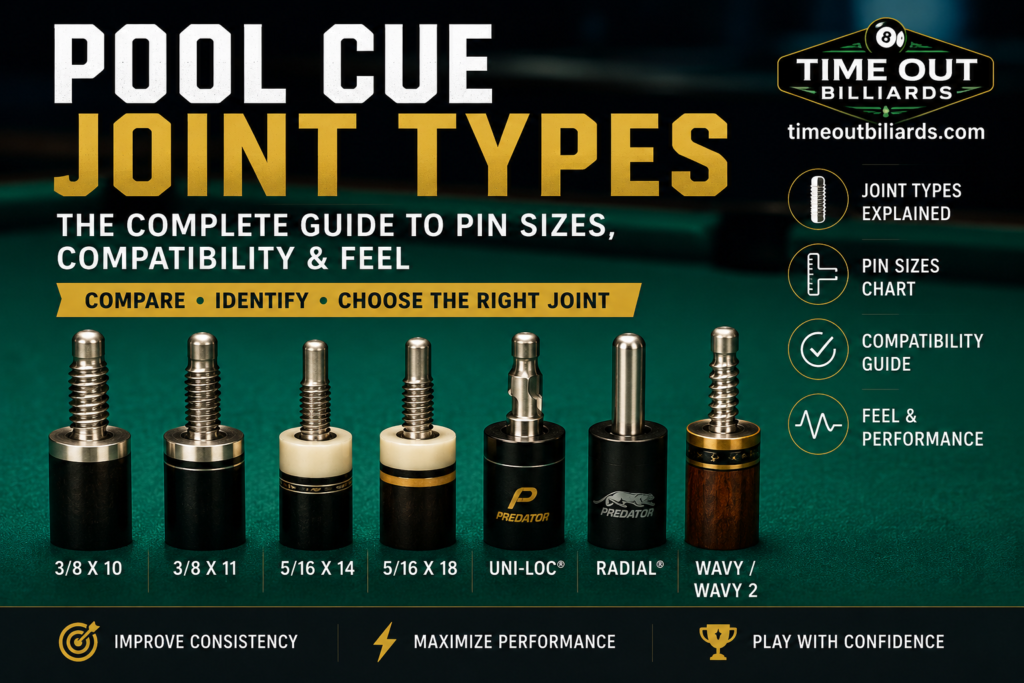
Pool cue joint types are the connection systems that join a cue shaft to a cue butt. They determine shaft compatibility, vibration feedback, assembly speed, balance characteristics, and overall playing feel. Common pool cue joint types include 3/8×10, 3/8×11, 5/16×14, 5/16×18, Uni-Loc, Radial, and wood-to-wood designs.
Far from a minor detail, the joint system directly governs structural rigidity, vibration transmission, assembly speed, and long-term shaft compatibility. Every purchasing decision involving an aftermarket or replacement shaft begins with accurate joint identification.
The joint consists of several precision-engineered components: the joint pin, the collar, the insert, and in many designs, a pilot—a small-diameter guide section that centers the shaft during assembly. Variations in pin diameter, thread pitch, collar material, and pilot geometry define each pool cue joint type and determine what shafts are mechanically compatible.
Understanding pool cue joint types is not optional for serious players. It is the foundation of informed equipment decisions.
| Joint Type | Pin Diameter | Threads Per Inch | Common Brands | Feel Profile |
|---|---|---|---|---|
| 3/8 x 10 | 3/8 inch | 10 TPI | McDermott, Meucci, Viking | Moderate, versatile |
| 3/8 x 11 | 3/8 inch | 11 TPI | Schon, Joss, custom makers | Firm, traditional |
| 5/16 x 14 | 5/16 inch | 14 TPI | Lucasi, Cuetec, budget lines | Stiffer, direct |
| 5/16 x 18 | 5/16 inch | 18 TPI | Pechauer, OB Cues, Mezz | Solid, refined |
| Uni-Loc | Proprietary | Proprietary | Predator | Fast assembly, consistent |
| Radial | Proprietary | Proprietary | Predator, OB Cues | Traditional, tactile |
| Wavy / Wavy 2 | Proprietary | Proprietary | Meucci | Soft, wood-forward feel |
Critical distinction: Pin diameter and thread pitch are independent specifications. A 5/16×14 and a 5/16×18 pin share the same diameter but use incompatible thread pitches. Never assume two pool cue joint types are interchangeable based on diameter alone.
Pin size is the most fundamental variable across all pool cue joint types. The following chart documents industry-standard pin specifications, their typical applications, and key compatibility notes.
| Pin Size | Diameter | TPI | Collar Material | Compatible Shaft Lines | Notes |
|---|---|---|---|---|---|
| 3/8 x 10 | 3/8″ | 10 | Phenolic, Implex, steel | McDermott, OB, Predator (converted) | Most widely available aftermarket shafts |
| 3/8 x 11 | 3/8″ | 11 | Phenolic, wood | Schon, Joss, custom | Tighter thread engagement; not interchangeable with 3/8×10 |
| 5/16 x 14 | 5/16″ | 14 | Phenolic, brass | Lucasi, Cuetec, imports | Common in budget-to-mid lines |
| 5/16 x 18 | 5/16″ | 18 | Phenolic, stainless | Pechauer, OB Cues, Mezz | Finest standard thread pitch; preferred for performance shafts |
| Uni-Loc | Proprietary | N/A | Proprietary | Predator REVO, Predator 314 | Quarter-turn quick release; brand-exclusive |
| Radial | Proprietary | N/A | Phenolic, stainless | Predator, OB Cues | Smooth-bore compression fit; no thread indexing |
| Wavy / Wavy 2 | Proprietary | N/A | Wood, phenolic | Meucci only | Wave-pattern interface; not compatible with third-party shafts |
Measurement standard: Pin diameter is measured across thread crests using a digital caliper. Thread pitch is measured in threads per inch (TPI) using a calibrated thread gauge. Both measurements are required for accurate joint identification—diameter alone is insufficient.
Industry note: Among all pool cue joint types, the 3/8×10 standard represents the broadest aftermarket shaft ecosystem in American cue manufacturing. Players who anticipate future shaft upgrades benefit disproportionately from choosing or retaining a 3/8×10-equipped butt.
Among all pool cue joint types, the 3/8×10 uses a 3/8-inch diameter pin with 10 threads per inch and represents one of the most widely distributed joint standards in American cue manufacturing. Its broad adoption across mid-range and professional-grade cues has established the 3/8×10 as the most widely distributed of all pool cue joint types in American manufacturing, appearing consistently across brands such as McDermott, Meucci, and Viking.
The 3/8×10 configuration typically pairs with a stainless steel or brass pin set into a phenolic or Implex collar. This material pairing produces a firm but moderately dampened hit—stiffer than a wood-to-wood joint, yet less rigid than smaller-diameter pin systems. Players transitioning from house cues frequently report that the 3/8×10 delivers a natural, accessible feel without sacrificing structural feedback.
Aftermarket shaft availability for the 3/8×10 standard is among the highest in the industry, making it a practical choice for players who anticipate future shaft upgrades, including carbon fiber shaft installations from manufacturers such as Cuetec and OB Cues.
Among standard pool cue joint types, the 3/8×11 is distinguished by retaining the 3/8-inch pin diameter while increasing thread pitch to 11 threads per inch. This tighter threading produces measurably more secure engagement under repeated use—a characteristic valued by custom cue builders and players who prioritize mechanical precision.
Brands including Schon and several boutique American cue makers have historically favored the 3/8×11 specification. The additional thread contact area reduces micro-movement at the joint interface, which many experienced players describe as contributing to a cleaner, more consistent vibration signature through the stroke.
Key specification note: The 3/8×10 and 3/8×11 are not interchangeable. Thread pitch differences make cross-compatibility mechanically impossible without professional joint conversion.
The 5/16×14 is one of two 5/16-inch pool cue joint types in common production use, employing a 5/16-inch diameter pin with 14 threads per inch. Its smaller pin diameter relative to 3/8-inch systems concentrates joint stiffness differently, often producing a more direct, less filtered energy transfer from shaft to butt. Players who prefer to feel cue ball contact with high immediacy frequently gravitate toward this configuration.
The 5/16×14 appears extensively across budget-to-mid-range cue lines and many import manufacturers. While its prevalence makes replacement shafts accessible, the 5/16-inch standard offers fewer premium aftermarket options compared to 3/8-inch or proprietary pool cue joint types.
The 5/16×18 joint uses the same 5/16-inch pin diameter as the 5/16×14 but employs 18 threads per inch—the finest thread pitch among standard pool cue joint types. This tighter threading produces exceptionally secure shaft engagement and is associated with a precise, refined hit that appeals to technically oriented players.
Manufacturers including Pechauer, OB Cues, and Mezz have built reputations for high-quality 5/16×18 implementations. The 5/16×18 is particularly common among players who use performance aftermarket shafts, where consistent joint alignment and minimal play in the connection directly influence low-deflection shaft performance.
Specification reminder: 5/16×14 and 5/16×18 pins are dimensionally incompatible despite sharing the same diameter. Thread pitch governs engagement, not diameter.
The Uni-Loc Quick Release joint is a proprietary connection system developed and exclusively used by Predator. Rather than conventional threaded engagement, Uni-Loc employs a quarter-turn locking mechanism that allows shaft and butt to be separated or connected in approximately one second. This design eliminates the repetitive threading motion that causes collar wear in conventional pool cue joint types over time.
Uni-Loc’s structural design routes the primary load-bearing contact through the collar face rather than the pin threads, which Predator engineers have argued produces more consistent joint alignment across thousands of assembly cycles. Among all pool cue joint types, Uni-Loc is the system most frequently cited by league and tournament players for maintaining repeatable feel across high-cycle assembly and disassembly use.
Predator’s REVO carbon fiber shaft and the Predator 314 shaft series are both engineered around the Uni-Loc system, making this joint type the primary access point for Predator’s full shaft ecosystem.
Compatibility is strictly proprietary. Uni-Loc shafts are mechanically incompatible with non-Predator butts, and non-Uni-Loc shafts cannot be mounted on Uni-Loc-equipped butts without professional conversion.
The Radial is among the pool cue joint types produced by both Predator and OB Cues, using a smooth, unthreaded pin that locks into position through a compression-fit collar system rather than conventional threading. The absence of thread engagement eliminates the angular indexing variability inherent in threaded designs—each assembly produces identical rotational shaft alignment, a characteristic that technically-minded players argue contributes to stroke consistency.
Available in configurations compatible with multiple shaft lines, the smooth-bore engagement mechanism produces a solid, direct hit feel that many players associate with high-end custom cue construction.
Radial vs. Uni-Loc: Radial joints prioritize alignment consistency and traditional tactile feedback. Uni-Loc prioritizes assembly speed and long-term mechanical durability. Neither is objectively superior—the distinction is functional and preference-driven.
The Wavy joint is a proprietary system developed by Meucci and central to the brand’s claimed playing characteristics. Rather than a conventional cylindrical insert, the Wavy design uses an irregular, wave-patterned contact surface between shaft and butt. Meucci’s position is that this geometry distributes vibration differently than conventional joint interfaces, producing a softer, more wood-like hit even in cues that use non-wood collar materials.
The Wavy 2 is an updated iteration with refined geometry and improved material tolerances. Both versions are proprietary to Meucci cues and are not compatible with third-party shafts without joint conversion.
Among proprietary pool cue joint types, the Wavy system is most frequently cited by players who prioritize a softer, more dampened hit over the stiffness associated with metal-faced joint designs. Whether this difference is attributable to joint geometry, overall cue construction, or a combination of both remains a subject of active debate among serious players.
Wood-to-wood pool cue joint types eliminate metal collar components from the connection interface, allowing the shaft and butt to meet directly through their respective wooden surfaces. This construction was standard in American cue building prior to the widespread adoption of phenolic and metal collars, and it remains the preferred specification among many traditional custom cue builders and players.
The acoustic and mechanical properties of wood-to-wood joints produce a distinctly different vibration profile. Because wood absorbs and transmits vibration differently than dense synthetic or metal materials, wood-to-wood joints are consistently described as delivering a softer, warmer, more natural hit—a characteristic particularly valued by players who developed their game on traditional American hard maple cues.
Wood-to-wood pool cue joint types are not inherently superior or inferior to synthetic alternatives. They represent a different engineering philosophy—one that prioritizes organic playing feel over mechanical durability and broad compatibility.
Across all pool cue joint types, face geometry is one of the most frequently overlooked compatibility variables, yet it directly influences shaft alignment, energy transfer, and aftermarket component compatibility.
Among pool cue joint types, piloted designs are common in mid-range and performance lines where precise shaft alignment is the priority. A piloted joint incorporates a small-diameter cylindrical extension—the pilot—that protrudes from the shaft’s joint face and seats into a corresponding recess in the butt collar. This pilot-to-socket engagement mechanically centers the shaft during assembly, reducing radial play at the joint interface.
The additional centering contact slightly increases the surface area through which vibration is transmitted, which many players describe as producing a more solid, less hollow feel at contact.
A flat-faced joint omits the pilot, allowing the shaft and butt to connect through flat-surface collar contact alone. Alignment depends entirely on pin threading precision. Flat-faced designs are common in custom and high-end cue construction, where tight manufacturing tolerances make the pilot’s centering function unnecessary.
Many experienced players and custom cue makers argue that flat-faced joints produce cleaner, more transparent vibration feedback—the absence of the pilot eliminates a secondary contact point that some perceive as interfering with feel.
Critical rule: A piloted shaft cannot be installed on a flat-faced butt, and a flat-faced shaft cannot seat properly in a piloted butt collar. Pilot geometry must be matched between shaft and butt before any joint conversion or shaft upgrade is attempted.
Can you put a piloted shaft on a flat-faced butt? No. The pilot protrusion will prevent full collar contact, producing an unstable joint with compromised feel and potential structural stress on the pin.
Can you put a flat-faced shaft on a piloted butt? No. Without the pilot, the shaft cannot seat into the butt’s recess, resulting in misalignment, reduced collar contact, and inconsistent vibration transmission.
For players whose primary selection criterion is playing feel rather than compatibility range or assembly convenience, pool cue joint types can be ranked by their characteristic feel profiles:
Softest Feel: Wood-to-wood pool cue joint types deliver the most dampened, organic hit response. The absence of synthetic collar materials allows vibration to travel through wood grain alone, producing the warmest, most traditional feel available across any pool cue joint type.
Moderate, Natural Feel: The 3/8×10 joint with a phenolic or Implex collar produces a balanced response—firm enough to transmit detailed feedback without the stiffness associated with smaller-diameter or all-metal systems. Widely regarded as the most accessible feel profile among standard pool cue joint types for intermediate players.
Firm, Precise Feel: The 5/16×18 joint and Radial joint both produce a tighter, more immediate sensation at contact. The fine thread engagement of the 5/16×18 and the compression-fit design of the Radial minimize energy dissipation at the joint interface, resulting in a crisper, more direct feedback signature than most other pool cue joint types.
Stiffest Feel: Metal-to-metal joint configurations—particularly those pairing stainless steel pins with stainless steel collar inserts—produce the highest-rigidity feel profile available in production cue construction. This characteristic is often described as unforgiving on off-center hits but highly informative for technically precise stroke mechanics.
Best Pool Cue Joint for Carbon Fiber Shafts: The Uni-Loc system for Predator REVO and 314 shafts, and the 3/8×10 or 5/16×18 standard for carbon fiber shafts from Cuetec Cynergy, OB Cues Defy, and Jacoby lines. Carbon fiber shafts amplify quality differences between pool cue joint types—a well-fitted, high-tolerance joint maximizes the performance characteristics these shafts are engineered to deliver.
Best Pool Cue Joint for Custom Cues: Flat-faced designs in 3/8×10 or 5/16×18 specifications are the most common choices among American custom cue makers including Jacoby, Schon, and Joss. These pool cue joint types allow the cue maker to optimize feel through wood selection and geometry rather than relying on joint hardware to shape the playing character.
Best Pool Cue Joint for Beginners: Among all pool cue joint types, the 3/8×10 offers the broadest shaft compatibility ecosystem, the widest range of available replacement parts, and a forgiving feel profile that does not penalize developing stroke mechanics. For players who are not yet certain which direction their game will develop, the 3/8×10 represents the lowest-risk joint specification.
Summary: There is no universally best choice among pool cue joint types. Players seeking a softer feel often prefer wood-to-wood or 3/8×10 joints, while players seeking maximum rigidity frequently choose 5/16×18 or Uni-Loc systems. The best choice depends on feel preference, shaft compatibility requirements, and long-term equipment strategy.
Pool cue joint types influence playing feel through three primary mechanical mechanisms:
The joint is the primary pathway through which impact vibration travels from shaft to butt and into the player’s grip hand. Joint material, contact surface area, and geometry all modulate this transmission. Metal-to-metal pool cue joint types transmit vibration with greater amplitude and speed, producing the crisp, stiff sensation associated with performance cues. Wood-to-wood and phenolic joints absorb and diffuse vibration, producing the softer, more dampened feel preferred by traditional players.
Joint rigidity affects how the cue responds to off-center hits. A stiffer joint maintains the shaft’s intended deflection geometry more consistently across shot types. A more compliant joint introduces subtle flex at the connection point, which some players perceive as forgiving and others perceive as imprecise.
A mechanically tight, well-fitted joint minimizes energy loss at the connection interface. Loose joints—whether from wear, incorrect thread engagement, or manufacturing tolerances—dissipate a portion of the stroke’s kinetic energy before it reaches the cue ball. Across all pool cue joint types, condition matters as much as specification: a worn joint will underperform a well-maintained joint of a less-favored type.
Does joint type affect cue ball deflection? No. Pool cue joint types do not directly affect cue ball deflection. Deflection is primarily determined by shaft construction, front-end mass, ferrule design, and tip offset. Pool cue joint types influence feel and feedback—not cue ball physics.
The material composition of pool cue joint types affects not only playing feel but the cue’s physical balance point—the fulcrum position that determines how weight is distributed across the player’s grip hand during the stroke.
Joint hardware is positioned at a structurally significant location: the interface between the shaft’s rear mass and the butt’s forward mass. Because this position sits close to the cue’s natural balance point—typically located 18 to 19 inches from the butt cap on a standard 58-inch cue—variations in joint assembly mass produce measurable shifts in center of gravity.
Stainless steel collars and pins are the heaviest standard joint materials. A stainless steel joint assembly shifts the balance point slightly forward, toward the tip, producing a tip-heavy feel that some players associate with power and control on long shots.
Brass inserts and collars are moderately heavy and were the industry standard in American cue manufacturing prior to the widespread adoption of stainless steel. Brass-jointed cues tend to balance closer to the mid-butt position.
Phenolic resin collars are lighter than metal alternatives, shifting the balance point slightly rearward when substituted for steel or brass in an otherwise identical cue. Phenolic’s lower density also reduces the joint’s contribution to overall vibration stiffness, producing a marginally softer feel than metal equivalents across comparable pool cue joint types.
Wood collars in wood-to-wood joint configurations contribute the least mass of any standard joint material. The result is a rearward balance point shift and the most organic feel profile available—characteristics that define the traditional American custom cue aesthetic.
A forward balance point (toward the tip) is associated with a pendulum-like stroke feel that many players find natural for long straight shots and power breaks. A rearward balance point reduces tip-side mass, which some players prefer for finesse shots and precise cue ball control.
When players change pool cue joint types—either through cue purchase, shaft upgrade, or professional joint conversion—the resulting balance point shift is a predictable mechanical consequence, not an incidental side effect. Players who are sensitive to balance point should treat joint material selection as a direct variable in cue feel engineering, not merely a compatibility or durability consideration.
Key principle: Across all pool cue joint types, material selection is simultaneously a feel decision, a balance decision, and a durability decision. All three dimensions should be evaluated before any joint modification or shaft upgrade is finalized.
Misidentifying pool cue joint types before purchasing a shaft is the most common—and most preventable—equipment error in cue sports. Before acquiring any replacement or aftermarket shaft, verify all of the following specifications against your butt:
1. Pin Diameter
Measure the outer diameter of the joint pin. Common values are 3/8 inch and 5/16 inch across standard pool cue joint types. Do not assume; measure.
2. Thread Pitch (Threads Per Inch)
Count threads per inch on the pin or use a thread gauge. Confirm the exact TPI—3/8×10 and 3/8×11 are not interchangeable, nor are 5/16×14 and 5/16×18.
3. Collar Diameter and Material
Confirm the collar’s outer diameter matches the shaft’s joint face. Collar material (wood, phenolic, Implex, stainless steel, brass) affects feel and balance but does not govern mechanical compatibility.
4. Pilot Geometry
Determine whether your butt uses a piloted or flat-faced design. Identify pilot diameter and depth if applicable. Match precisely.
5. Proprietary vs. Standard
Confirm whether your cue uses a proprietary joint system (Uni-Loc, Radial, Wavy) or a standard threaded specification. Proprietary pool cue joint types require brand-specific shaft solutions.
6. Thread Engagement Depth
Measure pin length and confirm the shaft’s corresponding threaded sleeve depth accommodates full engagement without bottoming out.
7. Manufacturer Confirmation
When possible, contact the shaft manufacturer directly with your butt’s complete joint specifications before purchase. This step prevents the majority of compatibility errors across all pool cue joint types.
Industry standard guidance: When full specification documentation is unavailable, provide the cue’s brand, model, and year of manufacture to the shaft manufacturer. Most major shaft producers maintain compatibility databases for common butt configurations.
The widespread adoption of carbon fiber shafts has introduced compatibility variables across all pool cue joint types that did not exist when the industry’s thread standards were originally established. Key products in this category include the Predator REVO, Cuetec Cynergy, OB Cues Defy, and Jacoby carbon lines.
Carbon fiber shafts are manufactured with a threaded metal sleeve at the joint end, engineered to the shaft’s target joint specification. Unlike wood shafts, carbon fiber shafts cannot be retapped or converted to alternative pool cue joint types without voiding manufacturer warranties and risking structural damage to the shaft.
| Specification | Requirement |
|---|---|
| Pin Diameter | Must match exactly |
| Thread Pitch (TPI) | Must match exactly |
| Collar Diameter | Must match within tolerance |
| Pilot Geometry | Must match (piloted or flat-faced) |
| Engagement Depth | Must allow full thread engagement |
Attempting to install a carbon fiber shaft on a non-matching joint risks cross-threading the metal sleeve—a failure mode that is typically irreparable and results in complete shaft loss.
Yes—provided the pool cue joint types align. The process requires:
Among pool cue joint types, the 3/8×10, 5/16×18, and Uni-Loc specifications offer the widest carbon fiber shaft selection. Players with 3/8×11 or Wavy-joint cues face more limited options and may require professional joint conversion before a carbon fiber upgrade is feasible.
Recommendation: When upgrading an older cue to a carbon fiber shaft, obtain complete joint documentation from the cue’s original manufacturer before purchasing the shaft. If documentation is unavailable, have the joint professionally measured by a qualified cue technician prior to purchase.
The following errors account for the majority of preventable purchasing failures when selecting shafts across different pool cue joint types:
Mistake 1: Assuming Diameter Equals Compatibility
The most frequent error. Players identify pin diameter without confirming thread pitch—one of the most consequential misunderstandings of how pool cue joint types differ from one another. A 5/16×14 shaft installed on a 5/16×18 butt will cross-thread on first assembly attempt.
Mistake 2: Ignoring Pilot Geometry
Players focus exclusively on pin diameter and TPI while overlooking pilot configuration. A piloted shaft ordered for a flat-faced butt will not seat correctly regardless of pin specification accuracy.
Mistake 3: Assuming Carbon Fiber Shafts Are Universally Convertible
Carbon fiber shafts use fixed metal sleeves that cannot be retapped. Pool cue joint types must be matched before purchase—not after.
Mistake 4: Purchasing Based on Brand Alone
Brands produce cues across multiple pool cue joint types. A McDermott cue is not guaranteed to use a 3/8×10 joint simply because McDermott commonly uses that standard. Model and year must be verified.
Mistake 5: Cross-Threading During Installation
Forcing a shaft that does not engage smoothly risks cross-threading both the pin and the shaft sleeve. If a shaft does not begin threading with finger pressure alone and without resistance, stop immediately. Do not force the connection.
Mistake 6: Neglecting Joint Wear Assessment
Players upgrade shafts without evaluating the butt’s existing joint condition. A worn collar or pin with degraded threads will underperform with any new shaft regardless of which pool cue joint types are involved. Joint condition should be assessed—and if necessary, repaired—before any shaft investment.
Prevention standard: Before purchasing any shaft, verify pin diameter, thread pitch, pilot geometry, and proprietary status across all relevant pool cue joint types. If any specification is uncertain, consult the manufacturer or a qualified cue technician before completing the purchase.
Beyond Uni-Loc, quick-release designs represent a distinct category within pool cue joint types, developed by several manufacturers to reduce assembly time and collar wear. These systems typically employ a partial-turn engagement mechanism—usually a quarter-turn or half-turn—that locks the shaft securely without requiring full thread engagement.
Quick-release pool cue joint types appeal primarily to:
The primary performance tradeoff of quick-release pool cue joint types is reduced thread engagement surface area compared to fully threaded joints. Some technically-oriented players argue this reduction slightly affects joint rigidity. In practice, most players report no perceptible difference in playing feel between a well-designed quick-release joint and its conventional equivalent.
Joint maintenance is among the most neglected aspects of pool cue care, yet joint condition directly determines how effectively any pool cue joint type performs its structural function. Degraded threads, contaminated contact surfaces, and improperly stored joints compromise feel and accelerate wear regardless of joint specification or collar material.
Thread contamination—chalk dust, grip residue, and environmental debris—is the primary cause of rough shaft engagement and premature thread wear across all pool cue joint types. Clean joint threads using the following protocol:
Cross-threading occurs when shaft and butt are brought together at a slight angle, causing threads to engage incorrectly on first contact. Prevention requires:
Joint protectors are threaded caps designed to protect exposed joint pins and shaft sleeves during transport and storage. They serve three functions: preventing mechanical damage to threads, excluding environmental debris from thread surfaces, and reducing moisture contact with wood collar materials.
Joint protectors are available in standard sizes corresponding to common pool cue joint types and should be considered essential accessories for any player who transports equipment regularly. For proprietary pool cue joint types including Uni-Loc and Radial, manufacturer-specific protectors must be used.
Wood-to-wood pool cue joint types and wood collar designs are vulnerable to dimensional changes caused by humidity fluctuation. Excessive humidity causes wood to swell, which can tighten thread engagement to the point of difficulty or create collar surface irregularities that affect feel. Low humidity causes wood to contract, introducing play at the joint interface.
Store wood-jointed cues in a controlled environment with relative humidity between 45% and 55%. Use a cue case with moisture regulation capability when transporting equipment across climate zones.
With proper maintenance, high-quality pool cue joint types can remain fully functional for decades regardless of specification. Phenolic and stainless steel joints are particularly durable under regular use. Wood collar joints require more active maintenance but can achieve comparable longevity in controlled storage conditions.
The primary wear modes for threaded pool cue joint types are thread surface abrasion—from repeated assembly cycles—and collar face compression from over-tightening. Players who over-torque their shafts accelerate both failure modes simultaneously. Shafts should be tightened firmly by hand until collar faces make solid contact—no additional torque is required or beneficial.
Maintenance principle: Longevity across pool cue joint types is determined more by assembly habit than by specification. A correctly assembled and regularly cleaned joint of any pool cue joint type will outlast a neglected joint of superior specification.
Accurate identification of pool cue joint types requires physical measurement and, in some cases, manufacturer consultation. The following process applies to standard threaded joints:
Step 1: Measure Pin Diameter
Use a digital caliper to measure the outer diameter of the exposed pin threads. Record the measurement in inches.
Step 2: Count Threads Per Inch
Use a thread pitch gauge or count threads manually across a known length. Threads per inch (TPI) is the critical differentiator between otherwise similar pool cue joint types.
Step 3: Identify Pilot or Flat-Face Design
Examine the shaft’s joint face. A small cylindrical protrusion indicates a piloted design. A flush, flat face indicates a flat-faced design.
Step 4: Identify Collar Material
Note whether the collar is wood, phenolic resin, Implex, stainless steel, or brass. This affects feel and balance point but does not govern compatibility between pool cue joint types.
Step 5: Cross-Reference Specifications
Compare measured specifications to the standard pool cue pin sizes chart above to identify which of the common pool cue joint types your butt uses. For proprietary systems, contact the manufacturer with your cue’s brand, model, and year.
Step 6: Confirm with Manufacturer
For any joint where measurements do not clearly match a standard specification, contact the butt manufacturer directly before purchasing a shaft.
Custom pool cue joint types are built by cue makers to precise client specifications, offering configurations that extend beyond standard industry thread patterns. A qualified cue maker can engineer joint geometry, collar material, pilot design, and pin metallurgy as integrated variables in a cue’s overall playing characteristic profile—not as afterthoughts.
Professional joint conversion—changing an existing cue’s pool cue joint type—is technically feasible in most cases. The process typically involves machining the butt’s existing joint interface and installing a new collar and pin assembly matched to the desired specification. However, joint conversion carries meaningful tradeoffs:
Professional recommendation: Converting between pool cue joint types is best approached as a deliberate customization decision rather than a repair. Consult a qualified cue technician and discuss the full range of playing characteristic implications before proceeding.
The most common pool cue joint types are 3/8×10, 3/8×11, 5/16×14, 5/16×18, Uni-Loc Quick Release, Radial, and Wavy. Each system produces distinct feel characteristics and governs shaft compatibility independently of the others.
Among all pool cue joint types, the 3/8×10 is the most common in American cue manufacturing, offering the broadest aftermarket shaft compatibility ecosystem across mid-range and professional-grade cues.
No. Pool cue joint types vary by pin diameter, thread pitch, pilot design, and proprietary specifications. A shaft engineered for one joint type is mechanically incompatible with a different joint type, even when external dimensions appear similar.
Measure pin diameter with a digital caliper, count threads per inch with a thread gauge, and identify whether the design is piloted or flat-faced. Compare results to the standard pool cue pin sizes chart above to identify which pool cue joint types match your butt. When measurements are ambiguous, contact the manufacturer.
Yes. Pool cue joint types directly influence vibration transmission, structural rigidity, and energy transfer at the connection interface. Wood-to-wood joints produce a softer, more dampened feel; metal-to-metal joints produce a stiffer, more immediate sensation. Pool cue joint types do not alter cue ball deflection—that is governed by shaft geometry and tip offset.
Both are 5/16-inch pool cue joint types, but 5/16×14 uses 14 threads per inch and 5/16×18 uses 18 threads per inch. The difference in thread pitch makes them mechanically incompatible despite identical pin diameters.
Uni-Loc provides faster assembly and superior mechanical durability across high-cycle use. Radial provides consistent rotational alignment and a traditional, tactile hit feel. Among pool cue joint types, neither is objectively superior—the distinction is functional and player-preference-driven.
Yes, provided the shaft is manufactured to match your butt’s exact pool cue joint type—including pin diameter, thread pitch, collar diameter, and pilot geometry. Carbon fiber shaft sleeves cannot be retapped; pool cue joint types must be matched exactly before any carbon fiber shaft purchase is completed.
No. The pilot protrusion will prevent full collar contact, creating an unstable joint with compromised feel and potential structural stress at the pin interface regardless of which pool cue joint types are involved.
No. Without the pilot, the shaft cannot properly seat into the butt’s recess, resulting in shaft misalignment, reduced collar contact, and inconsistent vibration feedback across any pool cue joint type.
In most cases, yes. Professional cue technicians can convert between pool cue joint types through precision machining and collar replacement. Conversion will affect the cue’s balance point, resonance characteristics, and in some cases, resale value. The decision should be made with full awareness of these tradeoffs.
With proper maintenance, high-quality pool cue joint types can remain fully functional for decades. The primary determinants of longevity across pool cue joint types are assembly habit, cleaning frequency, and storage environment—not specification alone.
Pool cue joint types are not background specifications—they are foundational variables in cue performance, shaft compatibility, and long-term equipment strategy. The pool cue joint type you choose, or inherit with an existing cue, determines what shafts you can use, how your cue feels across shot types, how your equipment’s balance point responds to material changes, and how your hardware performs over years of competitive play.
The most technically sound approach to joint selection is systematic: identify your existing pool cue joint types precisely, understand the feel and balance characteristics associated with each specification, and verify complete compatibility before any shaft purchase. For players building a new cue from components, pool cue joint type selection should be treated as a primary design decision—not a default.
No pool cue joint type is universally superior. The 3/8×10 offers broad compatibility and accessible feel; the 5/16×18 offers refined thread engagement preferred by performance players; Uni-Loc offers mechanical durability across thousands of assembly cycles; Radial offers alignment consistency; wood-to-wood pool cue joint types offer the most organic feel available in production cue construction. Each represents a different set of engineering priorities, matched to different playing philosophies and equipment ecosystems.
The players who make the best equipment decisions are those who understand that pool cue joint types are not interchangeable commodities—they are precision mechanical systems that interact with every other element of cue performance. Match your pool cue joint type to your game, your equipment ecosystem, and your long-term performance goals—and you will have made one of the most durable and consequential equipment decisions available to a serious pool players.
Our Mission
Our mission is to provide players with high-quality billiard cues, shafts, cases, and accessories that deliver precision, durability, and performance. We aim to be a trusted destination for pool players across the USA looking for reliable equipment to improve their game and enjoy billiards at every level. 🎱