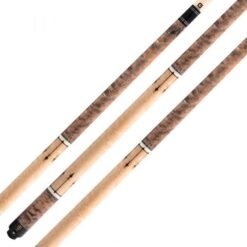

Choosing the wrong cue doesn’t just cost money—it costs accuracy, consistency, and competitive edge. For serious players competing in league or tournament formats, the cue is the single most consequential equipment decision they will make.
This guide evaluates the best pool cue brands for serious players based on shaft technology, deflection performance, construction quality, joint compatibility, and long-term upgrade potential. Whether you’re choosing between carbon fiber and maple, Predator vs Cuetec, or McDermott vs Meucci, this breakdown gives you the technical foundation to make an informed decision in 2026.
The best pool cue brands for serious players in 2026 are Predator, Cuetec, Meucci, Schon, McDermott, and J. Pechauer. Predator leads in low-deflection carbon fiber technology, Cuetec offers outstanding value, Meucci excels in traditional wood-shaft feel, and McDermott provides unmatched warranty support. Serious players should prioritize shaft technology, balance point, and joint compatibility over aesthetics.
Not every expensive cue is a professional cue—and not every professional cue looks expensive. The defining characteristics of a professional-grade billiard cue are measurable, not cosmetic. In 2026, the performance gap between carbon fiber and traditional maple construction has widened further, making shaft material selection more consequential than at any previous point in the sport’s equipment history.
Professional cues are defined by:
Expert Take: A professional-quality cue in 2026 is not a price point—it is an engineering specification. The combination of low deflection, joint precision, and tip-to-ferrule consistency determines whether a cue performs at a competitive level, not the inlay work on the butt sleeve.
The brands evaluated in this guide are not ranked by popularity or marketing spend. They earned their position through competitive validation, engineering investment, and sustained performance across sanctioned APA, BCA, and WPA tournament formats. In 2026, carbon fiber shaft adoption among professional players has reached a tipping point—making shaft material selection the single most debated equipment variable in competitive billiards.
Selection criteria applied:
Why this matters in 2026: Serious players competing in APA leagues, BCA-sanctioned events, or WPA-affiliated tournaments operate in environments where equipment consistency is a measurable competitive variable. Carbon fiber shaft dominance at the professional level is no longer an emerging trend—it is the established standard against which all competing technologies are now evaluated.
Best for: Tournament players, advanced league competitors, carbon fiber adopters
Predator Cues has defined the low deflection category for over two decades and remains the most widely endorsed brand among professional players competing in 2026. The Predator REVO shaft—constructed from a proprietary aerospace-grade carbon fiber composite—delivers measurably lower deflection than any production wood shaft, with dimensional stability across humidity and temperature fluctuations that routinely compromise maple in variable venue conditions.
Shane Van Boening, Fedor Gorst, and Joshua Filler are among the elite professionals who have competed with Predator equipment, lending the brand a level of competitive validation that no marketing campaign can replicate.
What separates Predator from the field in 2026:
Predator REVO shaft specifications:
Predator currently offers the lowest-deflection production shaft through the REVO carbon fiber platform. Among serious players prioritizing cue ball accuracy and spin consistency in 2026, the REVO remains the industry benchmark against which all competing shafts are measured.
Who should buy Predator in 2026: Any serious player prioritizing cue ball accuracy, low deflection performance, and long-term equipment reliability in competitive environments where carbon fiber has become the expected standard.
Best for: Competitive players seeking carbon fiber performance without premium pricing
Cuetec occupies a strategically important position in the 2026 high-performance cue market: the brand delivers measurable low-deflection performance through its Cynergy carbon fiber shaft at a price point that undercuts Predator without meaningfully sacrificing functional accuracy.
The Cynergy shaft’s carbon fiber composite core minimizes deflection while preserving a stroke feedback profile that players transitioning from maple consistently find more accessible than the REVO. This makes Cuetec the rational first carbon fiber cue for players graduating from wood in 2026.
Cuetec’s competitive advantages:
Carbon fiber cues are objectively more stable, durable, and consistent than wood cues across varying environmental conditions. Manufacturer and independent testing indicates deflection reductions of up to 40% versus traditional hard rock maple shafts of equivalent diameter. However, some advanced players still prefer maple shafts for their superior tactile feedback and shot feel. The correct choice depends on whether the player prioritizes mechanical consistency or sensory communication—a distinction that remains as relevant in 2026 as it was when carbon fiber shafts first entered competitive play.
Expert Take: Cuetec’s Cynergy shaft represents the strongest argument in 2026 that carbon fiber performance does not require top-tier pricing. For players who cannot justify Predator REVO pricing but refuse to compromise on deflection control, the Cynergy remains the rational choice.
| Feature | Predator REVO | Cuetec Cynergy |
|---|---|---|
| Shaft Material | Aerospace Carbon Fiber | Carbon Fiber Composite |
| Deflection Level | Extremely Low | Very Low |
| Price Range | $$$$ | $$$ |
| Stroke Feedback | Minimal | Moderate |
| Transition Friendliness | Moderate | High |
| Pro Endorsements | Extensive | Growing |
| Joint System | Uni-Loc | Multiple Options |
Best for: Players who prefer wood shaft feedback and classic American cue construction
Meucci Originals has maintained a loyal competitive following for decades—not through marketing, but through the consistent performance of its Hard Rock Maple shafts and the unmistakable feedback of its Radial joint system. In 2026, Meucci remains the definitive answer for serious players unwilling to abandon wood shaft feel for carbon fiber consistency.
Bob Meucci’s foundational contribution to cue engineering—the flexible shaft theory and the development of a proprietary shaft taper—established principles that influenced low deflection design long before carbon fiber entered the market. The brand’s G-Core and i-Shaft options extend performance capabilities for players unwilling to abandon wood entirely.
What defines Meucci’s performance profile:
Expert Take: Meucci is the correct answer in 2026 for the serious player who has shot wood their entire career and finds carbon fiber feedback insufficient for shot diagnosis. The brand does not ask players to sacrifice feel in exchange for performance.
Best for: Advanced players who prioritize mechanical precision and refined construction
Schon Cues has earned a reputation among serious competitors as the production cue brand that performs closest to custom-level tolerances. Every Schon cue is built to specifications that most production manufacturers cannot maintain at volume—a reflection of the brand’s commitment to mechanical consistency over mass-market scalability that remains unchanged in 2026.
Schon’s defining characteristics:
Schon cues occupy a respected position in the McDermott vs Meucci vs Schon comparison precisely because they offer a third performance path: neither the customization ecosystem of McDermott nor the heritage feel of Meucci, but a refined mechanical consistency that speaks directly to technically minded players.
Who should buy Schon in 2026: The advanced player who wants production-line reliability at near-custom tolerances, without the lead time or pricing of a fully custom build.
Best for: Players who want maximum customization options, upgrade paths, and long-term manufacturer support
McDermott Cues differentiates itself in 2026 not through a single signature shaft technology, but through the depth of its equipment ecosystem and the industry’s most player-friendly ownership terms. The brand’s lifetime warranty—one of the most comprehensive in the billiards industry—signals manufacturing confidence that translates directly into long-term ownership value.
McDermott’s performance ecosystem:
McDermott prioritizes ecosystem depth, upgrade flexibility, and ownership experience backed by a lifetime warranty. Meucci prioritizes heritage shaft engineering, Radial joint feedback, and tactile stroke consistency. Neither is objectively superior in 2026—the correct choice depends on whether a player values upgrade architecture or playing feel.
Expert Take: McDermott’s lifetime warranty is not a marketing footnote—it is a competitive differentiator in 2026. For players investing $800–$1,500 in a cue they intend to use for a decade, that warranty materially changes the total cost of ownership calculation.
Best for: Serious players seeking hand-fitted custom quality without full custom timelines or pricing
J. Pechauer occupies a distinct position in the 2026 high-end billiard cue market: the brand delivers craftsmanship standards associated with boutique custom makers through a production process disciplined enough to ensure consistency across units. Notably, J. Pechauer also offers a lifetime warranty—matching McDermott’s ownership commitment at a comparable performance tier.
What distinguishes J. Pechauer in 2026:
Who should buy J. Pechauer in 2026: The advanced player ready to invest in a cue that performs at custom-level standards without committing to the lead times, pricing, or acquisition complexity of a true boutique custom build.
Carbon fiber shafts have fully transitioned from advanced-player equipment to competitive standard by 2026. The following production carbon fiber shafts represent the current performance tier in serious billiards:
| Shaft | Brand | Deflection Level | Feedback | Price Range |
|---|---|---|---|---|
| REVO | Predator | Extremely Low | Minimal | $$$$ |
| Cynergy | Cuetec | Very Low | Moderate | $$$ |
| Defy | McDermott | Low | Moderate | $$$ |
| Mezz Ignite | Mezz | Low | Moderate | $$$ |
Manufacturer and independent testing data indicates that modern carbon fiber shafts reduce cue ball deflection by up to 40% compared to traditional hard rock maple shafts of equivalent diameter—a performance differential that directly affects positional accuracy when applying English at competitive distances. In 2026, this figure has become the industry-standard reference point for shaft performance comparison.
Technical Note: The polyurethane foam core used in select carbon fiber shafts, including the REVO, contributes to vibration dampening and stroke feel characteristics that distinguish premium carbon fiber construction from entry-level composite alternatives.
Advanced players have different technical requirements depending on game format, playing environment, and skill development stage. This matrix maps brand strengths to player profile as of 2026:
| Player Type | Best Brand | Primary Reason |
|---|---|---|
| Tournament Players | Predator | Lowest deflection, pro-validated |
| League Competitors | McDermott | Ecosystem depth, lifetime warranty |
| Traditionalists | Meucci | Wood shaft feel, Radial joint feedback |
| Custom Enthusiasts | J. Pechauer | Custom-level build, lifetime warranty |
| Value Seekers | Cuetec | Carbon fiber performance, accessible pricing |
| Precision Players | Schon | Near-custom production tolerances |
The best pool cues for advanced players in 2026 share a common denominator: engineering decisions made in response to competitive play data, not retail market positioning.
High-end billiard cues are defined by engineering investment and construction precision—not visual complexity. The price ceiling for genuine performance gains in the 2026 professional cue market sits between $1,000 and $1,500 for production cues. Above that threshold, incremental performance improvements diminish sharply; additional cost reflects customization, exclusivity, and artistry.
Investment tiers for serious players in 2026:
Investment Principle: The highest return on equipment investment for a serious player in 2026 occurs in the $500–$1,500 range. This is where shaft engineering, construction quality, and joint precision translate directly into measurable competitive performance.
Warranty coverage is an underreported variable in the high-end billiard cue market. For players making long-term equipment investments in 2026, warranty terms directly affect total cost of ownership.
| Brand | Warranty Coverage | Notes |
|---|---|---|
| McDermott | Lifetime | Covers defects in materials and workmanship |
| J. Pechauer | Lifetime | Full manufacturer support |
| Predator | Limited | Terms vary by product line |
| Cuetec | Limited | Terms vary by product line |
| Meucci | Limited | Terms vary by product line |
| Schon | Limited | Terms vary by product line |
Key Insight for 2026: McDermott and J. Pechauer remain the only major production cue brands offering lifetime warranty coverage as standard. For players investing $800–$1,500 in a primary playing cue, lifetime warranty support changes the long-term value calculation in a way that deserves explicit consideration before purchase.
Tournament pool in 2026 demands equipment that performs consistently under pressure, across venues, and in variable environmental conditions. Professional players competing in WPA, BCA, and APA-sanctioned events do not select cues based on brand prestige—they select based on measurable performance criteria that match their technical game.
These associations carry technical weight: professional players at this level test equipment obsessively and change brands when performance demands it. Their continued endorsement of carbon fiber shafts in WPA competition in 2026 is the strongest available signal that the technology has fully matured into an uncontested tournament standard.
Tournament selection criteria applied by professionals in 2026:
Expert Take for 2026: The transition from carbon fiber shafts as “advanced player equipment” to uncontested tournament standard is complete. Any serious competitor who has not evaluated a carbon fiber shaft by 2026 is making equipment decisions based on market conditions that no longer exist at any level of sanctioned competitive play.
The Radial joint remains the preferred connection system in 2026 among players who prioritize tactile feedback, vibration transmission, and mechanical energy transfer over shaft interchangeability.
| Brand | Radial Joint Available | Notes |
|---|---|---|
| Meucci | ✅ Yes | Standard across most models |
| Predator | ✅ Yes | Available on select REVO configurations |
| Cuetec | ✅ Yes | Available on Cynergy platform |
| McDermott | ✅ Yes | Available on select G-Series |
| Schon | Limited | Primarily 5/16×14 pin configuration |
Why Radial joints remain preferred by experienced players in 2026:
The carbon fiber vs wood debate has reached a definitive resolution at the professional level by 2026—carbon fiber dominates tournament play. At the recreational and league level, the debate remains active because stroke feel preferences are not resolved by performance data alone.
| Performance Factor | Carbon Fiber Shaft | Hard Rock Maple Shaft |
|---|---|---|
| Deflection Level | Extremely Low | Low to Moderate |
| Environmental Stability | High (humidity/temp resistant) | Moderate (warps over time) |
| Stroke Feedback | Minimal | Rich, communicative |
| Maintenance Required | Minimal | Regular cleaning, conditioning |
| Durability | Excellent | Good with proper care |
| Break-In Period | None | Moderate |
| Price Range (shaft only) | $300–$600 | $100–$400 |
Manufacturer and independent testing data indicates carbon fiber shafts reduce cue ball deflection by up to 40% compared to traditional hard rock maple shafts of equivalent diameter—a performance differential that directly affects positional accuracy when applying English, particularly on cut shots at distances exceeding half-table length.
Definitive 2026 Position: Carbon fiber shafts are objectively superior for deflection control and environmental consistency. Wood shafts remain superior for stroke feedback and feel-based shot diagnosis. In 2026, the correct shaft material is still determined by playing philosophy—not by which technology is more current.
Low deflection performance remains the most technically consequential variable in cue selection for advanced players in 2026. Cue ball squirt—the lateral deviation caused by off-center contact when applying English—is directly reduced by low deflection shaft engineering.
Low deflection rankings by shaft technology in 2026:
Technical Note: Low deflection is not a binary feature—it exists on a measurable continuum. Players selecting a shaft based on deflection performance in 2026 should prioritize shaft material and taper geometry over brand loyalty alone.
The joint system remains the most mechanically consequential connection in cue construction in 2026. Its engineering directly affects feedback, energy transfer, and shaft-to-butt alignment consistency across sessions.
Radial Joint
Uni-Loc Joint (Predator)
3/8×10 and 5/16×14 Pin Joints
| Joint Type | Compatible Shafts | Primary Brands |
|---|---|---|
| Uni-Loc | REVO, Cynergy | Predator, Cuetec |
| Radial | REVO, Cynergy, Mezz Ignite | Predator, Cuetec, Mezz |
| 3/8×10 | Jacoby, McDermott G-Series | McDermott, custom makers |
| 5/16×14 | Schon, aftermarket maple | Schon, production brands |
Joint Selection Rule for 2026: Players who maintain a single shaft-butt combination and prioritize feedback should select Radial. Players who rotate shafts or prioritize convenience should select Uni-Loc. Pin joints remain valid for players whose primary cue uses a traditional configuration they are not willing to abandon.
Shaft diameter is a functionally significant variable that affects spin application, cue ball contact consistency, and shot-making feel. It is not a preference decision—it is a technique-matching decision that remains as technically relevant in 2026 as in any prior competitive era.
| Diameter | Player Profile | Primary Advantage |
|---|---|---|
| 11.8mm | Advanced spin players, English specialists | Maximum spin application surface |
| 12.2mm | Advanced all-around players | Balanced spin and accuracy |
| 12.4mm | Tournament standard (REVO default) | Optimal deflection-to-control ratio |
| 12.9mm | Power players, break specialists | Maximum cue ball contact stability |
Most competitive players in APA and BCA-sanctioned formats select shaft diameters between 12.2mm and 12.5mm in 2026—a range that provides an optimal balance between English application capability and shot-making consistency across game formats.
Technical Guidance: Players who miss position shots to the English side should evaluate whether their shaft diameter is too narrow for their bridge length and stroke mechanics before adjusting aim compensation habits.
For players whose requirements exceed what production brands offer—in specification precision, visual personalization, or both—the custom cue market continues to provide options in 2026 that no catalog can replicate.
Recognized custom cue makers with competitive billiards validation in 2026:
Custom cues require lead times ranging from weeks to years depending on maker demand, and pricing begins where premium production cues peak. The performance advantage over top-tier production cues remains marginal in 2026. The primary value is specification control, construction exclusivity, and the ownership experience of a purpose-built instrument.
Expert Take for 2026: Custom cues are not objectively better than top-tier production cues for competitive play. They are better for players who require specifications that production lines cannot accommodate, or who value the experience of owning an instrument built precisely to their game.
Selecting among the best pool cue brands for serious players in 2026 requires matching equipment specifications to playing style, competitive environment, and long-term performance goals—not defaulting to the most expensive or most endorsed option.
The 2026 decision framework:
Step 1 — Identify your shaft material priority
Carbon fiber delivers superior deflection control and environmental consistency. Hard rock maple delivers superior tactile feedback. Hybrid shafts offer a middle path. In 2026, determine which performance dimension matters more to your specific game before evaluating brands.
Step 2 — Determine joint system preference
If you intend to maintain multiple shafts, Uni-Loc is the practical choice. If you play a single shaft-butt combination and prioritize feedback, Radial is the correct selection. If you’re joining an existing equipment ecosystem, match the joint to your current butt.
Step 3 — Select shaft diameter to match technique
Most advanced players perform optimally between 12.2mm and 12.5mm in 2026. Players with pronounced English technique and shorter bridges may benefit from 11.8mm. Power players may prefer 12.9mm for break and jump applications.
Step 4 — Evaluate warranty and upgrade compatibility
For long-term investment cues in 2026, lifetime warranty coverage (McDermott, J. Pechauer) changes the total cost of ownership calculation. Evaluate whether the brand’s shaft ecosystem allows future upgrades without replacing the butt.
Step 5 — Match price tier to competitive level
$500–$999 covers genuine competitive performance for league play in 2026. $1,000–$1,500 covers tournament-grade production cues. Above $1,500, performance gains diminish—additional investment reflects customization and exclusivity.
2026 Selection Principle: The best pool cue brand for a serious player is the one whose engineering specifications most closely match that player’s technical game. Brand prestige is a trailing indicator of performance—not a substitute for specification analysis.
Predator, Cuetec, Meucci, Schon, McDermott, and J. Pechauer are the consistently recommended brands for advanced league and tournament players in 2026, distinguished by shaft technology, construction quality, and competitive validation in APA, BCA, and WPA-sanctioned formats.
Yes. Carbon fiber shafts deliver lower deflection, superior environmental stability, and minimal maintenance requirements compared to maple shafts. Independent testing indicates deflection reductions of up to 40% versus traditional hard rock maple. In 2026, carbon fiber has become the standard at every level of serious competitive play.
A low deflection pool cue uses advanced shaft geometry and material engineering to minimize cue ball squirt when side spin is applied. This reduces the need for aim compensation on cut shots with English, improving both positional accuracy and shot-making consistency at a competitive level.
Predator and Cuetec are the most widely used brands among professional players in WPA-sanctioned competition. Fedor Gorst and Joshua Filler compete with Predator REVO shafts; Shane Van Boening competes with Cuetec’s Cynergy carbon fiber shaft.
Advanced players most commonly select shaft diameters between 12.2mm and 12.5mm—a range that balances English application capability with consistent shot-making accuracy across competitive game formats recognized by the APA, BCA, and WPA.
Uni-Loc and Radial joints are the preferred systems among serious players in 2026. Uni-Loc prioritizes shaft interchangeability and alignment convenience; Radial joints prioritize feedback richness and energy transfer. Selection should reflect playing style and cue management habits, not brand preference.
The optimal investment range for a high-performance competitive cue in 2026 is $500–$1,500. Custom and collector-grade cues can exceed $3,000, but incremental performance gains above the $1,500 threshold are marginal for most competitive formats recognized by the APA, BCA, and WPA.
Professional-quality cues in 2026 are characterized by low deflection shaft engineering, precision-machined joint systems, premium tip materials (Kamui, Tiger, Moori), consistent weight distribution, and verifiable construction tolerances—not price or visual complexity.
The best pool cue brands for serious players in 2026 are not a universal answer—they are the intersection of your technical game, your playing environment, and your performance priorities.
The definitive 2026 selection framework:
Serious players competing in APA leagues, BCA events, or WPA-affiliated tournaments in 2026 do not buy cues based on aesthetics—they buy based on engineering specifications, performance data, and long-term competitive value. Every brand on this list has earned its position through competitive validation, not marketing. Use this framework to match specification to game, and the equipment decision becomes straightforward.
The right cue does not make you a better player. But the wrong cue actively limits how good you can become.

Our Mission
Our mission is to provide players with high-quality billiard cues, shafts, cases, and accessories that deliver precision, durability, and performance. We aim to be a trusted destination for pool players across the USA looking for reliable equipment to improve their game and enjoy billiards at every level. 🎱