
| Specification | Detail |
|---|---|
| Origin | USA-made (Menomonee Falls, Wisconsin) |
| Shaft Material | Hard rock maple |
| Tip Diameter | 13.25mm |
| Tip Construction | Phenolic-enhanced (Stinger technology) |
| Standard Weight | 19 oz |
| Weight Range | ~18–21 oz (adjustable weight bolt) |
| Joint Type | Quick-release jump joint |
| Warranty | Lifetime, including warpage protection |
| Price Range | Under $400 |
| League Compliance | APA and BCA accepted |
$430.00

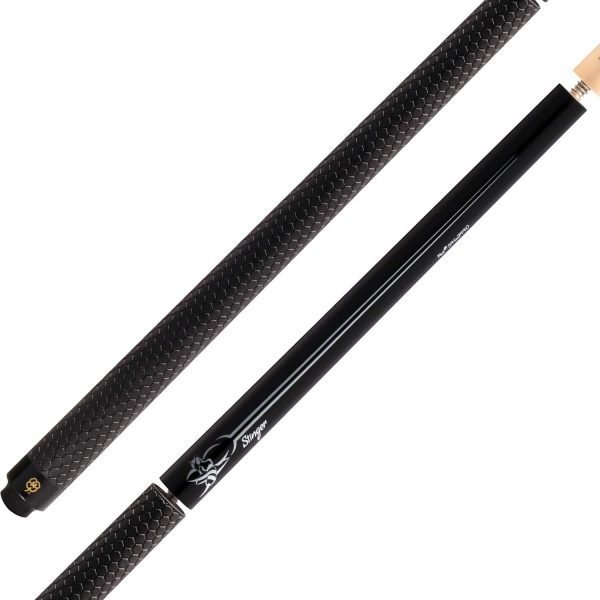
The McDermott NG08 Stinger Break Jump Cue is a USA-made hybrid cue engineered for powerful breaks and controlled jump shots. Featuring patented Stinger technology, a quick-release jump joint, and lifetime warpage warranty coverage, the NG08 delivers measurably efficient energy transfer, consistent cue-ball control, and tournament-ready versatility for APA and BCA league players seeking a single cue that performs both roles without compromise.
The McDermott NG08 Stinger Break Jump Cue is a premium American-made break/jump cue built on patented Stinger technology, which projects a phenolic core through the ferrule to maximize kinetic energy transfer and elevate cue-ball exit speed at contact. Constructed from hard rock maple with a 13.25mm phenolic-enhanced tip, the NG08 achieves explosive break performance and rapid jump-shot conversion through an integrated quick-release joint system.
Against carbon fiber competitors such as the Predator BK Rush, the NG08 distinguishes itself through traditional maple feedback, accessible pricing under $400, and one of the most comprehensive lifetime warranties in the billiards industry — including full warpage protection. The cue is widely trusted by APA and BCA league players who require documented durability, measurable cue-ball control, and multi-function tournament performance from a single investment.
Expert Verdict: The McDermott NG08 Stinger Break Jump Cue offers one of the strongest combinations of break efficiency, jump versatility, and long-term value currently available under $400 — making it a technically sound investment for competitive league players who refuse to compromise between power and precision.
Most pool players eventually face the same strategic limitation: carrying a dedicated break cue and a separate jump cue means managing two investments, two setups, and two points of failure during competition. The McDermott NG08 Stinger Break Jump Cue was engineered specifically to eliminate that compromise.
What separates the NG08 from generic hybrid cues is not simply its dual-function design — it is the patented Stinger technology underlying that design. Rather than treating the break tip and jump joint as independent features bolted onto a standard shaft, McDermott integrated both functions around a unified energy-transfer system. The result is a USA-made cue that competes credibly against premium single-purpose alternatives at a fraction of the combined cost.
Among the best break jump cues USA league players can buy under $400, the NG08 stands out for a reason that goes beyond marketing: it solves a documented engineering problem — energy loss at the tip-ferrule interface — with a patented solution, then extends that solution into a complete competitive instrument.
This McDermott Stinger review examines the NG08’s construction, performance benchmarks, warranty structure, and competitive positioning to give players the information needed to make a confident purchasing decision.
The McDermott NG08 Stinger Break Jump Cue enters a competitive segment populated by cues that claim break power, jump capability, or durability — rarely all three with documented engineering to support each claim. The NG08 is notable precisely because its performance advantages are traceable to specific construction decisions rather than brand positioning.
Three factors define the NG08’s market position:
Patented technology with a measurable mechanism. The Stinger system is not a proprietary name applied to a standard ferrule. It is a documented engineering solution — a phenolic core projected through the ferrule — that reduces energy loss at the critical contact interface. Players can evaluate the mechanism, not just the claim.
Dual-function performance without meaningful compromise. Many hybrid cues sacrifice break efficiency for jump capability or vice versa. The NG08’s quick-release joint system and Stinger tip construction allow both functions to operate at competitive levels independently — not as diluted versions of dedicated single-function cues.
Warranty coverage that addresses real failure modes. Warpage is the most common structural failure in wooden cue shafts. McDermott’s lifetime warranty covers it directly, converting what is typically an unprotected risk into a documented long-term asset for the player.
“The McDermott NG08 Stinger Break Jump Cue succeeds because it improves energy-transfer efficiency rather than simply increasing cue stiffness — a more durable performance gain for players whose break mechanics are already established.”
| Specification | Detail |
|---|---|
| Origin | USA-made (Menomonee Falls, Wisconsin) |
| Shaft Material | Hard rock maple |
| Tip Diameter | 13.25mm |
| Tip Construction | Phenolic-enhanced (Stinger technology) |
| Standard Weight | 19 oz |
| Weight Range | ~18–21 oz (adjustable weight bolt) |
| Joint Type | Quick-release jump joint |
| Warranty | Lifetime, including warpage protection |
| Price Range | Under $400 |
| League Compliance | APA and BCA accepted |
These specifications reflect a cue designed around measurable performance priorities — not cosmetic differentiation. Every core feature of the NG08 serves a defined function in break power, jump conversion, or long-term durability.
The defining feature of the McDermott NG08 is its patented Stinger technology, and understanding how it works separates informed buyers from those purchasing on brand recognition alone.
In a conventional break cue, energy generated by the stroke passes through the shaft, into the ferrule, and finally into the tip before reaching the cue ball. Each material transition in that sequence represents a potential point of energy loss through vibration absorption or deflection. The Stinger system addresses this directly: a phenolic core extends through the ferrule itself, shortening the energy path and reducing transfer loss at the critical moment of contact.
The practical result is a more direct, stiff energy transfer that translates into higher cue-ball exit speed without requiring the player to increase stroke force. For league players whose break mechanics are already established, the Stinger system effectively upgrades the transfer efficiency of an existing stroke rather than demanding a technique overhaul.
The ferrule construction and shaft taper geometry work in concert with the Stinger core to maintain consistent impact efficiency across varying stroke speeds — an important characteristic for players whose break speed fluctuates under match pressure. Unlike low-deflection designs optimized for positional play, the Stinger system is specifically engineered for maximum impact efficiency at the break contact point.
This is the core reason the NG08 merits serious evaluation beyond its price point. The patented Stinger technology represents a documented engineering solution to a real performance problem — not a marketing descriptor applied to a commodity ferrule design.
Break power in pool is not simply a function of raw force. It is a product of energy transfer efficiency, contact precision, and cue-ball control after impact. The McDermott NG08 Stinger addresses all three variables through deliberate construction decisions.
Energy Transfer and Break Speed
The phenolic core extending through the ferrule minimizes vibration absorption at contact, delivering more of the stroke’s generated energy directly into the cue ball. Players consistently report a harder, more authoritative rack spread compared to standard maple-tip break cues at equivalent stroke speeds — an outcome attributable to improved impact efficiency rather than increased cue stiffness.
In nine-ball and ten-ball formats, where rack spread and cue-ball placement after the break directly determine the probability of a continuation run, this efficiency advantage compounds across a match. A break that consistently scatters the rack with controlled cue-ball deflection creates more shot opportunities than a harder break that loses positional control.
Cue-Ball Control and Deflection Management
The 13.25mm tip diameter provides a larger, more forgiving contact surface than the narrower tips found on some dedicated break cues. This translates into improved cue-ball placement consistency after the break — a performance variable that determines position for the first shot, not just rack scatter. Cue-ball deflection patterns are more predictable at this diameter, allowing players to program specific break positions through repetition.
“For most league players, cue-ball control after the break is more valuable than maximum break speed — and the McDermott NG08 Stinger is engineered around exactly that principle.”
Feedback and Break Stroke Mechanics
Hard rock maple transmits tactile feedback more transparently than carbon fiber alternatives. Players who have developed their break stroke mechanics on maple shafts will find the NG08’s response intuitive rather than disorienting, which preserves established stroke timing during competition. The cue’s balance point supports a fluid, full-extension break stroke without the forward-heavy feel that affects some shorter hybrid cues.
For APA and BCA league players, these characteristics combine into a break cue that rewards technical execution rather than substituting raw stiffness for skill.
The McDermott NG08 Stinger’s quick-release jump joint is the mechanical feature that converts a high-performance break cue into a functional jump cue within seconds. Understanding the engineering behind this joint clarifies why not all hybrid cues perform equally in both roles.
Jump shots require a shortened, lighter cue configuration to generate the steep downward angle and controlled follow-through that lift the cue ball over an obstacle ball. A standard full-length break cue is mechanically unsuited for this purpose — its weight distribution, shaft taper, and overall length work against the physics of the jump stroke.
The NG08’s quick-release joint allows the player to detach the butt section and use the shaft alone as a dedicated jump cue, producing the weight, balance point, and cue geometry that effective jump shots demand. This is not a cosmetic feature. It is a functional engineering decision that makes the difference between a cue that technically converts and one that actually performs at a competitive level.
The jump success rate in match play depends heavily on setup speed and mechanical confidence in the converted configuration. A joint that requires prolonged adjustment or produces inconsistent shaft alignment under pressure is a performance liability. The NG08’s quick-release mechanism is designed to eliminate that variable — fast conversion, consistent alignment, reliable performance.
The NG08 remains a leading billiard break cue with jump joint functionality in its price class precisely because that joint system was engineered for match conditions, not just catalog specifications.
One of the most important practical questions surrounding any break cue with phenolic tip construction is league compliance. Solid phenolic tips — which make full contact with the cue ball as a hard, non-compressible surface — are prohibited in many APA and BCA league formats due to concerns about miscue risk, equipment damage, and play consistency.
The McDermott NG08 navigates this restriction through its hybrid tip construction. The Stinger phenolic core extends through the ferrule but does not constitute the full striking surface. The tip itself retains a phenolic-enhanced maple contact layer, which satisfies the American Poolplayers Association and Billiard Congress of America requirements for non-solid phenolic construction while preserving the energy-transfer advantages of the Stinger system.
Players are always advised to verify current equipment rules with their specific league coordinator before tournament use, as regulations can vary by region and format. However, the NG08’s hybrid construction was specifically engineered with league compliance in mind, and it is broadly accepted across APA and BCA play formats — including bar-box eight-ball, nine-ball, and ten-ball competition.
This compliance engineering is a meaningful distinction. A break cue that cannot be used in league competition is a liability, not an asset. The NG08 resolves that conflict by design.
Warranty language in the billiards industry ranges from comprehensive protection to narrow coverage that excludes the most common failure mode in wooden cues: warpage. McDermott’s lifetime warranty for the NG08 is notable precisely because it addresses warpage directly.
McDermott provides lifetime warranty coverage that includes warpage protection under normal playing conditions. For a hard rock maple shaft exposed to humidity fluctuations across different playing environments — league halls, tournament venues, storage conditions — this is the most relevant coverage a player can hold. A warped shaft is functionally unusable, and replacement without warranty coverage represents a significant unplanned cost on a premium instrument.
Maple aging under variable humidity is a documented durability concern with all wooden cues. The NG08’s warranty structure converts that risk into a covered liability, which changes the long-term cost calculation of the investment substantially. Joint wear and tip degradation are maintenance items; warpage is a structural failure. McDermott’s coverage addresses the more serious failure mode.
The warranty structure reflects McDermott’s confidence in the NG08’s construction quality and signals a long-term relationship with the customer rather than a transactional sale.
“The combination of patented Stinger technology, integrated jump functionality, and lifetime warpage coverage creates a value proposition rarely matched below $400 in the break/jump cue category.”
Always review current warranty terms directly with McDermott or an authorized retailer, as specific coverage conditions may be updated.
The Predator BK Rush is the most commonly cited alternative when evaluating the McDermott NG08 Stinger Break Jump Cue, and the comparison is instructive because the two cues represent genuinely different engineering philosophies rather than equivalent products at different price points.
The fundamental difference between the NG08 and carbon fiber break cues like the Predator BK Rush is not simply price — it is the underlying performance model each cue is built around.
Carbon fiber shafts achieve stiffness through material properties: the fiber composite resists deformation at contact, maximizing force transmission at the expense of tactile feedback and shaft flexibility. Maple shafts achieve performance through geometry, tip construction, and — in the NG08’s case — a patented energy-transfer mechanism that compensates for maple’s natural vibration absorption at the ferrule interface.
Predator BK Rush:
McDermott NG08 Stinger:
The core trade-off is clearly defined: players who prioritize absolute maximum break speed and are already comfortable with carbon fiber feedback should evaluate the Predator BK Rush on its merits. Players who prioritize versatility, traditional maple feel, league compliance confidence, long-term warranty protection, and integrated jump functionality will find the McDermott NG08 Stinger Break Jump Cue a more complete competitive instrument at a lower total investment.
Neither cue is universally superior. The correct choice depends on how a player weights those specific performance and value variables — and on whether a second jump cue purchase is acceptable in the overall equipment budget.
Understanding why the Stinger system produces measurable performance gains requires a brief engagement with the physics of break contact — specifically, the relationship between kinetic energy, coefficient of restitution, and impact efficiency at the tip-ferrule interface.
Kinetic Energy and Break Speed
The kinetic energy delivered to the cue ball at contact is determined by cue mass, tip velocity at impact, and the efficiency with which that energy transfers across the contact interface. In a standard maple tip construction, some portion of that energy is absorbed by tip compression and ferrule vibration rather than transferred to the cue ball — a loss that reduces cue-ball exit speed relative to the player’s input force.
Coefficient of Restitution
The coefficient of restitution at the tip-ball interface describes how much energy is retained versus lost in the collision. A harder tip material — such as the phenolic-enhanced construction of the Stinger system — produces a higher coefficient of restitution, meaning more energy is returned into the cue ball’s motion rather than dissipated as heat, sound, or vibration.
Impact Efficiency
The Stinger system’s phenolic core extending through the ferrule reduces the number of material transitions between the shaft’s stored energy and the cue ball. Each transition is a potential loss point. By minimizing those transitions through integrated ferrule construction, the Stinger system improves impact efficiency — the ratio of energy delivered to the cue ball versus energy lost in the contact event.
The practical implication for players is that improved impact efficiency at the tip-ferrule interface produces faster cue-ball exit speed and a more consistent rack spread without requiring the player to generate additional stroke force. The cue does more work per unit of player input — which is the definition of an efficiency gain, not simply a power gain.
The McDermott NG08 Stinger Break Jump Cue is designed for long-term competitive use, and its durability profile reflects construction decisions made with sustained performance — not just initial impressiveness — as the priority.
Maple Aging and Warpage Prevention
Hard rock maple is a dimensionally stable wood species under controlled conditions, but all wooden cues are subject to moisture absorption in high-humidity environments. Over time, inconsistent humidity exposure can introduce curvature along the shaft — warpage — that degrades straight-line accuracy and break consistency.
Players can mitigate warpage risk through deliberate maintenance: storing the cue in a hard case rather than a soft bag, avoiding temperature extremes, and rotating the cue periodically during extended storage to prevent uneven moisture exposure. These practices extend the service life of the shaft between warranty claims and maintain the Stinger system’s alignment geometry.
Joint Wear
The quick-release jump joint is a mechanical component subject to wear over time, particularly under the high-impact stress of repeated break shots. Players should inspect the joint connection regularly for looseness, thread wear, or alignment drift. A joint that does not seat fully and consistently will compromise both break energy transfer and jump-shot accuracy. McDermott’s warranty covers manufacturing defects; normal joint maintenance is the player’s responsibility.
Maintenance Schedule
A practical maintenance approach for the NG08 includes:
Following this schedule preserves the cue’s structural integrity and performance characteristics across years of competitive use.
The McDermott NG08 Stinger Break Jump Cue is specifically engineered for the conditions that define APA and BCA league competition — not controlled testing environments. Understanding how those conditions affect performance clarifies why certain design decisions in the NG08 matter in practice.
Bar-Box Performance
On smaller bar-box tables — the standard format for many APA eight-ball and nine-ball leagues — break power must be calibrated to prevent scratching or driving the cue ball off the table. The NG08’s cue-ball control characteristics are particularly valuable in this context: the 13.25mm tip diameter and Stinger energy-transfer profile produce strong rack spread with more predictable cue-ball deflection patterns than maximum-stiffness carbon fiber alternatives. Players report consistent cue-ball positioning in the center-table zone after the break, which is the target position in most APA bar-box formats.
Tournament Cloth Conditions
Tournament cloth — typically faster, tighter nap — amplifies cue-ball speed and reduces friction-based cue-ball deflection compared to worn recreational table cloth. On tournament surfaces, the NG08’s energy transfer efficiency produces break speeds and rack spread patterns that are noticeably stronger than on recreational cloth. Players transitioning from bar leagues to BCA tournament formats should expect to adjust break speed downward slightly to maintain cue-ball control on faster tournament cloth.
Nine-Ball and Ten-Ball Breaks
In nine-ball, the standard break targets the one-ball at the top of the rack from the side rail, requiring a controlled angle and reliable cue-ball return to the center of the table. In ten-ball, break requirements are similar but with a larger rack that demands more rack spread force to produce a legal open table. The NG08’s adjustable weight system is directly applicable here: heavier configurations favor the additional momentum needed for consistent ten-ball rack spread; lighter configurations suit the precision-oriented nine-ball break.
Jump Shot Frequency in League Play
Jump shots occur less frequently in APA eight-ball than in nine-ball or ten-ball, but when they arise, they are often match-deciding situations. The NG08’s quick-release jump joint allows conversion in competitive time frames without disrupting match flow — a practical advantage that players carrying separate jump cues do not always achieve under pressure.
The McDermott NG08 Stinger includes an adjustable weight bolt system that allows players to configure the cue’s total weight within an approximate range of 18 to 21 ounces, with a standard configuration of 19 ounces.
This feature has practical implications that extend beyond personal preference. Break stroke mechanics are sensitive to cue weight — heavier configurations favor players whose break relies on momentum transfer through a slower, more deliberate stroke, while lighter configurations suit players with faster, more whip-driven break mechanics. The ability to fine-tune this variable without purchasing a different cue allows the NG08 to adapt to evolving technique and changing competitive formats.
The relationship between weight, cue balance point, and break speed is iterative — small changes in weight produce measurable changes in cue-ball exit speed and rack spread consistency for players with established stroke mechanics. The NG08’s adjustable system allows that iteration to occur within a single instrument rather than across multiple cue purchases.
For intermediate players still refining their break mechanics, the adjustable weight system provides a structured testing environment — the ability to isolate cue weight as an independent variable and measure its effect on rack spread and cue-ball placement without changing any other equipment. This is a meaningful long-term advantage that fixed-weight competitors cannot offer.
Yes — for the right player. The McDermott NG08 Stinger Break Jump Cue is worth buying for competitive league players seeking a dual-purpose cue with patented energy-transfer technology, integrated jump-shot capability, and lifetime warpage coverage at a price below most premium single-function competitors.
The value proposition holds specifically because the NG08 does not require a companion jump cue purchase to remain competitive. A player who would otherwise budget for both a dedicated break cue and a separate jump cue can invest in the NG08 and allocate the difference toward accessories, practice time, or league fees — all of which return more competitive value than redundant equipment.
The cue is worth buying when the player matches the instrument’s design intent: established break mechanics on maple shafts, regular APA or BCA league competition, preference for cue-ball control alongside break power, and commitment to a long-term equipment investment protected by a lifetime warranty.
It is not worth buying as an entry-level cue for beginners, as a replacement for players already committed to carbon fiber shaft performance, or as a secondary instrument for players whose primary cue already handles both break and jump duties effectively.
The McDermott NG08 Stinger Break Jump Cue is best suited for a specific type of player — and being precise about that fit prevents both over-recommendation and under-recommendation.
The NG08 is the right investment for:
Who Should Avoid This Cue
The NG08 is not the optimal choice for every player, and intellectual honesty about those limitations strengthens rather than undermines the recommendation for those it does suit.
This specificity is intentional. The NG08 is a high-performance instrument that rewards players who are ready to use its capabilities — not a universal solution marketed as suitable for every situation equally.
Executing effective jump shots with the McDermott NG08 requires understanding how the quick-release joint changes the cue’s physical characteristics — not just its length. The converted jump configuration has a different balance point, a lighter overall feel, and a shorter effective stroke path than the full break cue setup. Adjusting for these differences is the foundation of consistent jump performance.
Step 1: Convert the cue. Detach the butt section using the quick-release joint to create the shortened jump cue configuration. Confirm the joint is fully released and the shaft tip is secure before play. An improperly seated shaft will produce inconsistent contact and unreliable jump trajectories.
Step 2: Establish cue angle. Position the cue at approximately 30 to 45 degrees above the table surface. Steeper angles generate more lift but reduce distance control; shallower angles favor distance but require greater precision on the downstroke. Most league jump situations fall within the 35 to 40-degree range.
Step 3: Aim at the lower half of the cue ball. Contact below center generates the lift needed for the cue ball to clear an obstacle. Contact at center or above will drive the cue ball into the table surface rather than elevating it — a common error among players new to jump shots.
Step 4: Execute a firm, controlled downstroke. The jump stroke is not a power stroke — it is a precision stroke. Accelerate the cue downward through the cue ball using a compact, controlled motion rather than a full follow-through swing. The Stinger system’s impact efficiency supports a responsive jump stroke without requiring excessive force.
Step 5: Calibrate distance through practice. Jump shots at varying obstacle distances behave differently as cue angle and stroke force interact with the NG08’s specific weight and balance profile in jump configuration. Deliberate practice across a range of distances — not just the most common league scenario — builds the mechanical fluency needed for reliable match performance.
The Stinger technology’s energy transfer efficiency applies in jump configuration as well as break configuration, producing a responsive, predictable jump stroke that intermediate players can develop quickly with systematic practice.
The McDermott NG08 Stinger’s patented tip construction creates a specific maintenance consideration that distinguishes it from standard break cue service: the phenolic Stinger core extends through the ferrule, and improper tip replacement can permanently damage that core.
Standard tip replacement techniques — aggressive sanding, power tools, or excessive heat application — risk compromising the Stinger system’s structural integrity at the ferrule interface. Because the Stinger core is the primary performance mechanism of the cue, damage at this point degrades the impact efficiency that defines the NG08’s performance advantage over conventional break cues.
Professional installation by a qualified cue technician or authorized McDermott service center is strongly recommended for all tip replacement on the NG08. Players who attempt self-replacement without a thorough understanding of the Stinger core’s ferrule construction risk voiding warranty coverage and permanently diminishing the cue’s performance characteristics.
This is not a significant operational burden — tip replacement on a break cue is an infrequent maintenance event relative to the cue’s service life — but it is essential information for any player making a long-term investment in the NG08. Budget for professional tip service when evaluating the cue’s total cost of ownership.
The NG08 uses patented Stinger technology that projects a phenolic core through the ferrule, reducing energy loss at the point of contact and delivering more efficient kinetic transfer into the cue ball. This produces higher cue-ball exit speed and more consistent rack spread without requiring increased stroke force — a measurable performance advantage over conventional tip-and-ferrule construction at this price point.
Yes. The NG08 is broadly accepted in APA and BCA league formats because its hybrid phenolic/maple tip construction does not constitute a solid phenolic striking surface — the category restricted by most league equipment rules. Players should confirm current equipment regulations with their specific league coordinator before tournament use, as rules can vary by region and format.
Yes. The quick-release jump joint enables fast, reliable conversion from full break cue to shortened jump cue configuration during competitive play, making the NG08 a functionally complete dual-purpose instrument — not simply a break cue with a joint.
The standard configuration is 19 ounces. The adjustable weight bolt system allows customization within an approximate range of 18 to 21 ounces to match individual break stroke mechanics and competitive format requirements.
Yes. McDermott’s lifetime warranty includes warpage protection under normal playing conditions — coverage that directly addresses the most consequential structural failure mode in wooden cue shafts and converts a common unprotected risk into a documented long-term asset.
The NG08 offers traditional maple feedback, integrated jump functionality, accessible pricing under $400, and lifetime warpage coverage. The Predator BK Rush emphasizes carbon fiber stiffness and maximum break speed output as a dedicated single-function break cue at a higher price point. The correct choice depends on whether versatility and warranty protection or absolute break power represents the player’s primary competitive priority.
Yes, but professional installation is strongly recommended. The patented Stinger phenolic core extends through the ferrule and can be damaged by improper replacement techniques — including aggressive sanding or heat application — potentially compromising both performance and warranty coverage.
Yes — specifically for intermediate players who have developed consistent break mechanics on maple shafts and are ready to optimize energy transfer efficiency and add jump-shot capability without purchasing separate equipment. It is not recommended as a first break cue for players still developing fundamental stroke consistency, as the Stinger system amplifies an existing stroke rather than teaching one.
The McDermott NG08 Stinger Break Jump Cue earns its position in the competitive market not through premium pricing or brand prestige alone, but through a coherent engineering argument backed by documented construction decisions: patented Stinger technology solves a real energy-transfer problem, the quick-release jump joint solves a real versatility problem, and the lifetime warpage warranty solves a real long-term investment risk — all within a single USA-made instrument priced under $400.
For APA and BCA league players who compete regularly in nine-ball, ten-ball, and eight-ball formats, who value maple feedback and break stroke predictability, and who want documented warranty protection on a multi-year equipment commitment, the NG08 represents one of the most complete value propositions currently available in the break/jump cue category.
It is not the highest break-speed cue on the market. It is something more practically useful for most competitive players: a technically sound, versatile, warrantied instrument that performs its dual function without meaningful compromise in either role — and that protects the investment behind it with coverage the billiards industry rarely matches at this price point.
Players who understand what the McDermott NG08 Stinger Break Jump Cue was engineered to do — and whose game matches that design intent — will find it a reliable, durable competitive asset across years of league and tournament play.
| Weight | 18oz, 19oz, 20oz, 21oz |
|---|


Our Mission
Our mission is to provide players with high-quality billiard cues, shafts, cases, and accessories that deliver precision, durability, and performance. We aim to be a trusted destination for pool players across the USA looking for reliable equipment to improve their game and enjoy billiards at every level. 🎱
Reviews
There are no reviews yet.