| Specification | Detail |
|---|---|
| Tip | Patented one-piece phenolic tip and ferrule |
| Tip Diameter | 13.25mm |
| Shaft | Hard rock maple |
| Joint | 3/8″-10 wood-to-wood |
| Weight Range | 19–21 oz |
| Wrap | Textured sport wrap |
| League Legal | APA and BCA approved |
| Warranty | Lifetime (McDermott) |
| Price Range | Under $500 |
| Tip Hardness | Shore D scale (high-hardness rating) |
$480.00

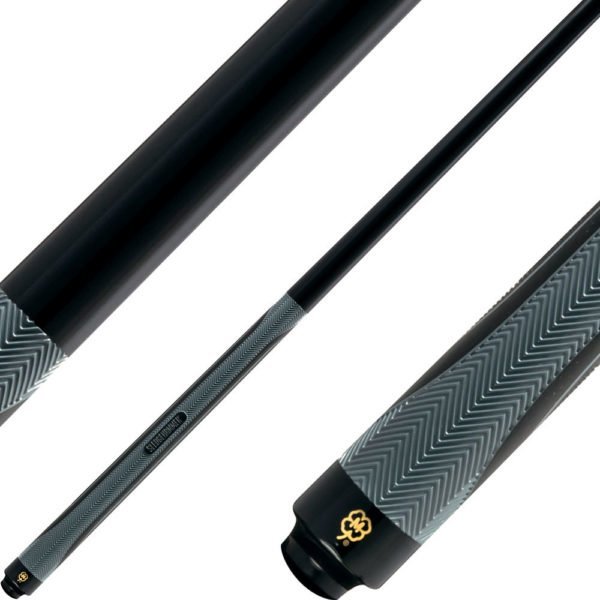
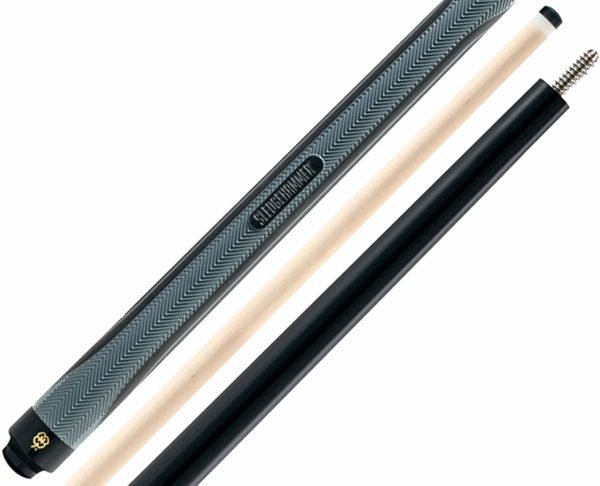
The McDermott Sledgehammer SH1 Break Cue is a dedicated break cue featuring a patented one-piece phenolic tip and ferrule, hard rock maple shaft, and 3/8″-10 wood-to-wood joint. Designed for maximum kinetic energy transfer, it delivers exceptional rack dispersion, league-legal performance, and long-term durability for competitive players seeking the best phenolic tip break cue under $500.
Not every break cue earns a reputation. Most are forgotten after a few seasons of league play, replaced by whatever promises more pop or costs less. The McDermott Sledgehammer SH1 is different.
Built on the legacy of Mike Gulyassy’s original Sledgehammer design and refined through McDermott Cue Manufacturing’s decades of production expertise, the SH1 occupies a rare position in the market: a break cue that delivers measurable, repeatable power without requiring a carbon fiber price tag. It is not a cue marketed on hype. It is engineered on physics.
For competitive players who need a league-legal, high-performance break cue that holds up under real-world use, the McDermott Sledgehammer SH1 Break Cue deserves serious consideration. This review examines every meaningful specification, explains the engineering decisions behind them, and positions the SH1 honestly against the alternatives.
The Sledgehammer break cue did not begin on a factory floor. It began with a problem that serious pool players had been unable to solve: how to convert a human break stroke into maximum rack dispersion without sacrificing control or legality.
Mike Gulyassy, a custom cue builder with deep roots in competitive billiards, developed the original Sledgehammer design around a core insight that most cue manufacturers had overlooked. The limiting factor in break cue performance was not the player’s stroke speed — it was energy dissipation at the contact point. Conventional leather tips, regardless of how hard the player broke, absorbed a measurable portion of the stroke’s kinetic energy before it ever reached the cue ball. Gulyassy’s solution was to engineer the tip and ferrule system around phenolic resin, a material hard enough to eliminate that compression loss almost entirely.
The original Sledgehammer developed a following among serious league and tournament players who reported immediate, tangible improvements in rack spread after switching from conventional break cues. Word spread through APA and BCA circuits, and the cue’s reputation grew faster than Gulyassy’s custom production could scale.
McDermott Cue Manufacturing, one of America’s most established billiards equipment producers and based in Menomonee Falls, Wisconsin, recognized both the performance validity of the Sledgehammer concept and the commercial opportunity it represented. The licensing transition brought Gulyassy’s design philosophy into McDermott’s production environment — standardizing tolerances, implementing quality control infrastructure, and adding the lifetime warranty protection that custom work cannot provide. Critically, the transition preserved the foundational engineering principle: maximum energy transfer through a hardened, integrated contact system.
The McDermott Sledgehammer SH1 is the direct production descendant of that original design. It represents not just a manufactured version of a custom cue, but a maturation of the concept — refined by production experience, validated by competitive use, and backed by institutional manufacturer support.
“The Sledgehammer concept was never about novelty. It was about solving a real physics problem that leather-tipped break cues could not solve. McDermott took that solution and made it accessible at scale.”
Understanding the McDermott SH1 specs requires looking beyond the numbers. Each specification reflects a deliberate engineering decision with direct performance consequences.
| Specification | Detail |
|---|---|
| Tip | Patented one-piece phenolic tip and ferrule |
| Tip Diameter | 13.25mm |
| Shaft | Hard rock maple |
| Joint | 3/8″-10 wood-to-wood |
| Weight Range | 19–21 oz |
| Wrap | Textured sport wrap |
| League Legal | APA and BCA approved |
| Warranty | Lifetime (McDermott) |
| Price Range | Under $500 |
| Tip Hardness | Shore D scale (high-hardness rating) |
Key Technical Facts for Reference:
These McDermott SH1 specs place it among the most structurally sound heavy break pool cues available at this price point, competing directly with break cues that cost significantly more.
The SH1’s power output is not a product of marketing language. It is the result of three converging engineering decisions that collectively minimize energy dissipation and maximize forward kinetic force at the moment of rack contact.
To understand what the SH1 does differently, it helps to understand how break shot physics actually work.
When a player executes a power break, kinetic energy travels from the body through the arm, into the grip, down the cue shaft, across the joint, and finally into the cue ball. That cue ball impact then distributes energy throughout the rack, determining rack dispersion. Every transition point in that chain — every material interface, every seam, every compression layer — represents a site of potential energy dissipation.
Energy dissipation occurs in three primary ways during a break shot:
The SH1 addresses all three directly. Its phenolic tip eliminates impact compression. Its wood-to-wood joint minimizes material-mismatch scatter. Its hard rock maple shaft provides the stiffness profile necessary to limit lateral energy loss during the power break stroke.
Break efficiency — defined as the percentage of stroke kinetic energy that successfully transfers into cue ball forward momentum — is the true metric of break cue performance. The SH1 is engineered to maximize that percentage at every structural level.
A properly executed break with the SH1 produces predictable cue ball behavior. Center-ball hits generate strong forward momentum into the rack with controlled cue ball squat, allowing players to manage cue ball position after the break. The stiffness of the phenolic tip means break speed translates more directly into rack spread than with softer alternatives, making the SH1 particularly effective for players whose break strategy prioritizes maximum rack separation over precise cue ball placement.
“The McDermott Sledgehammer SH1 remains one of the few wood-shaft break cues capable of delivering near carbon-fiber break power while maintaining traditional maple feedback — a combination that is genuinely difficult to achieve at any price point.”
The defining feature of the pool break cue with patented tip ferrule design is the SH1’s integrated one-piece phenolic tip and ferrule system. This is the feature that most directly separates the SH1 from competitors in the heavy break pool cues category.
The distinction between phenolic and leather tip performance is not subjective. It is measurable, and the mechanism is straightforward.
Leather tips are porous and compressible. On high-force contact, a leather tip deforms — sometimes by several millimeters — absorbing kinetic energy through compression before that energy can fully transfer to the cue ball. This compression is actually valuable in a playing cue, where it contributes to spin control, touch, and cue ball manipulation. In a break cue, it is a liability.
Phenolic resin is non-porous and rated at the high end of the Shore D hardness scale — the industry standard for measuring the hardness of polymers and rubber compounds. At phenolic hardness levels, the tip deforms negligibly on impact. Instead of absorbing energy through compression, it deflects the full force of the stroke into the cue ball. The practical result is a measurably faster cue ball at the moment of rack contact, and greater energy available for rack dispersion.
Phenolic vs. Leather: Performance Comparison
| Factor | Phenolic Tip | Leather Tip |
|---|---|---|
| Impact compression | Minimal | Significant |
| Energy transfer efficiency | High | Moderate |
| Chalk retention | Requires maintenance | Natural |
| Durability under power breaks | Excellent | Moderate |
| Spin/touch control | Limited | Excellent |
| Best application | Break cue | Playing cue |
The SH1 advances the phenolic tip concept further by eliminating the seam between tip and ferrule. Conventional break cues with phenolic tips retain a structural joint at the tip-ferrule interface — a seam that can loosen under repeated high-force impact and introduce micro-deflections that scatter energy laterally. By molding tip and ferrule as a single integrated unit, McDermott removes that failure point entirely.
“The SH1’s patented one-piece phenolic tip and ferrule eliminates a common energy-loss point found in conventional break cue construction — and does so permanently, not just at the time of purchase.”
This is what makes the SH1 the best phenolic tip break cue at its price point: not just the material choice, but the structural integration that makes that material choice last.
Carbon fiber shafts dominate conversation in high-performance billiards equipment. They are stiffer, lighter, and engineered to reduce cue ball deflection with precision. For a playing cue, those properties translate directly into shot-making accuracy. For a break cue, the calculation is different.
The McDermott SH1 uses a hard rock maple shaft — the same wood that has served as the standard for quality American pool cues for over a century. The choice is deliberate and defensible.
Hard rock maple provides a natural stiffness profile that suits high-force break shots. It transmits vibration feedback to the player’s hand in a way carbon fiber does not, allowing experienced players to calibrate their stroke and adjust timing based on feel. The shaft taper of a quality maple break cue is engineered to provide structural rigidity through the break stroke while preserving enough flex to absorb impact stress before it reaches the joint.
For break cue applications, where repeatability and raw power take priority over low-deflection accuracy, maple’s mechanical properties are well-matched to the task. There is also a practical durability argument: hard rock maple is a proven material with well-understood tolerances that resists warping under proper care and maintains its performance characteristics across years of regular use.
“Players who have spent years developing break stroke mechanics calibrated to wood feedback often report that carbon fiber break cues require a measurable adjustment period. For players invested in maple shaft feel, the SH1 eliminates that variable entirely — and does not ask them to pay a premium for the privilege.”
The SH1’s 3/8″-10 wood-to-wood joint is a considered engineering choice, not a default. Metal-to-wood and metal-to-metal joints are common in modern pool cues and offer advantages in playing cues, where a crisper, more isolated hit feel may be desirable. In a break cue, that same crispness can translate into harsher vibration and reduced energy coherence at the moment of impact.
A wood-to-wood joint creates a more unified energy pathway from butt to tip. Because both surfaces at the joint share the same material, the transition is mechanically consistent. Energy does not encounter the resistance differential that occurs when wood meets metal under high-force impact. The result is a hit that feels solid rather than sharp — and that directs more of the stroke’s kinetic energy into forward motion rather than dissipating it as vibration.
The 3/8″-10 thread specification is a standard pool cue joint size, which also means shaft replacement and compatibility with aftermarket components remain practical options across the cue’s lifetime.
The SH1 is available in weights ranging from 19 to 21 ounces, covering the practical spectrum for competitive break cue use. This range reflects the core physics of break shot mechanics: heavier cues carry more momentum at a given stroke speed, but they also require more physical effort to accelerate efficiently through the break stroke.
A 19-ounce configuration favors players with faster, more compact break strokes, where cue speed at contact is the primary energy variable. A 21-ounce configuration favors players with longer, more controlled strokes who rely on mass and momentum to drive rack dispersion. Both approaches can produce effective power breaks — the correct weight depends on how the player generates force, not on which number is theoretically larger.
Expert Take: There is no universally correct break cue weight. The optimal choice depends on the player’s physical build, stroke mechanics, and break style. Players who are unsure should begin at 19–20 ounces and adjust based on rack spread results and physical comfort over extended play.
The McDermott Sledgehammer SH1 is fully approved for competition under both American Poolplayers Association (APA) and Billiard Congress of America (BCA) equipment regulations. This is a non-trivial consideration.
Some high-performance break cues incorporate features — tip hardness beyond permitted specifications, unauthorized shaft materials, or non-standard joint configurations — that disqualify them from sanctioned competition. The SH1 was designed with compliance as a baseline requirement, not an afterthought. For league players who compete regularly under APA or BCA rules, that legal status removes a practical barrier that affects every match.
McDermott break cues warranty coverage on the SH1 is lifetime — one of the strongest manufacturer guarantees in the break cue category. Under that warranty, McDermott covers defects in materials and workmanship for the life of the cue, with no expiration date and no performance degradation clause.
This matters more for break cues than for playing cues. Break cues sustain significantly higher mechanical stress with every use: repeated high-force impacts, accelerated tip and ferrule wear, and greater joint stress than a standard playing cue experiences in normal use. A lifetime warranty from an established manufacturer signals genuine confidence in construction quality — and provides long-term protection that helps justify the SH1’s position as a primary break tool rather than a disposable accessory.
McDermott’s Menomonee Falls, Wisconsin manufacturing base and decades of production history reinforce that warranty’s practical value. A lifetime guarantee is only meaningful if the company backing it remains in business to honor it.
Phenolic tips are lower maintenance than leather, but they are not maintenance-free. Because phenolic resin is non-porous, chalk does not adhere as readily to the surface. Over time and repeated use, the tip face can glaze — a condition where the contact surface becomes too smooth to hold chalk consistently, increasing miscue risk on off-center break shots.
Proper maintenance protocol:
Most performance problems with phenolic break cues trace back to a small number of avoidable errors:
Over-chalking: Phenolic tips require less chalk than leather. Applying chalk with the same pressure used on a leather tip can actually create chalk buildup that reduces rather than improves grip on the cue ball surface.
Poor tip maintenance: Neglecting to scuff the tip surface allows glazing to develop. A glazed phenolic tip dramatically increases miscue frequency on break shots — the worst possible moment for a miscue to occur.
Excessive weight selection: Players who select a break cue weight beyond what their stroke mechanics can efficiently accelerate generate less cue ball speed than players using a lighter cue matched to their natural stroke. More weight does not automatically produce more power.
Off-center contact: A phenolic tip’s low compression means it is less forgiving of contact errors than a leather tip. Break shots that miss center ball by even a small margin produce less effective energy transfer and unpredictable cue ball behavior.
Because the SH1 uses an integrated one-piece tip and ferrule, players do not face the conventional risk of tip separation at the ferrule seam. However, surface maintenance remains necessary to sustain consistent chalk retention across extended use.
The SH1’s sustained popularity among competitive league and tournament players reflects a straightforward value proposition: it solves the right problem, at the right price, with documentation behind it.
Among the heavy break pool cues available under $500, few combine a patented tip system, manufacturer warranty, and proven league legality in a single package. Players who switch to the SH1 from conventional leather-tipped break cues consistently report improved rack spread — not because the cue adds power to their stroke, but because it stops wasting the power their stroke already generates.
The SH1’s reputation has grown through competitive use rather than advertising. APA and BCA league players who break regularly recognize the difference between a cue that performs and a cue that merely promises to. The Sledgehammer SH1 has built its following by delivering consistent, measurable improvements in break efficiency for players across a wide range of skill levels and physical builds.
The comparison between the McDermott Sledgehammer SH1 Break Cue and the Predator BK Rush is the most common head-to-head evaluation in this market segment — and it is a genuinely useful comparison because these cues represent different engineering philosophies rather than simply different price points.
McDermott Sledgehammer SH1:
Predator BK Rush:
The decisive distinction: The Predator BK Rush prioritizes cue ball control and low deflection — properties most valuable to players who need precise cue ball placement after the break. The McDermott Sledgehammer SH1 Break Cue prioritizes raw energy transfer and rack dispersion power — properties most valuable to players whose break strategy centers on maximum rack separation and break speed.
Neither cue is objectively superior. The correct choice depends on what the player’s break game actually demands.
The McDermott Sledgehammer SH1 Break Cue earns its reputation through engineering clarity rather than marketing claims. Its patented one-piece phenolic tip and ferrule eliminates a structural failure point that costs conventional break cues measurable performance with every shot. Its hard rock maple shaft and 3/8″-10 wood-to-wood joint create a coherent energy pathway that converts stroke power into rack dispersion with documented efficiency. Its APA and BCA legality, combined with lifetime McDermott break cues warranty coverage from one of America’s most established manufacturers, make it a low-risk, high-reward investment for the right player.
Among pool break cues with a patented tip ferrule system at this price point, no competing product offers the same combination of proven lineage, structural innovation, and institutional backing. The Mike Gulyassy Sledgehammer concept was built to solve a real physics problem. McDermott’s production version of that concept solves it consistently, repeatedly, and at a price that does not require players to choose between quality and accessibility.
For power-oriented league players, tournament competitors, and anyone seeking the best phenolic tip break cue under $500, the McDermott Sledgehammer SH1 remains one of the most defensible equipment choices in competitive billiards — a cue built on physics, validated by competition, and designed to perform break after break for as long as the game is played.
The McDermott Sledgehammer SH1 Break Cue is a dedicated break cue engineered for maximum kinetic energy transfer. It features a patented one-piece phenolic tip and ferrule, a hard rock maple shaft, and a 3/8″-10 wood-to-wood joint designed to deliver explosive rack dispersion with consistent, repeatable performance across APA and BCA competition.
Yes. The SH1 is fully compliant with both American Poolplayers Association and Billiard Congress of America equipment regulations and is approved for use in sanctioned league and tournament competition without modification.
The SH1’s patented one-piece phenolic tip and ferrule eliminates the seam between tip and ferrule found in conventional break cue construction. By removing that structural joint, McDermott increases break efficiency, eliminates the most common tip separation failure point, and improves shot-to-shot consistency under high-force impact.
The McDermott SH1 features a 13.25mm one-piece phenolic tip and ferrule, hard rock maple shaft, 3/8″-10 wood-to-wood joint, 19–21 oz weight range, textured sport wrap, and lifetime manufacturer warranty. It is APA and BCA approved and priced under $500.
The McDermott Sledgehammer SH1 prioritizes raw energy transfer and rack dispersion power through a maple shaft and patented phenolic tip system. The Predator BK Rush emphasizes low deflection and cue ball control through carbon fiber shaft technology. The SH1 delivers superior value at its price point; the BK Rush targets players who prioritize precision cue ball placement after the break.
The McDermott Sledgehammer SH1 is available in weights from 19 to 21 ounces. Heavier configurations favor players with controlled, mass-driven break strokes; lighter configurations suit players with faster, speed-driven stroke mechanics. Players unsure of their optimal weight should begin at 19–20 ounces and adjust based on rack spread results.
Yes. Phenolic tips require periodic light scuffing to maintain chalk retention, as the non-porous surface glazes with repeated use. Consistent chalk application and occasional tip surface abrasion are sufficient to preserve performance. The SH1’s integrated one-piece design eliminates tip separation risk, but surface maintenance remains necessary for consistent break efficiency.
For players who prioritize power, durability, league legality, and long-term value, the McDermott Sledgehammer SH1 Break Cue is one of the most structurally sound break cues available under $500. Its lifetime warranty, patented tip system, and proven competitive performance make it the best phenolic tip break cue at its price point — and a defensible primary break cue investment for serious players.
| Weight | 18oz, 19oz, 20oz, 21oz |
|---|


Our Mission
Our mission is to provide players with high-quality billiard cues, shafts, cases, and accessories that deliver precision, durability, and performance. We aim to be a trusted destination for pool players across the USA looking for reliable equipment to improve their game and enjoy billiards at every level. 🎱
Reviews
There are no reviews yet.