
$510.00

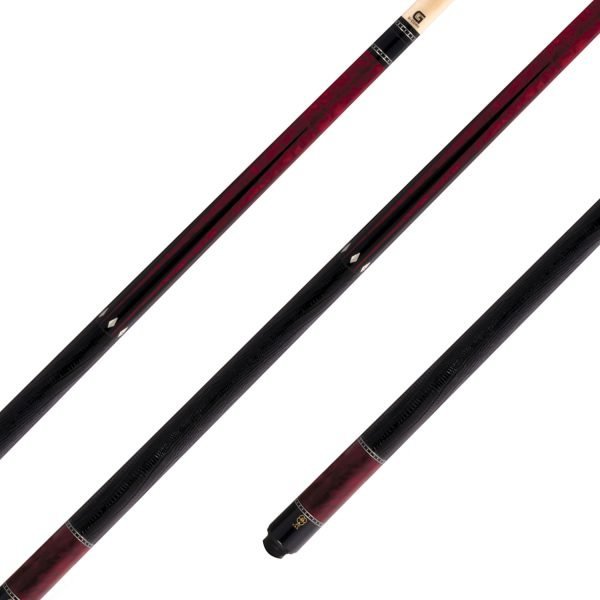
The McDermott G428 Pool Cue is an American-made performance cue featuring the G-Core low-deflection shaft, a 3/8″-10 wood-to-wood joint, Birdseye Maple construction, and a lifetime warpage warranty. Engineered for serious league competitors, it bridges the gap between traditional maple feel and modern shaft consistency — delivering controlled cue-ball response, improved humidity resistance, and predictable deflection characteristics without requiring a transition to full carbon fiber.
The McDermott G428 Pool Cue is a mid-tier premium cue engineered for intermediate and advanced APA and BCA players who demand low-deflection performance without abandoning the tactile feedback of a wood-based shaft. Manufactured in Menomonee Falls, Wisconsin by McDermott Cue Mfg., the G428 is built on a G-Core shaft with internal carbon fiber stabilization — a hybrid construction that improves radial consistency, reduces cue-ball deflection, and resists humidity-driven warpage. Standard appointments include a Tiger Everest medium tip, Birdseye Maple construction, Recon Ebony accents, and a 3/8″-10 wood-to-wood joint. For players competing in humid climates or high-volume league environments, the G428’s combination of durable shaft engineering and McDermott’s lifetime warpage warranty makes it one of the most defensible investments in the sub-$600 American-made cue category.
Decision Summary: The McDermott G428 is a hybrid low-deflection cue designed for intermediate and advanced league players who want measurably improved cue-ball control, humidity resistance, and stroke feedback — without committing to the mechanical trade-offs of a full carbon fiber shaft system.
McDermott G428 Pool Cue – Short Specs
- Model: McDermott G428
- Brand: McDermott Cue Mfg. (USA)
- Series: G-Series
- Shaft: G-Core (maple + carbon fiber core)
- Tip: Tiger Everest Medium (13mm)
- Joint: 3/8″-10 wood-to-wood
- Weight: 19 oz standard (adjustable 18–21 oz)
- Wrap: Irish Linen
- Forearm: Birdseye Maple with Recon Ebony & turquoise accents
- Deflection: Low to moderate (hybrid LD shaft)
- Warranty: Lifetime (includes warpage)
- Use Case: APA / BCA league play, intermediate–advanced players
- Price Range: ~$550 USD
The McDermott G428 occupies a specific and underserved position in the performance cue market: it is neither a traditional solid maple shaft nor a full carbon fiber instrument. Instead, the G-Core shaft uses internal carbon fiber stabilization to reduce cue-ball squirt and improve radial consistency while preserving the maple resonance characteristics that players trained on wood shafts rely on for stroke feedback and shot alignment correction.
Unlike full carbon fiber shafts — which many intermediate players find tonally flat and mechanically unforgiving during tip compression — the G-Core shaft maintains a natural hit feel through the taper transition. The shaft’s taper engineering reduces english application variance at contact, producing more consistent cue-ball behavior on cut shots without requiring players to recalibrate their stroke calibration consistency from a wood baseline.
This makes the G428 particularly effective for APA and BCA league players moving up from entry-level maple cues who want measurable deflection improvement without rebuilding their entire mechanical approach to the game.
League play imposes conditions that expose the structural weaknesses of lower-tier cues: inconsistent table speeds, varying cloth conditions, high shot volume per session, and — particularly in Texas and Gulf Coast markets — elevated ambient humidity that accelerates warpage and degrades shaft geometry over a competitive season.
The G428 addresses each of these variables through deliberate engineering choices rather than cosmetic upgrades.
The G-Core shaft’s internal carbon fiber stabilization resists the moisture absorption that causes solid maple shafts to swell, lose radial consistency, and develop english application variance across a multi-month league schedule. McDermott’s lifetime warpage warranty reinforces this reliability claim with a manufacturer guarantee that holds meaningful financial value when equipment consistency directly affects performance outcomes in weekly APA or BCA formats.
The 3/8″-10 wood-to-wood joint contributes stroke calibration consistency that steel or phenolic joint systems suppress by dampening vibration transfer. For league players who read cue-ball contact by feel — particularly on draw shots, extreme english applications, and long rail position shots — this feedback channel is a tactical advantage. The Tiger Everest medium tip’s layered leather construction maintains consistent tip compression across extended play sessions, reducing the mushrooming and spin transfer inconsistency that single-layer soft tips develop under high-volume use.
At the table-speed adaptation level, the G428’s weight bolt system — adjustable from 18oz to 21oz — allows players to recalibrate stroke feel between slower bar-box cloth and faster tournament felt without changing equipment.
Understanding where the G428 excels — and where it reaches its performance ceiling — is the most efficient framework for matching the cue to the right player.
Hybrid shaft performance. The G-Core shaft delivers measurable cue-ball squirt reduction over solid maple while preserving the maple resonance characteristics and stroke feedback that wood-trained players depend on. This is the G428’s defining competitive advantage over both entry-level and full carbon fiber alternatives at this price point.
Lifetime warpage warranty. McDermott’s warranty explicitly covers shaft and butt warpage through authorized dealers — a protection that holds compounding value for players in high-humidity regions where solid maple shafts typically require replacement or refinishing within two to three competitive seasons.
Upgrade compatibility. The butt section accepts the McDermott Defy carbon fiber shaft via the 3/8″-10 joint specification, allowing players to access maximum deflection reduction technology without replacing the entire cue. This forward compatibility extends the G428’s effective performance ceiling beyond its initial purchase price.
Weight adjustability. The internal weight bolt system supports an 18oz to 21oz range without tools or additional purchase — a practical advantage for players adapting to different table speeds or transitioning between game formats mid-season.
Domestic manufacturing. Handcrafted in Menomonee Falls, Wisconsin with verifiable quality control at each production stage, the G428 carries the traceable manufacturing standards that most imported cues in this price tier cannot match.
Aesthetic distinction. The turquoise inlay pool cue design with Birdseye Maple construction and Recon Ebony accents produces a visually distinctive cue in a market segment dominated by conservative cosmetic choices — relevant for players who value equipment identity at the table.
Not a maximum deflection reducer. Players whose primary performance metric is raw cue-ball squirt reduction will find the Predator Revo, McDermott Defy, and Cuetec Cynergy outperform the G-Core shaft on that single variable. The G428’s hybrid design is a deliberate compromise, not a performance ceiling failure.
Not optimized for break shots. The Tiger Everest medium tip and G-Core shaft are calibrated for shot-making precision, not maximum power transfer. Players using a single cue for both breaking and running will accelerate tip wear and subject the joint to stress beyond the cue’s design parameters.
Not ideal for beginners. The G428’s performance advantages become accessible only after a player develops consistent stroke mechanics and can reliably apply english and execute cut shots with repeatable technique. Beginners investing at this price point before developing fundamentals will not yet extract the cue’s differentiated value.
Moderate secondary market liquidity. While the G428 retains value better than most cues in its tier, the used market for mid-range McDermott cues is smaller than for Predator equivalents, which can extend time-to-sale on the secondary market.
The answer depends entirely on what a player optimizes for. Full carbon fiber shafts — including the McDermott Defy, Predator Revo, and Cuetec Cynergy — represent the current performance ceiling for deflection reduction, dimensional stability, and moisture immunity. For players whose stroke mechanics are fully developed and who prioritize maximum cue-ball precision above all other variables, carbon fiber is the objectively superior shaft category.
The McDermott G428’s G-Core shaft does not match full carbon fiber in raw squirt reduction. What it delivers instead is a more complete performance profile for the majority of competitive league players: reduced cue-ball squirt relative to solid maple, preserved stroke feedback through the wood-to-wood joint, natural tip compression feel from the Tiger Everest medium tip, and maple resonance characteristics through the taper transition that players depend on for draw shot depth calibration and speed control on long rail shots.
Carbon fiber shafts require players to actively suppress the feedback they previously used for stroke calibration — a recalibration period that can span months of competitive play. The G-Core shaft eliminates this transition cost by maintaining familiar wood-based feedback while delivering meaningful deflection improvement. For intermediate players still developing shot consistency, or experienced players who have built their mechanical foundation around wood shaft feedback, the G428 offers a more appropriate and immediately productive performance match than carbon fiber.
“The McDermott G428 succeeds because it avoids the biggest weakness of many modern low-deflection cues: excessive rigidity. Its G-Core shaft preserves traditional maple resonance and stroke feedback while stabilizing cue-ball response under high-spin shots — a balance that full carbon fiber shafts at this price point rarely achieve without demanding a significant stroke recalibration investment from the player.”
Comparing the McDermott G428 directly to Predator cues in the same price tier requires separating shaft-level deflection performance from total cue investment value.
Predator’s shaft lineup — particularly the 314³ and Revo carbon fiber — is engineered around measurable deflection reduction as the primary performance variable. The Revo outperforms the G-Core in raw cue-ball squirt reduction. However, Predator cues at the G428’s price point typically pair performance shafts with butts offering fewer customization options, no equivalent warpage warranty structure, and no internal weight adjustment system.
The G428’s documented competitive advantages over similarly priced Predator options include: domestic manufacturing with traceable quality control in Menomonee Falls, Wisconsin; a lifetime warranty explicitly covering warpage; a weight bolt system adjustable between 18oz and 21oz without additional purchase; and butt compatibility with both the G-Core and Defy shaft systems, providing two distinct performance profiles from a single investment.
Where Predator maintains a clear advantage is shaft-level deflection performance — particularly the Revo, which measurably outperforms the G-Core for players whose primary concern is minimizing cue-ball squirt on angled cut shots. For players whose priorities include stroke feedback, table-speed adaptability, warranty protection, and upgrade path flexibility, the G428 presents a stronger total value argument within the sub-$600 American-made cue category.
The Tiger Everest medium tip is not a default compromise — it is a deliberate specification choice that defines the G428’s shot-making character.
The Everest is a layered leather tip engineered for consistent tip compression dynamics across high-volume play. Its medium density sits between the maximum-grip softness of tips like the Kamui Black and the harder, lower-grip profile of tips optimized for break applications. This positioning produces reliable spin transfer on draw shots and running english without the rapid mushrooming that soft single-layer tips develop after extended league use.
In practical terms, the Everest tip’s grip characteristics reduce english application variance at contact — the shot-to-shot inconsistency in how spin is transferred to the cue ball that softer tips introduce as they deform under cumulative use. For league players shooting fifty to one hundred shots per session across a full competitive season, this consistency advantage compounds into measurably more predictable cue-ball position on shape shots.
Compared to the Kamui tip frequently chosen as an aftermarket upgrade, the Everest trades some maximum-grip ceiling for broader consistency across temperature and humidity variation — a performance trade-off that favors league play environments over controlled practice conditions. Players who choose to replace the Everest with a Kamui Black or similar premium tip should expect a brief adaptation period as tip compression dynamics shift.
The Everest tip is replaceable by any competent cue technician, and the G428’s G-Core ferrule accommodates standard tip diameters without modification.
| Shaft | Construction | Deflection Reduction | Hit Feel | Humidity Resistance | Price Range |
|---|---|---|---|---|---|
| McDermott G-Core | Maple + carbon fiber core | Moderate | Natural / woody | High | Included with G428 |
| McDermott Defy | Full carbon fiber | Maximum | Stiff / muted | Maximum | ~$300–$400 upgrade |
| Predator Revo | Carbon fiber composite | Maximum | Stiff / muted | Maximum | ~$350–$500 |
| Cuetec Cynergy | Carbon fiber | Maximum | Stiff / muted | Maximum | ~$250–$400 |
| Predator 314³ | Maple with taper optimization | Low-moderate | Natural | Moderate | ~$200–$300 |
| Viking Valhalla | Solid maple | Minimal | Traditional | Low | ~$100–$200 |
The G-Core shaft occupies a deliberate middle position in the LD shaft category — delivering meaningful deflection improvement over solid maple while preserving the stroke feedback and cue resonance frequency characteristics that distinguish wood-based shafts from carbon fiber instruments. Players using Kamui tips on competing shafts should note that the Tiger Everest’s medium density provides comparable spin transfer with more consistent tip compression dynamics across humidity variation, favoring players who prioritize stroke calibration consistency over maximum english ceiling.
| Performance Category | Rating |
|---|---|
| Cue-ball control | 9.0 / 10 |
| Deflection reduction | 8.0 / 10 |
| Stroke feedback | 9.5 / 10 |
| Humidity resistance | 9.0 / 10 |
| Tip consistency | 8.5 / 10 |
| Weight adjustability | 9.0 / 10 |
| Build quality | 9.5 / 10 |
| Upgrade flexibility | 9.0 / 10 |
| Value at price point | 9.5 / 10 |
| Overall | 9.1 / 10 |
Ratings reflect performance relative to American-made pool cues in the $400–$600 price tier under APA and BCA league conditions.
The G428 is not the optimal choice for every player. Three player profiles are better served by alternative equipment.
Players fully committed to carbon fiber performance. If cue-ball squirt reduction is the overriding priority and stroke feedback from a wood shaft is irrelevant to the player’s existing mechanics, the McDermott Defy, Predator Revo, or Cuetec Cynergy will outperform the G-Core on that metric. The G428’s butt accepts the Defy shaft via 3/8″-10 joint compatibility, making a targeted shaft upgrade the more economical path than replacing the entire cue system.
True beginners. The G428’s performance advantages — deflection reduction, radial consistency, humidity resistance, stroke calibration feedback — are accessible only to players with developed stroke mechanics who can consistently apply english and execute cut shots with repeatable technique. Beginners whose fundamentals are still forming will not yet distinguish the G-Core’s benefits from a solid maple shaft, making a sub-$200 entry cue the more appropriate initial investment. The G428 becomes the correct upgrade when consistent stroke mechanics reveal the ceiling limitations of entry-level equipment.
Players who break with their playing cue. The Tiger Everest medium tip and G-Core shaft are engineered for shot-making precision and stroke calibration consistency — not maximum power transfer. Players who use a single cue for both breaking and running will accelerate tip wear and expose the joint system to mechanical stress beyond the cue’s design parameters. A dedicated break cue is the correct pairing for players competing at any level where break speed and power transfer are strategic variables.
The G-Core shaft’s taper engineering and Tiger Everest tip compression produce draw shot feedback that solid maple players find immediately familiar without requiring stroke recalibration. At medium bridge distances — 6 to 10 inches — draw consistency is reliable and repeatable across extended session volume. At extended bridge distances exceeding 14 inches, the G-Core’s deflection reduction provides a measurable advantage over solid maple, requiring less conscious shot alignment correction on angled draw shots where english application variance is highest.
High-spin shots expose the primary performance trade-off in the G-Core design: it reduces cue-ball squirt more effectively than solid maple but less completely than full carbon fiber. Players applying maximum running english on cut shots will still experience moderate squirt and will need to account for it — particularly during the adjustment period when transitioning from a solid maple shaft. The Everest tip’s consistent grip characteristics reduce the variability in how english is transferred at contact, stabilizing spin performance across extended play sessions and minimizing the shot-to-shot inconsistency that softer tips introduce under high-volume use.
The G428 is not engineered as a dedicated break cue. At moderate break speeds, power transfer is acceptable for recreational and lower-division league formats. At competitive break speeds where maximum power transfer and cue-ball control after contact are strategic variables, a dedicated break cue is the appropriate pairing. The G428’s shot-making precision is the performance priority; break-shot mechanics fall outside its optimized design envelope.
The G428’s most demonstrable performance advantage over solid maple appears on long rail shots requiring precise cue-ball position. The G-Core’s improved radial consistency reduces the shaft-geometry variation that causes solid maple cues to produce slightly different deflection responses as humidity changes across a season. Over a full competitive league schedule, this consistency compounds into measurably more reliable cue-ball position on long-distance shape shots — the category of shots where accumulated equipment inconsistency most frequently costs players position and innings.
The performance difference between the G-Core and full carbon fiber shafts is not simply a matter of degree — it reflects two distinct engineering philosophies about what a performance shaft should optimize for.
Full carbon fiber shafts — the McDermott Defy, Predator Revo, and Cuetec Cynergy — are built around maximum dimensional stability and minimum cue-ball squirt as primary design objectives. Carbon fiber’s near-zero moisture absorption eliminates humidity-driven warpage entirely. Its high stiffness-to-weight ratio produces shaft taper engineering that minimizes lateral deflection at the tip during off-center contact, reducing cue-ball squirt to the lowest measurable levels currently achievable in commercial cue production. The trade-off is cue resonance frequency: carbon fiber shafts transfer vibration differently than wood, producing a characteristic muted hit feel and suppressing the stroke feedback channels that wood-trained players use for draw shot depth calibration and speed control.
The G-Core shaft’s engineering approach prioritizes a different balance point. By embedding a carbon fiber core within a maple shaft, McDermott’s design retains the maple resonance characteristics and taper transition feel of a wood shaft while using the carbon fiber core to improve radial consistency and reduce moisture-driven shaft geometry variation. The result is a shaft that outperforms solid maple on deflection reduction and humidity resistance while preserving the stroke calibration feedback that makes wood shafts more immediately productive for the majority of competitive league players.
For players choosing between the G-Core and a full carbon fiber upgrade, the decision reduces to a single question: is the player’s primary performance gap cue-ball squirt reduction, or stroke consistency and feedback? Players whose mechanics are fully developed and whose shot-making is limited by shaft deflection should move to carbon fiber. Players who are still developing consistency, or who have built their mechanical foundation on wood shaft feedback, will typically perform better immediately on the G-Core — and can upgrade to the Defy when their game outgrows it.
Texas represents one of the highest-demand markets for American-made pool cues with lifetime warpage warranties — a direct consequence of humidity variation between Gulf Coast markets like Houston and drier inland regions like Dallas-Fort Worth and West Texas. Purchasing through an authorized McDermott dealer is a warranty eligibility requirement; third-party marketplace purchases may void warpage coverage and forfeit the primary financial protection the G428 offers over competing cues at this price point.
Houston billiard shops serving the Gulf Coast humidity corridor carry the G428 as a standard recommendation for league players whose solid maple shafts have shown seasonal warpage. The G-Core shaft’s moisture resistance and McDermott’s lifetime warranty are the most frequently cited dealer rationale for recommending the G428 over competing cues in this climate zone.
Dallas-Fort Worth cue dealers serve one of the densest APA and BCA league player populations in the country. Multiple authorized McDermott dealers in the DFW market carry the full G series lineup, allowing players to compare the G428 against adjacent price points before committing. DFW players also have access to in-store shaft upgrade consultations, including the G-Core to Defy transition path.
Austin pool supply retailers and San Antonio billiard shops maintaining authorized dealer status can facilitate McDermott’s weight bolt adjustments and shaft upgrade installations at point of purchase — a practical advantage over online-only purchases when a player needs to calibrate cue weight for a specific playing environment before their next league session.
Online authorized retailers including PoolDawg and Seybert’s Billiard Supply ship the G428 with full warranty documentation and provide access to McDermott’s shaft upgrade program — viable alternatives for Texas players outside major metropolitan dealer networks who cannot access in-store fitting consultations.
Yes. The G-Core shaft employs internal carbon fiber stabilization to measurably reduce cue-ball squirt compared to traditional solid maple shafts, while preserving the natural hit feel and stroke feedback that wood-trained players depend on for shot calibration. This balance — meaningful deflection reduction without the tonal rigidity of full carbon fiber — is the G-Core’s defining performance characteristic and the primary reason the G428 is recommended for players in the LD shaft category transitioning from entry-level maple cues.
Yes. The McDermott G428 is handcrafted in Menomonee Falls, Wisconsin by McDermott Cue Mfg. — one of the few remaining American cue manufacturers producing at this quality tier entirely domestically, with verifiable quality control at each stage of production. This domestic manufacturing standard directly supports the consistency and warranty reliability claims that distinguish the G428 from similarly priced imported alternatives.
The G428 ships standard with a Tiger Everest medium tip — a layered leather tip recognized among competitive players for consistent grip, reliable spin transfer, and durability across high-volume play sessions. Its medium density provides tip compression dynamics that favor stroke feedback and english application consistency over maximum grip ceiling, making it well-suited for league players who calibrate shot-making by feel rather than maximum spin output.
The 3/8″-10 wood-to-wood joint is the defining mechanical choice for players who prioritize stroke feedback over joint rigidity. It delivers fuller vibration transfer through the cue at contact, producing a softer and more communicative hit than steel or phenolic joint systems — a practical advantage for players who rely on tactile feedback to assess draw shot depth, english transfer quality, and cue-ball speed calibration on long rail position shots.
Yes. The G428 is purpose-built for the mechanical and environmental demands of structured league competition. Intermediate and advanced APA players benefit from its measurable deflection reduction on cut shots, its radial consistency under varying humidity conditions across a full competitive season, its weight adjustability between table speeds, and its lifetime warpage warranty protection — a combination of performance and durability advantages that no comparably priced imported cue currently matches.
Yes. McDermott’s lifetime warranty explicitly covers shaft and butt warpage when the cue is purchased through an authorized dealer. This protection holds compounding financial value for players in high-humidity regions — including the Gulf Coast, Southeast, and Pacific Northwest — where seasonal moisture variation accelerates warpage in solid maple shafts and reduces effective cue lifespan below its engineered expectancy. The warranty is non-transferable and requires proof of authorized dealer purchase for claim eligibility.
Yes. The G428 butt section is mechanically compatible with McDermott’s Defy carbon fiber shaft and other McDermott shaft upgrades sharing the 3/8″-10 joint specification. This compatibility allows players to begin with the G-Core’s hybrid wood-and-carbon performance profile and upgrade to maximum carbon fiber deflection reduction when their game demands it — without replacing the butt, wrap, weight system, or existing investment in the platform.
The G428 ships at a standard 19oz but supports a user-adjustable range of 18oz to 21oz through McDermott’s internal weight bolt system. This adjustability provides a practical advantage for players calibrating feel across different cloth speeds, transitioning between bar-box and tournament table formats, or adapting stroke mechanics to different game formats without changing equipment mid-season.
The G428 is not optimally matched to true beginners. Its performance advantages — G-Core deflection reduction, radial consistency, humidity resistance, stroke calibration feedback — become accessible only after a player develops consistent stroke mechanics and can reliably apply english and execute cut shots with repeatable technique. Beginners whose fundamentals are still forming will not yet distinguish the G-Core’s benefits from a solid maple shaft. A sub-$200 entry cue is the more appropriate initial investment. The G428 becomes the correct upgrade decision when consistent stroke mechanics begin revealing the ceiling limitations of entry-level equipment.
With proper maintenance — regular shaft burnishing, controlled storage humidity, and avoiding break-shot stress — a G-Core shaft can maintain performance consistency for five to ten years of league-level play. The internal carbon fiber stabilization reduces the moisture-driven geometric degradation that limits solid maple shaft lifespan in humid climates. McDermott’s lifetime warpage warranty provides manufacturer-backed structural protection throughout the shaft’s service life, covering the primary failure mode that ends the useful life of competing maple shafts prematurely.
The G428 retains resale value better than most cues in its price tier for three documented reasons: the McDermott brand carries broad recognition among APA and BCA players, the G-Core shaft’s hybrid construction remains a relevant and actively sought performance category, and the butt’s compatibility with the Defy shaft upgrade extends the cue’s useful life for buyers seeking future performance headroom. Used G428 cues in good condition typically sell for 55–70% of retail on the secondary market — a retention rate that compares favorably against comparable Predator and Lucasi Custom options at this price point.
The McDermott G428 Pool Cue is not the right cue for every player. It is, however, the right cue for a clearly defined and underserved player profile: the intermediate to advanced APA or BCA league competitor who wants measurable low-deflection performance, reliable humidity resistance, and genuine stroke feedback — without the mechanical trade-offs and stroke recalibration demands of a full carbon fiber shaft system.
At its price point, no American-made pool cue currently combines the G-Core’s hybrid shaft performance, McDermott’s lifetime warpage warranty, the weight bolt system’s adjustability range, and the Defy-compatible upgrade path into a single purchase. These are not marketing claims — they are engineering specifications and warranty terms that can be verified through McDermott’s authorized dealer network.
For Texas league players navigating Gulf Coast humidity, for APA competitors who have outgrown solid maple consistency, and for intermediate players ready to invest in equipment that will improve with their game rather than limit it, the McDermott G428 Pool Cue represents one of the most complete and defensible equipment decisions available under $600 in American-made cue production.
| Weight | 18oz, 19oz, 20oz, 21oz |
|---|


Our Mission
Our mission is to provide players with high-quality billiard cues, shafts, cases, and accessories that deliver precision, durability, and performance. We aim to be a trusted destination for pool players across the USA looking for reliable equipment to improve their game and enjoy billiards at every level. 🎱
Reviews
There are no reviews yet.