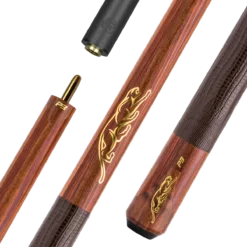

Serious players know that equipment care is not separate from performance — it is part of it. The right maintenance tools keep your tip shaped, your shaft friction-free, and your joint protected, session after session. This guide covers 11 essential accessories every player should own, with specific protocols for maple and carbon fiber shafts, product recommendations across three budget tiers, and a maintenance schedule built for league and tournament play.
A pool cue is a precision instrument governed by three interdependent variables: tip geometry, shaft friction, and joint integrity. When any one degrades, stroke repeatability suffers — and most players misattribute the resulting inconsistency to technique rather than equipment failure.
Tip geometry determines how chalk adheres and transfers to the cue ball. A tip that has flattened, mushroomed, or glazed produces unpredictable contact regardless of stroke quality. Shaft friction affects stroke fluidity and deflection. Oil, chalk dust, and skin residue accumulate in the wood grain after every session, progressively increasing resistance and altering the shaft’s feel. Joint integrity governs the structural connection between shaft and butt. Debris and moisture in unprotected threads introduce micro-movement that compounds over time, undermining the solid hit that accurate positional play requires.
“Maintenance is not about preserving a cue’s appearance — it is about preserving the conditions under which it was designed to perform.”
Addressing all three variables systematically — not reactively — is what separates equipment that holds its performance from equipment that quietly declines.
Premium cues — particularly those with low-deflection maple shafts or composite shafts such as the Predator REVO and Cuetec Cynergy — represent a significant investment. Without consistent care, that investment depreciates faster than it should.
Leather tips compressed by improper shaping wear unevenly and require earlier replacement. Maple shafts left unconditioned absorb moisture and oils that raise the grain, increase deflection, and compromise the shaft taper. Joint pins exposed to dirt and impact forces develop thread wear that no tip or shaft work can compensate for.
Used correctly and on a defined schedule, the right tools extend a cue’s functional lifespan by years — reducing replacement costs and eliminating the performance variance that forces players to compensate for their gear rather than trust it.
The tip shaper and scuffer addresses the two most common tip failure modes: shape loss and chalk adhesion failure.
A shaper restores curvature to a dime radius (tighter, preferred for spin players) or nickel radius (broader, preferred for straight-line power). A scuffer abrades the tip surface to create micro-texture that mechanically anchors chalk, preventing the glazed surface that causes miscues under pressure.
Recommended tools: Bowtie Tip Tool, Willard Tip Tool — both deliver shaping, scuffing, and trimming in one compact instrument.
When to use: Shape when curvature has visibly flattened. Scuff only when chalk adhesion becomes uneven or the surface glazes — typically every two to four weeks for active league players. Over-scuffing accelerates tip wear without improving performance.
Chalk formulation, particle size, and adhesion chemistry directly determine how reliably spin and follow transfer from tip to cue ball — particularly on off-center contact where miscue risk is highest.
Recommended products: Kamui chalk (0.98 and 1.21 hardness ratings) and Master chalk. Kamui’s ultra-fine particle formulation produces superior cue ball coverage with minimal shaft residue. Master chalk remains the standard for recreational and league play due to its consistent formulation and broad availability.
Application protocol: Apply in a smooth, rotating motion — never grind into the tip. Grinding accelerates tip compression and distributes chalk unevenly across the contact surface.
The cue shaft cleaner and conditioner is the most underused tool in recreational play and one of the most consequential for long-term performance. After every session, skin oils, chalk dust, and environmental particulates embed in the wood grain. Left untreated, this residue raises the grain, increases friction, and progressively alters deflection characteristics.
Application protocol: Apply a purpose-formulated cleaner to a microfiber cloth — never directly to the shaft — and wipe in long, even strokes from ferrule to joint. Follow with a dry cloth to remove remaining residue.
For carbon fiber shafts (Predator REVO, Cuetec Cynergy): Use isopropyl alcohol wipes exclusively. Oil-based conditioners designed for maple will not absorb into composite material and may leave residue that attracts chalk dust and degrades grip consistency.
The cue slicker is a burnishing pad — typically constructed from dense synthetic material — that compresses and seals the wood grain of a maple shaft after cleaning. Where shaft cleaner removes contamination, the slicker restores the low-friction surface that allows the shaft to travel cleanly through the bridge hand.
How to use: After cleaning, wrap the slicker around the shaft and draw it from ferrule to joint with moderate, consistent pressure. Three to five passes are sufficient for a noticeably smoother feel and reduced stroke drag.
Compatibility note: Designed for maple shafts only. Carbon fiber shafts do not respond to grain compression and must be maintained with alcohol wipes exclusively.
Where the slicker addresses surface smoothness, the billiard cue burnisher performs a deeper conditioning function — sealing the wood grain structurally and providing moisture resistance that extends the interval between full cleanings.
Burnishers are typically constructed from compressed leather or hardwood and applied with moderate pressure using the same ferrule-to-joint motion as the slicker. The friction generated slightly heats the shaft surface, driving grain compression deeper and producing a more durable seal.
Particularly valuable for players competing in high-humidity environments — outdoor tournaments, older facilities without climate control — where moisture absorption is the primary driver of grain raising and shaft warp in maple cues.
Joint protectors thread onto the shaft and butt when the cue is disassembled, shielding the joint pin and receiver from dirt, moisture, and impact forces. They are among the most cost-effective accessories available and among the most consistently overlooked.
Unprotected threads accumulate debris that creates resistance during assembly and micro-movement during play. Over time, this produces perceptible joint looseness — a measurable loss of energy transfer that undermines the solid hit precision positional play requires.
Material consideration: Stainless steel and brass options offer superior impact resistance. Rubber protectors provide adequate coverage for cue bags but are not equivalent to hard-shell options for tournament travel.
The hard case is not a storage solution — it is a precision-controlled environment for a precision instrument. Soft cases and cue tubes offer convenience but no meaningful protection against the temperature fluctuations, humidity shifts, and physical impacts that warp shafts, compress wraps, and damage ferrules.
A quality hard case holds the cue in a stable position, distributes external impact forces across its own structure rather than transferring them to the cue, and accommodates accessories without creating pressure points on the shaft or tip.
Recommended features: High-density foam interior, lockable latches, moisture-resistant exterior shell, and a dedicated accessory compartment. For players traveling to APA or BCA League events, a 2×4 or 4×8 configuration is the functional standard.
Microfiber is the only cloth material recommended for routine cue care. Its ultra-fine fiber structure lifts and traps oils, chalk particles, and debris without scratching the shaft finish or depositing lint on the tip surface.
Standard cotton towels and paper products are abrasive at the microscopic level and leave residue that defeats the purpose of cleaning. A dedicated set — one cloth for shaft cleaning, one for buffing, one for tip work — costs under ten dollars and eliminates cross-contamination between products.
Wash separately from other laundry and avoid fabric softeners, which coat the fibers and eliminate their absorption capacity.
Even with consistent shaping and scuffing, tips have a finite lifespan. A tip compressed below optimal thickness, showing edge separation from the ferrule, or lacking structural integrity requires replacement. The ability to perform that replacement without a shop visit is a meaningful competitive advantage.
A basic kit includes a tip clamp, tip cement or super glue gel, sandpaper for ferrule preparation, and replacement tips in multiple hardness ratings.
Tip hardness reference:
A repair kit extends beyond tip replacement to cover the full range of in-session emergencies — delaminating tips, loose ferrules, contaminated joints — that occur during league nights and tournaments where a cue shop is inaccessible.
Essential contents:
Owning this kit converts a maintenance failure into a two-minute field repair rather than a forfeited match.
Carbon fiber shafts — including the Predator REVO and Cuetec Cynergy — require a fundamentally different protocol than maple. Their performance is defined by a factory-applied surface finish that cannot be restored once compromised.
Protocol:
“Carbon fiber shafts do not age the way wood does — they perform at specification until the finish is compromised, and then they do not recover.”
Players who migrate from maple to carbon fiber and apply identical protocols frequently report unexplained performance degradation. The cause is almost always abrasive or oil-based product application on a surface not engineered to receive it.
The pool cue repair kit represents the intersection of maintenance and emergency readiness — a category traditional cue care guides consistently underserve.
| Item | Purpose |
|---|---|
| 3-in-1 tip tool | Shape, scuff, and trim in the field |
| Tip cement + accelerator | Secure a replacement tip in under 10 minutes |
| Two replacement tips | Address delamination or structural tip failure |
| Isopropyl alcohol wipes | Clean joints and carbon fiber shafts |
| Microfiber cloth | Shaft cleaning without surface abrasion |
| Extra chalk (2 cubes) | Redundancy for the most-consumed consumable |
All minimum viable kit items, plus:
Over-scuffing the tip. Scuffing removes material. Performed too frequently, it compresses the tip prematurely and shortens its lifespan without improving chalk retention.
Using sandpaper on carbon fiber shafts. This permanently removes the factory finish. The resulting surface cannot be restored and will exhibit increased friction, altered deflection, and accelerated chalk dust accumulation.
Ignoring joint threads. Debris in unprotected threads creates assembly resistance and micro-movement during play, eventually requiring professional re-threading.
Applying wood-specific products to composite shafts. Oil-based conditioners and burnishing compounds designed for maple accumulate on carbon fiber surfaces, attract chalk dust, and increase friction rather than reducing it.
Long-term storage in a soft case. Soft cases provide no protection against humidity, temperature change, or impact. A maple shaft stored in a soft case in a hot vehicle or damp room will warp. A hard case is structural protection for a structural instrument.
For recreational players in APA or BCA league play establishing foundational habits:
Priority: Post-session shaft cleaning and pre-session tip inspection. These two habits eliminate the majority of performance failures at any experience level.
For competitive players, tournament participants, and collectors:
For league nights, tournaments, and travel events:
This kit weighs under half a pound, fits in any case accessory compartment, and converts potential equipment failures into two-minute field repairs.
| Interval | Action |
|---|---|
| Every session | Wipe shaft with microfiber cloth; inspect tip for glazing; apply chalk with rotating motion |
| Weekly | Clean shaft with cleaner and conditioner; inspect joint threads; scuff tip if adhesion has degraded |
| Monthly | Burnish shaft; inspect ferrule for micro-cracks; evaluate tip thickness and compression |
| Annually | Replace tip if compressed below optimal thickness; inspect joint pin for thread wear; check case foam for compression loss |
For carbon fiber shafts, replace the monthly burnishing step with an alcohol wipe and visual inspection of the factory finish.
Best for: Beginners establishing baseline habits before investing in performance-grade tools.
Best for: League players who want performance-grade tools without premium pricing.
Best for: Tournament players, collectors, and owners of premium or custom cues where consistency justifies best-in-class tools across every category.
The best pool cue maintenance accessories protect your tip, shaft, and joint so you can execute smoother strokes, more reliable spin, fewer miscues, and years of consistent performance. A properly shaped tip holds chalk. A burnished shaft reduces drag. Protected joints preserve the structural integrity that repeatable strokes demand.
The accessories in this guide — combined with the maintenance schedule and budget tiers above — form a complete protective system. One that extends cue life, eliminates preventable failures, and lets you trust your equipment instead of compensating for it.
Protect the tool. Trust the stroke.
The essential kit includes a tip shaper and scuffer, shaft cleaner and conditioner, premium chalk, a cue slicker, billiard cue burnisher, joint protectors, and a hard case. These tools address every performance-critical failure point — tip geometry, shaft friction, chalk retention, and joint integrity — within a single systematic protocol.
A dedicated shaper, scuffer, or multi-function instrument such as the Bowtie or Willard tip tool. These establish and maintain a dime or nickel radius — the geometric variable that most directly governs chalk coverage and spin transfer at contact.
Clean with a purpose-formulated shaft cleaner applied via microfiber cloth to remove oils, chalk residue, and skin particulates. Follow immediately with a cue slicker or leather burnisher to compress and seal the wood grain, restoring the low-friction surface that supports a consistent stroke.
A shaper establishes tip curvature — dime or nickel radius depending on playing style. A scuffer abrades the surface to create micro-texture that anchors chalk and prevents glazing. Both address distinct failure modes and are most effective used together.
Yes. Carbon fiber shafts such as the Predator REVO and Cuetec Cynergy must be cleaned with isopropyl alcohol wipes only. Abrasive burnishers, oil-based conditioners, and sandpaper designed for maple will permanently compromise the composite surface in ways that cannot be corrected.
Only when chalk adhesion becomes uneven or the surface glazes — typically every two to four weeks for active league players. Over-scuffing compresses the tip prematurely and shortens its lifespan without delivering measurable performance benefit.
No. On maple, it removes the protective finish and raises the grain. On carbon fiber, it permanently strips the factory coating and introduces surface irregularities that increase deflection and reduce stroke consistency.
Yes. They prevent debris, moisture, and impact forces from degrading joint threads and pin alignment — factors that directly govern shaft-to-butt connection integrity and the stroke repeatability that precision positional play depends on.
Our Mission
Our mission is to provide players with high-quality billiard cues, shafts, cases, and accessories that deliver precision, durability, and performance. We aim to be a trusted destination for pool players across the USA looking for reliable equipment to improve their game and enjoy billiards at every level. 🎱