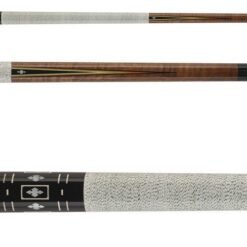
A pool cue is precision sporting equipment. Unlike a tennis racket or a golf club, it has no mechanical parts to absorb inconsistency — every variable in your stroke transfers directly through the shaft to the cue ball. That makes knowing how to clean a pool cue and maintain it correctly one of the most controllable performance factors available to any player.
Most cue problems that players attribute to technique are actually maintenance problems. A sticky shaft creates friction that disrupts stroke speed. A warped shaft introduces deflection that no amount of aim adjustment can fully correct. A degraded tip reduces spin transfer and cue ball control. None of these failures are inevitable. All of them are preventable with a simple, consistent pool cue maintenance routine.
This guide explains exactly how to clean a pool cue shaft, ferrule, tip, and wrap; how to identify and eliminate sticky buildup; how to store a pool cue to prevent warping; and which products are worth using. Whether you play recreationally or compete in APA or BCA league play, learning how to clean a pool cue correctly applies to every cue from entry-level to professional grade.
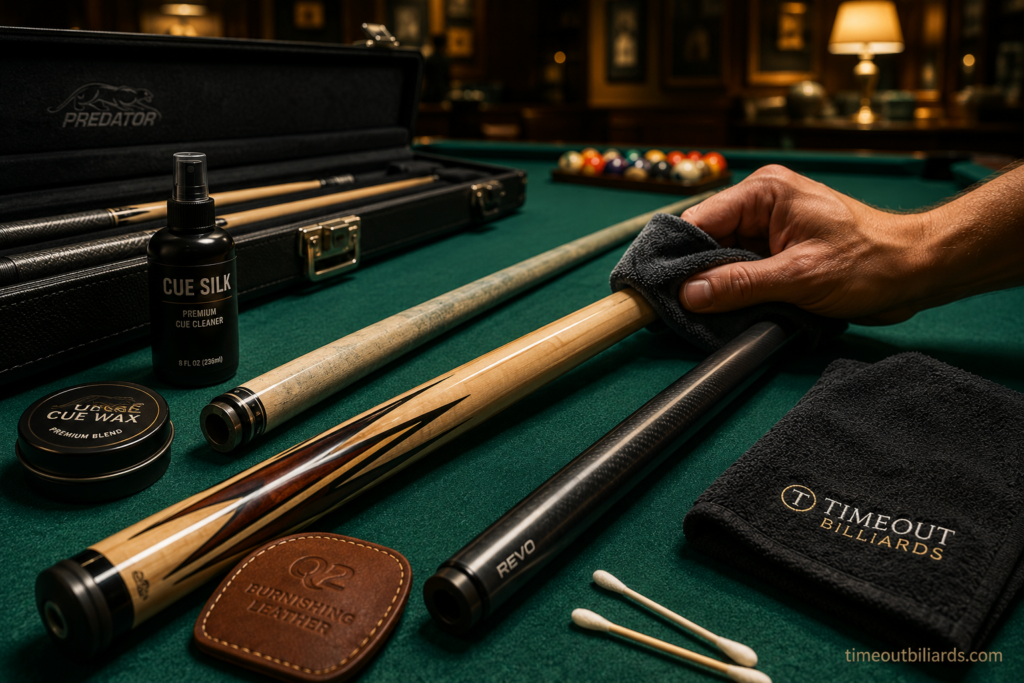
Effective pool cue maintenance does not require an expensive kit. The following tools cover every cleaning and conditioning task described in this guide.
Essential tools:
Optional but useful:
Avoid paper towels, furniture polish, silicone sprays, and general-purpose household cleaners. These products either abrade the wood surface, strip natural moisture from the grain, or leave residues that accelerate future buildup.
The shaft is the most performance-sensitive component of any cue. Hard rock maple — the industry standard for shaft construction — is an open-grain wood that absorbs sweat, skin oils, and chalk dust with every session. This accumulation is the direct cause of the sticky, high-friction feel that players commonly report after weeks of regular play.
Knowing how to clean a pool cue shaft correctly means removing that contamination without damaging the wood grain or stripping the finish.
Fold a microfiber cloth and draw the shaft through it using light, even pressure. Work from the ferrule end toward the joint in a single smooth pass. This removes surface chalk dust and moisture before either has time to penetrate the wood pores. This step takes approximately 60 seconds and is the single most effective habit in pool cue maintenance.
When the shaft feels tacky or shows visible discoloration, apply a small amount of dedicated cue cleaner to a clean microfiber cloth — not directly to the shaft. Wipe the full length of the shaft using moderate pressure, then immediately follow with a dry cloth to remove all moisture and dissolved residue. Never allow cue cleaner to sit on the wood.
Products such as Cue Silk and OB Clean are purpose-formulated for this task. They dissolve chalk and oil deposits without raising the wood grain or compromising the finish. Generic cleaners and household solutions are not appropriate substitutes when learning how to clean a pool cue properly.
Burnishing is the process of smoothing and partially sealing the wood grain through controlled friction. Wrap a piece of burnishing leather or a purpose-made pool cue shaft slicker around the shaft and draw it back and forth with firm, consistent pressure. The friction generates mild heat that compresses the grain, reduces surface porosity, and restores a naturally smooth feel.
This step is critical after any wet cleaning. It closes the grain before residual moisture can be absorbed and provides the tactile foundation that cue wax builds on.
Apply a thin, even layer of cue wax using a microfiber cloth, working along the grain from ferrule to joint. Allow the wax to sit for 30 to 60 seconds, then buff to a smooth finish. Cue wax provides a low-friction surface layer that reduces chalk adhesion, repels moisture, and slows the rate of future buildup.
Use restraint with wax application. Excess product accumulates in the grain and creates a new form of stickiness over time. A light coat applied consistently outperforms a heavy coat applied occasionally.
A sticky shaft is one of the most common complaints among regular players and one of the most straightforward problems to diagnose. The cause is nearly always the same: sweat, hand oils, and chalk dust have accumulated within the open pores of the maple grain to the point where surface drag is noticeable during the stroke.
To clean a sticky pool cue shaft:
For shafts with severe buildup, a Q Wiz or similar mechanical cleaning tool can accelerate the process by abrading the surface layer more aggressively than a cloth alone. Use these tools carefully and follow immediately with burnishing and wax.
Can I use rubbing alcohol to clean my pool cue shaft?
Isopropyl alcohol is effective at dissolving oil-based residue and is safe for use on sealed maple shafts and carbon fiber shafts when applied sparingly on a cloth. It should never be applied directly to unsealed wood or to any wrap material. Because alcohol draws moisture from wood, always dry the shaft completely after use and follow with burnishing and wax to restore the surface. This is the safest method when players want to know how to clean a pool cue without a dedicated product on hand.
The ferrule — the white collar between the shaft and the tip — is typically made from phenolic resin, ivory composite, or carbon fiber depending on the cue. It accumulates chalk residue and discolors with regular play.
Dampen a cotton swab with cue cleaner or diluted isopropyl alcohol and clean the ferrule surface using small circular strokes. Avoid contact with the tip during this process. Dry the ferrule immediately. Do not submerge the joint area in any liquid, as moisture intrusion at the ferrule-to-shaft bond can cause the ferrule to loosen or separate over time.
The cue tip directly determines how effectively force and spin transfer to the cue ball. A glazed, hardened, or mushroomed tip reduces that transfer and introduces inconsistency into every shot.
To maintain your tip:
Do not attempt to clean a cue tip with liquid products. Moisture degrades adhesion and accelerates separation from the ferrule.
The wrap occupies the grip section of the cue butt and is the surface most directly exposed to hand oils and sweat. Cleaning the wrap is a necessary but often overlooked part of knowing how to clean a pool cue completely.
Irish linen is the most common wrap material and the most maintenance-intensive. It is porous by design, which means it absorbs sweat efficiently but also retains it. Clean linen wraps by dampening a cloth with a mild dilution of dish soap and water, then wiping firmly along the wrap. Follow immediately with a dry cloth and allow the cue to stand upright in open air until the wrap is completely dry before storage. Never apply cue wax or shaft cleaner products to linen.
Leather wraps are less absorbent than linen and require less frequent cleaning. Wipe with a dry microfiber cloth after each session. For deeper cleaning, use a leather conditioner applied sparingly with a cloth. Avoid excessive moisture, which can cause leather to stiffen, crack, or discolor.
Some high-end cues feature an unwrapped butt section finished with lacquer or a similar hard coating. Clean these surfaces with a dry microfiber cloth or a cloth lightly dampened with cue cleaner. Avoid abrasive materials that could scratch the finish.
Carbon fiber shafts — including the Predator Revo and Cuetec Cynergy — have fundamentally different surface properties than wood. Their non-porous composite construction does not absorb oils or moisture, which eliminates the sticky buildup that makes maple shaft maintenance essential. Players who upgrade to carbon fiber still need to know how to clean a pool cue shaft, but the process is considerably simpler.
Carbon fiber shaft maintenance checklist:
The joint, ferrule, and tip on carbon fiber shafts require the same maintenance as their wood counterparts. Cleaning protocol for these components does not change based on shaft material.
Storage is the most consequential maintenance decision a cue owner makes. The majority of permanently damaged shafts — warped, cracked, or structurally compromised — result from improper storage, not manufacturing defects or physical impact. Understanding how to store a pool cue correctly costs nothing beyond the initial investment in an appropriate case.
| Feature | Hard Case | Soft Case |
|---|---|---|
| Impact protection | High | Low |
| Temperature insulation | Moderate to high | Low |
| Humidity buffering | Moderate | Minimal |
| Long-term storage | Recommended | Not recommended |
| Travel use | Strongly recommended | Acceptable for short trips only |
| Weight | Higher | Lower |
A hard case is the only appropriate container for regular or long-term storage. Soft cases provide minimal protection against the impact, temperature, and humidity variables that cause warping. They are acceptable for brief transport between locations within a controlled environment, nothing more.
| Condition | Recommended Range |
|---|---|
| Indoor temperature | 65°F–75°F (18°C–24°C) |
| Relative humidity | 40%–50% |
| Light exposure | Minimal (avoid direct sunlight) |
| Air circulation | Moderate |
Wood shafts respond to humidity the same way all wood does — they expand when moisture increases and contract when it decreases. Repeated cycling through these states introduces stress across the grain that accumulates over time and eventually manifests as warping. Maintaining consistent relative humidity between 40% and 50% eliminates this variable entirely.
A hygrometer placed in your storage area costs less than most tip replacements and eliminates guesswork. In regions with significant seasonal humidity swings, a small humidifier or dehumidifier in the storage space is a worthwhile investment for serious players.
Acceptable storage locations:
Storage locations to avoid:
Both orientations are structurally acceptable when the cue is stored indoors in a stable environment. The shaft does not warp preferentially based on orientation under normal conditions. The priority is containment inside a hard case, which provides protection against physical impact and moderates exposure to environmental fluctuation regardless of whether the case stands upright or lays flat.
Warping is the permanent deformation of the shaft along its longitudinal axis. It is caused by uneven moisture absorption across the wood grain — typically the result of one side of the shaft being exposed to more heat, humidity, or direct moisture than the other over a sustained period.
The most common causes of pool cue warping:
Once a significant warp has developed in a wood shaft, it cannot be reliably reversed. Minor deflection may be partially manageable through careful manual pressure over an extended period, but there is no guaranteed correction method. Shaft replacement is the definitive solution for structurally significant warping.
The only reliable approach to pool cue warp prevention is consistent, controlled storage from the day the cue is purchased.
This point warrants its own section because the damage it causes is both severe and entirely preventable.
Vehicle interiors reach temperatures that most players significantly underestimate. On a sunny day with an ambient temperature of 90°F, the interior of a parked car routinely exceeds 130°F within 30 minutes. At these temperatures, wood cells in the shaft expand rapidly and unevenly based on grain direction, moisture content, and exposure angle. When the vehicle cools, the wood contracts — but not uniformly, and not back to its original geometry.
A single prolonged exposure at these temperatures is sufficient to permanently warp a quality maple shaft. The damage is not always immediately visible. A shaft that appears straight after a hot-car incident may reveal its warp within days as the wood continues to settle.
There is no safe duration for leaving a pool cue in a parked vehicle in warm weather. Carbon fiber shafts are significantly more resistant to thermal deformation but are not immune to extreme heat, and the tips, ferrules, and wraps on any cue remain heat-sensitive regardless of shaft material.
Consistent pool cue maintenance does not require large time investments. The following schedule covers all components of pool cue care across appropriate intervals.
Ambient humidity varies significantly across the United States, and pool cue storage strategy should reflect local climate conditions. Knowing how to store a pool cue in a humid coastal environment requires different tools than storing one in an arid high-desert climate.
| Region | Climate Challenge | Recommended Action |
|---|---|---|
| Florida, Gulf Coast | High year-round humidity (70%–90%) | Use dehumidifier in storage space; inspect wraps monthly for mold |
| Texas (Houston, Dallas) | High summer humidity, dry winters | Monitor humidity seasonally; use hard case with humidity buffer |
| Arizona, Nevada, New Mexico | Extreme aridity (10%–30% humidity) | Use small humidifier near storage; apply cue wax more frequently |
| Colorado, Utah | Low humidity, altitude variation | Humidify storage space; avoid outdoor or garage storage |
| Pacific Northwest | Moderate to high humidity, rain season | Dehumidify during winter months; inspect linen wraps regularly |
| Midwest (Chicago, Detroit) | Cold dry winters, humid summers | Seasonal humidity management; avoid basement storage year-round |
| Northeast | Cold dry winters, warm humid summers | Maintain indoor storage consistently; use hard case at all times |
The target range of 40%–50% relative humidity applies universally. The tools required to achieve it vary by region.
Choosing the best pool cue cleaner depends on shaft material, maintenance frequency, and budget. The following products represent the established standard for pool cue maintenance at the time of publication.
Cue Silk
The most widely used dedicated cue cleaner in the market. Formulated to dissolve chalk and skin oil deposits on maple shafts without raising the grain or stripping finish. Leaves a light conditioning layer that slows future buildup. Cue Silk is the benchmark product for players learning how to clean a pool cue shaft for the first time.
OB Clean
Developed in conjunction with OB Cues and designed specifically for low deflection maple shafts. Effective on both standard and ultra-low deflection shaft profiles.
Q Wiz
A mechanical cleaning tool rather than a liquid product. The Q Wiz uses a contained pad that draws chalk and oils from the grain through friction. Useful for deep cleaning between liquid product applications.
Pool cue shaft wax (paste formula)
Applied after burnishing to provide a low-friction surface layer. Use sparingly — one light coat per week is sufficient for regular players.
Leather burnishing pad
Not a product applied to the shaft but an essential maintenance tool. Burnishing after wet cleaning is non-optional for wood shafts. Quality leather pads outlast multiple shafts and cases.
Hard cases (recommended for all storage)
Hard cases with molded interiors, locking mechanisms, and humidity-buffering lining provide the highest level of protection for transport and storage. Brands such as Predator, Viking, and Instroke produce cases appropriate for both recreational and competitive players.
Soft cases (transport only)
Acceptable for carrying a pool cue between a vehicle and a venue within a controlled environment. Not appropriate for vehicle storage, airline travel, or unsupervised storage.
Proper pool cue maintenance is not complicated, but it is cumulative. The decisions made after every session — wiping the shaft, returning the cue to a hard case, storing it in a climate-controlled space — compound over months and years into measurable differences in shaft performance, tip integrity, and overall cue longevity.
The core principles of how to clean a pool cue and store it properly:
Most warped shafts, degraded tips, and sticky grips are the result of neglect rather than defect. A cue maintained consistently from purchase will outperform an equivalent cue that is cleaned only when the problem becomes impossible to ignore.
For players competing in APA or BCA league play, equipment consistency directly supports performance consistency. The stroke you practice should match the stroke you execute under pressure — and that requires a cue that performs the same way every time you pick it up.
Understanding how to clean a pool cue and store it correctly is not advanced knowledge — it is the baseline standard for any player who takes the game seriously. Treat your cue as precision equipment, and it will perform like precision equipment.
Wipe the full length of the shaft with a dry microfiber cloth after every session. When chalk or oil buildup is visible, apply a small amount of dedicated cue cleaner to a cloth, wipe clean, dry immediately, burnish with a leather pad to close the wood grain, and finish with a thin application of cue wax.
Shaft stickiness results from the cumulative deposit of sweat, hand oils, and chalk dust within the open pores of the wood. Hard rock maple is particularly absorbent, and without regular cleaning, this residue creates surface drag that disrupts stroke speed and feel.
Isopropyl alcohol can be used sparingly on sealed maple or carbon fiber shafts, but it should never be applied to unsealed wood or wraps. Always dry the shaft completely and immediately afterward to prevent moisture absorption and grain raising.
Store your cue in a hard case at stable room temperature with 40%–50% relative humidity. Avoid locations where temperature and moisture fluctuate, including garages, basements, car trunks, and exterior closets.
Yes. Vehicle interiors routinely exceed 130°F in warm weather. At those temperatures, wood shafts expand and contract unevenly, initiating warps that become permanent within a single exposure. Even a single hot-car incident can permanently compromise a quality shaft.
Purpose-formulated products such as Cue Silk and OB Clean are specifically engineered to dissolve chalk residue and skin oils without stripping the wood’s natural moisture or damaging the finish. General household cleaners are not appropriate substitutes.
Both orientations are acceptable in a stable indoor environment. The critical factor is containment inside a hard case, which shields the cue from physical impact, humidity swings, and temperature extremes regardless of orientation.
Minor deflection may be partially manageable through careful manual pressure over time, but structurally significant warping typically requires full shaft replacement. Prevention through proper storage is the only reliable solution.

Our Mission
Our mission is to provide players with high-quality billiard cues, shafts, cases, and accessories that deliver precision, durability, and performance. We aim to be a trusted destination for pool players across the USA looking for reliable equipment to improve their game and enjoy billiards at every level. 🎱