
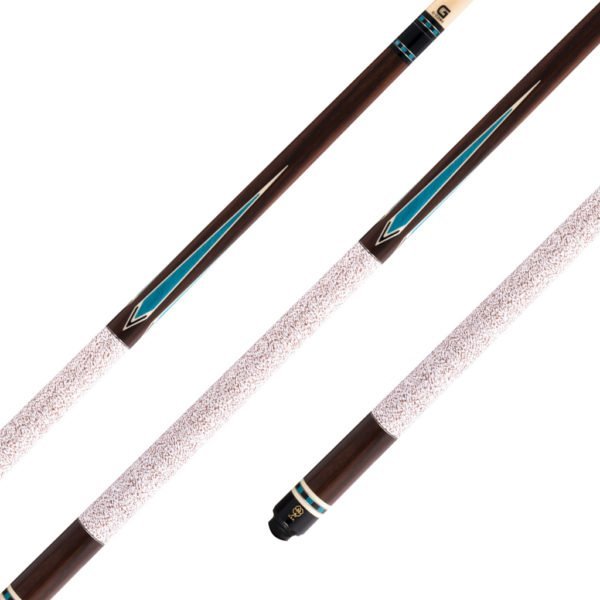
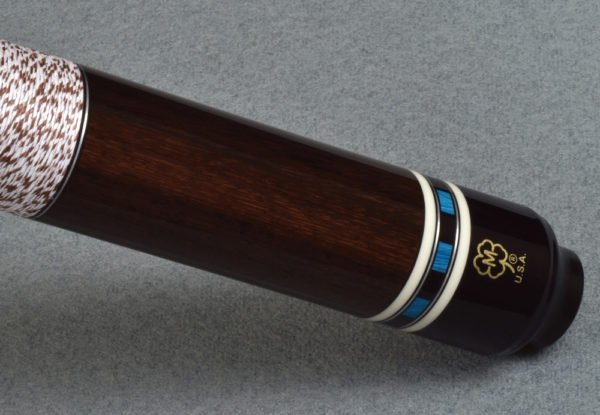
| Specification | Detail |
|---|---|
| Manufacturer | McDermott Cue Mfg. |
| Origin | Menomonee Falls, Wisconsin, USA |
| Construction | Cocobolo forearm, Birdseye Maple sleeve |
| Shaft | G-Core low-deflection shaft |
| Shaft Diameter | 12.5mm |
| Cue Weight Range | 18–21 oz (adjustable) |
| Joint | 3/8″-10 wood-to-wood |
| Tip | Everest by Tiger |
| Wrap | Irish linen |
| Warranty | Lifetime (includes warpage) |
| Price Range | $740–$780 |
$650.00

| Question | Answer |
|---|---|
| Is the G426 low deflection? | ✅ Yes |
| Good for APA players? | ✅ Yes |
| Does warranty cover warpage? | ✅ Yes |
| Can it use the Defy shaft? | ✅ Yes |
| Worth the price for league play? | ✅ Yes |
The McDermott G426 delivers hybrid low-deflection performance with traditional maple feedback, making it one of the best transition cues for serious APA and BCA league players. Handcrafted in Menomonee Falls, Wisconsin, it combines a G-Core shaft, Cocobolo construction, 3/8″-10 joint, and lifetime warpage warranty into a cohesive package that outperforms its price tier in measurable ways. For intermediate and advanced league players evaluating the best pool cues under $800, the G426 represents one of the most defensible equipment investments in the American-made pool cue category.
This McDermott G426 pool cue review evaluates whether the cue truly delivers premium low-deflection performance, long-term durability, and tournament-grade value for APA and BCA league players. The G426 remains one of the strongest low deflection pool cue McDermott options for serious league competitors seeking hybrid shaft technology — sitting at a precise intersection that most pool cues never reach: traditional American craftsmanship with measurable low-deflection engineering.
This review examines the G426 from the standpoint of actual competitive use — covering G-Core shaft mechanics, construction materials, joint performance, warranty value, upgrade paths, humidity durability, and where this cue outperforms its price tier. If you compete in APA or BCA leagues, especially in humidity-variable environments, this is one of the most consequential purchasing decisions in your equipment progression.
The McDermott G426 is a premium American-made low-deflection pool cue featuring a G-Core shaft, 3/8″-10 wood-to-wood joint, Cocobolo construction, and lifetime warpage warranty. It is designed for intermediate and advanced APA/BCA players seeking hybrid wood feel with modern cue ball control.
Among American-made pool cues, the G426 consistently ranks among the best pool cues under $800 for players seeking hybrid low-deflection technology. It is handcrafted in Menomonee Falls, Wisconsin, under domestic quality control standards that distinguish McDermott’s G-Series from similarly priced import alternatives.
| Specification | Detail |
|---|---|
| Manufacturer | McDermott Cue Mfg. |
| Origin | Menomonee Falls, Wisconsin, USA |
| Construction | Cocobolo forearm, Birdseye Maple sleeve |
| Shaft | G-Core low-deflection shaft |
| Shaft Diameter | 12.5mm |
| Cue Weight Range | 18–21 oz (adjustable) |
| Joint | 3/8″-10 wood-to-wood |
| Tip | Everest by Tiger |
| Wrap | Irish linen |
| Warranty | Lifetime (includes warpage) |
| Price Range | $740–$780 |
These aren’t arbitrary choices. Every specification connects to a measurable outcome at the table — a design philosophy that distinguishes McDermott’s G-Series from aesthetics-first competitors at comparable price points.
| Pros | Cons |
|---|---|
| Lifetime warpage warranty with broad coverage | Premium price tier — not suited for casual players |
| Hybrid G-Core delivers genuine low-deflection improvement | Not maximum deflection reduction — full carbon fiber outperforms |
| Direct upgrade path to Defy carbon fiber shaft | Requires an adaptation period for players transitioning from standard shafts |
| Strong humidity and dimensional stability | Smaller aftermarket shaft ecosystem than Predator |
| Domestic manufacture with consistent quality control | Wood feedback may feel muted to players accustomed to stiffer carbon fiber response |
| Cocobolo construction competes with cues priced significantly higher | — |
| Player Type | Recommendation |
|---|---|
| Beginner | ❌ Over-engineered for developmental stage |
| Intermediate APA player | ✅ Ideal primary cue |
| Advanced BCA player | ✅ Strong competitive tool |
| Carbon fiber-only players | ⚠ Consider Defy shaft upgrade instead |
| Traditional wood-feel players | ✅ G-Core preserves familiar feedback |
| High-humidity environment players | ✅ Warpage warranty provides direct value |
This review evaluates the McDermott G426 against a defined framework applied consistently across competitive pool cue assessments at this price tier:
Shaft performance was assessed across deflection reduction mechanics, radial consistency claims, and feedback profile relative to comparable hybrid and full carbon fiber systems.
Construction materials were evaluated for structural relevance — density, vibration characteristics, dimensional stability — rather than aesthetic value alone.
Warranty coverage was analyzed against competitor terms at the $700–$800 price tier to establish relative value, not simply confirm its existence.
Long-term ownership costs were modeled across tip maintenance, shaft upgrade optionality, and warranty risk offset to produce a total cost-of-ownership comparison.
Environmental performance was evaluated specifically for players in variable-humidity competitive environments, a factor most competing reviews omit entirely.
The G-Core shaft is the functional core of the G426’s value proposition, and it requires precise explanation rather than generic praise.
The G-Core uses a 7-inch internal carbon fiber core embedded within a traditional maple shaft. This hybrid construction reduces front-end mass without abandoning the organic feedback that experienced players rely on for touch shots and speed calibration.
Unlike full carbon fiber shafts, the G-Core preserves tactile wood feedback while still reducing cue ball squirt during English-heavy shots. The result is a shaft that performs measurably closer to full carbon fiber in deflection reduction while maintaining the hit feel and cue responsiveness that many intermediate players require during their transition from standard shafts.
“The G426 succeeds because it solves the transition problem between traditional maple shafts and full carbon fiber systems — delivering quantifiable deflection reduction without eliminating the tactile feedback players have spent years calibrating.”
Players transitioning from standard shafts typically adapt to the G-Core faster than to full carbon fiber systems like the Predator Revo. The wood exterior communicates shot feedback in familiar terms while the internal core handles deflection reduction — a division of function that makes the adaptation period measurably shorter than full carbon fiber adoption.
Radial consistency is the second performance claim worth examining. McDermott machines the G-Core shaft to maintain uniform density around its circumference, meaning the shaft performs identically regardless of rotation in the joint. The shaft taper is engineered for consistent stiffness through the impact zone, supporting reliable spin transfer, English control, and energy transfer from stroke to cue ball.
Bottom line on G-Core performance: The G-Core delivers genuine low-deflection improvement with a hit feel and stroke consistency profile accessible to players who aren’t yet ready to commit to full carbon fiber feedback — and who shouldn’t be.
The G426’s butt construction uses Cocobolo for the forearm and Birdseye Maple for the sleeve. This pairing is neither arbitrary nor purely decorative.
Cocobolo is a dense tropical hardwood from Central America with a Janka hardness rating significantly higher than standard maple. Its density contributes directly to the cue’s balance point, weight distribution, and vibration dampening — characteristics that affect precision shotmaking and cue feel at contact.
Birdseye Maple provides the sleeve with dimensional stability maple is known for in competitive pool equipment, paired with a distinctive figured grain pattern. Together, these materials create a butt that competes structurally with cues priced well above the G426’s tier.
For players competing in variable-humidity environments — Texas pool halls in August, basement leagues during winter — the material stability of this construction is a practical consideration with direct performance consequences.
One performance variable competitors rarely address directly is humidity exposure — and for APA league players across the southern and midwestern United States, it is among the most relevant real-world factors in cue longevity.
For buyers researching McDermott pool cues Texas league players actually trust in humid conditions, the G426 remains one of the safest long-term choices because of its explicit warpage warranty coverage and material construction.
Wood cues are hygroscopic — they absorb and release moisture as ambient humidity changes, creating differential stress that can introduce subtle warp permanently compromising stroke consistency. The G426 addresses this risk through three reinforcing mechanisms:
1. Material selection. Cocobolo’s natural oil content provides inherent resistance to moisture absorption relative to many domestic hardwoods.
2. G-Core internal reinforcement. The carbon fiber core running through the shaft’s interior provides a dimensionally stable anchor that resists the bowing wood fibers produce under humidity stress — a structural benefit of hybrid construction extending beyond deflection reduction.
3. Lifetime warpage warranty. McDermott’s explicit warpage coverage provides a documented recovery path if material failure occurs despite proper storage.
“In climates where humidity variance between seasons exceeds 40 percentage points, a warpage warranty isn’t a bonus feature — it’s a material component of the cue’s actual value.”
The G426 uses a 3/8″-10 wood-to-wood joint — a specification with more long-term significance than most buyers initially recognize.
Wood-to-wood joints transmit more vibration from tip contact back through the butt than metal-to-metal alternatives. Many experienced players interpret this vibration as feel — and deliberately seek it for precision shotmaking and position play feedback.
The G426 also competes strongly within the 3/8-10 joint pool cues category because of its compatibility with future carbon fiber shaft upgrades — specifically the McDermott Defy shaft, which shares this joint specification exactly. A G426 purchased today is a direct upgrade path to full carbon fiber performance without requiring a new cue.
Best for: Players who want wood-feel feedback now with a documented path to carbon fiber performance later.
Not ideal for: Players who require immediate maximum deflection reduction and are prepared to abandon wood feedback entirely.
McDermott’s lifetime warranty is frequently cited but rarely examined with precision.
McDermott’s lifetime warranty covers manufacturing defects and includes explicit warpage protection. Buyers researching McDermott cue lifetime warranty warpage protection consistently place the G426 among the safest long-term investments in the G-Series lineup — and the coverage scope justifies that positioning.
Some competitor lifetime warranties cover cosmetic defects only, or exclude warpage on the grounds that humidity exposure constitutes user misuse. McDermott’s warpage coverage acknowledges the physical reality of wood cues in competitive play.
The G426’s lifetime warpage warranty significantly improves long-term ownership value compared to competing cues in the $700–$800 category. At a $740–$780 purchase price, a full replacement cue at retail represents substantial unplanned expenditure. The warranty converts that risk into a covered asset — which meaningfully changes the total cost-of-ownership comparison.
“Few American-made pool cues under $800 combine hybrid low-deflection engineering with lifetime warpage protection as effectively as the G426 — making the warranty less a reassurance and more a structural component of its value proposition.”
The APA handicap system creates a specific performance environment that generic cue reviews rarely address directly.
Shot consistency under pressure. The G-Core’s radial consistency means the cue performs identically across a match regardless of how the shaft seats between racks — eliminating a variable that causes inconsistent results during extended competitive sessions.
English and position play. The G426’s low-deflection profile directly benefits APA formats where position play separates skill levels. Players who have compensated for standard shaft squirt with aim adjustments will need recalibration — but once recalibrated, low-deflection accuracy and cue ball control improve measurably.
Durability across venues. APA play happens in bars, pool halls, and league venues with inconsistent climate control. The G426’s humidity resistance and warpage warranty address the durability demands of multi-venue competitive play more directly than competitors offering cosmetic-only coverage.
Q: Is the McDermott G426 good for APA league play?
A: Yes. The G426 provides low-deflection accuracy, consistent feedback, and durability suited for competitive APA league environments across skill levels from 4 through 7.
At $740–$780, the G426 competes directly with several Predator configurations and similarly priced options from Viking, Lucasi, and Meucci.
Predator’s primary competitive advantage at this price tier is carbon fiber shaft availability — particularly the Predator Revo — and a larger aftermarket shaft ecosystem. Players who prioritize maximum deflection reduction and are comfortable with full carbon fiber feedback from day one may find Predator configurations more immediately aligned with their priorities.
Players upgrading from standard maple shafts typically adapt to the G-Core faster than to full carbon fiber systems like the Predator Revo — a practical advantage that pure specification comparisons don’t capture.
Viking and Lucasi offer American-made alternatives at lower price points but don’t match the G426’s shaft technology or warranty depth. Meucci competes on hit feel but lacks McDermott’s documented warpage coverage. Tiger Everest tip compatibility gives the G426 a performance-matched tip that many competitors spec at a lower tier.
| Factor | McDermott G426 | Predator (Comparable Tier) |
|---|---|---|
| Shaft Type | Hybrid (wood + carbon core) | Full carbon fiber (Revo) |
| Hit Feel | Wood-forward, organic | Mechanical, stiff |
| Deflection Reduction | Moderate-high | Maximum |
| Adaptation Period | Shorter for wood players | Longer for wood players |
| Warpage Warranty | ✅ Explicit lifetime | ⚠ Limited |
| Domestic Manufacture | ✅ Wisconsin | ❌ Import components |
| Upgrade Path | Defy shaft (same joint) | Proprietary ecosystem |
For APA and BCA league players specifically: The G426’s combination of low-deflection performance, warranty coverage, and domestic manufacturing represents a defensible value position that Predator’s comparable configurations don’t consistently outperform when total cost of ownership is factored in.
The G426 occupies a deliberate middle position between traditional maple and full carbon fiber — and understanding that position clarifies who it serves.
Full carbon fiber shafts — including the Predator Revo and McDermott Defy — deliver maximum deflection reduction and shot-to-shot consistency. They are stiffer, provide less organic feedback, and require players to develop new tactile calibration from scratch.
The G-Core hybrid approach reduces deflection meaningfully without eliminating the wood feedback that intermediate players use to calibrate speed, draw, and touch shots. For players who haven’t yet developed stroke mechanics precise enough to leverage maximum carbon fiber consistency, the G-Core produces better practical results — not because it’s technically superior, but because it’s appropriately matched to the player’s development stage.
“The McDermott G426 is best for intermediate and advanced league players who want low-deflection accuracy with traditional wood feedback and long-term upgrade flexibility.”
The G426’s 3/8″-10 joint means carbon fiber is available when the player is ready — not locked behind a new cue purchase.
The G-Core shaft is the right choice for players who:
The Defy shaft is the right choice for players who:
Bottom line: Start with the G-Core unless you have already trained on low-deflection technology. The Defy shaft delivers maximum performance once your mechanics are ready to leverage it — and the 3/8″-10 joint makes that upgrade direct and cost-effective.
Both cues share the G-Core shaft, 3/8″-10 joint, and lifetime warranty. The differentiation is in butt materials, balance point, and vibration characteristics.
The G426 is the stronger choice for players who prioritize:
The G407 is more appropriate for players who prioritize:
Neither cue outperforms the other objectively. The choice is a function of individual stroke mechanics and tactile preferences — which is why testing both in person remains the only reliable selection method.
The McDermott Defy shaft is a full carbon fiber shaft engineered for maximum deflection reduction and stroke consistency. Because it shares the 3/8″-10 joint specification with the G426, the upgrade path is direct and requires no additional hardware.
Players who purchase the G426 and later want full carbon fiber performance can replace the G-Core shaft with the Defy shaft and retain the G426 butt — preserving the more expensive, difficult-to-replace component while allowing shaft evolution as skill develops.
The G-Core to Defy progression is a rational upgrade arc: the G-Core provides low-deflection training with familiar feedback; the Defy removes remaining deflection variables once mechanics are developed enough to benefit from maximum shaft stiffness and spin transfer precision.
A credible assessment of competitive pool equipment requires honest engagement with known limitations.
It is not maximum deflection. Players who have trained on full carbon fiber shafts and require the absolute lowest deflection available will find the G-Core’s hybrid construction a compromise. The Predator Revo and McDermott Defy both outperform the G-Core in pure deflection reduction.
It requires an adaptation period. Players transitioning from standard maple will find their aim compensation habits need recalibration. This period is shorter than full carbon fiber adaptation — but it exists and should be anticipated.
The aftermarket ecosystem is smaller than Predator’s. McDermott’s shaft compatibility is strong within the 3/8″-10 ecosystem, but Predator’s broader aftermarket gives players more third-party options at various price points.
The feedback profile may feel muted to carbon fiber veterans. Players who have spent years on stiff carbon fiber shafts sometimes find the G-Core’s wood-forward feedback insufficiently precise for their calibrated expectations.
The price tier excludes casual players. At $740–$780, the G426 is an investment that requires the playing frequency and competitive commitment to justify it.
Proper maintenance protects the G426’s performance and preserves warranty eligibility.
Shaft maintenance: Wipe the G-Core shaft with a clean, dry cloth after each session to remove chalk residue and hand oils. Avoid shaft conditioners containing silicone, which can compromise tip adhesion and shaft finish over time. Light burnishing with a shaft slicker maintains surface consistency without removing material.
Tip care: The Tiger Everest tip maintains optimal performance with regular shaping and scuffing. A mushroomed tip reduces English control and cue ball accuracy — reshape before performance degrades, not after.
Storage protocol: Store the G426 horizontally or in a quality two-piece hard case to distribute weight evenly across the cue. Vertical storage in cases that contact only the bumper concentrates stress at the joint over time.
Humidity management: For players in high-humidity environments, a two-way humidity control pack inside the cue case maintains moisture stability between sessions. Target 45–55% relative humidity. The G426’s warpage warranty covers manufacturing defects — it does not eliminate the need for reasonable humidity management.
Joint maintenance: Clean the 3/8″-10 joint threads periodically with a dry cloth. Avoid overtightening — secure finger-tight contact is sufficient for wood-to-wood joints and overtightening accelerates thread wear.
Tip replacement: The Tiger Everest tip requires replacement every 12–18 months under regular league play depending on maintenance frequency. Cost is nominal relative to the cue’s value.
Shaft upgrade: The Defy shaft upgrade adds $200–$300 to total ownership cost if pursued. The G-Core has no planned obsolescence and performs consistently over multi-year use without degradation under normal conditions.
Warranty risk offset: McDermott’s lifetime warpage coverage eliminates the replacement cost risk representing the largest potential unplanned expenditure in this price tier. Competitors without equivalent coverage require the buyer to absorb full replacement cost — a risk that can equal or exceed the original purchase price.
Total cost of ownership over five years — factoring tip maintenance, potential shaft upgrade, and warranty risk offset — positions the G426 favorably against comparably priced alternatives with weaker warranty structures.
Q: What shaft comes standard with the McDermott G426?
A: The McDermott G426 includes the G-Core low-deflection shaft, featuring a 7-inch internal carbon fiber core embedded in a maple exterior for improved cue ball control, spin transfer, and radial consistency.
Q: Is the McDermott G426 a low-deflection pool cue?
A: Yes. The G-Core shaft reduces front-end mass and minimizes cue ball squirt during spin shots, qualifying the G426 as a genuine low-deflection cue — not a marketing classification.
Q: Does McDermott’s warranty cover cue warpage?
A: Yes. McDermott’s lifetime warranty explicitly covers manufacturing defects including warpage — a coverage scope broader than many competitors at comparable price points.
Q: Where are McDermott pool cues manufactured?
A: McDermott pool cues are handcrafted in Menomonee Falls, Wisconsin, USA, under domestic quality control standards.
Q: Can the McDermott G426 accept a carbon fiber shaft?
A: Yes. The 3/8″-10 joint is directly compatible with the McDermott Defy carbon fiber shaft and other compatible aftermarket options, creating a clear upgrade path from the standard G-Core configuration.
Q: What type of players should buy the McDermott G426?
A: The G426 is best suited for intermediate and advanced APA or BCA league players seeking low-deflection performance, domestic manufacture quality, and long-term upgrade flexibility in a sub-$800 cue.
Q: How much does the McDermott G426 cost?
A: The McDermott G426 typically retails between $740 and $780, depending on shaft configuration and authorized dealer pricing.
Q: What is the difference between the G-Core and Defy shaft?
A: The G-Core combines a maple exterior with an internal carbon fiber core for hybrid feedback and reduced deflection. The Defy shaft is full carbon fiber, delivering maximum shaft stiffness and lower deflection for players whose mechanics are developed enough to leverage that precision.
Q: Is the McDermott G426 good for APA league play?
A: Yes. The G426 provides low-deflection accuracy, consistent feedback, and durability suited for competitive APA league environments across skill levels from 4 through 7.
Q: How does the G426 handle humidity?
A: The G426’s Cocobolo construction, G-Core internal reinforcement, and lifetime warpage warranty together provide the strongest humidity-resistance and recovery profile available at this price tier in the American-made pool cue category.
Yes. The McDermott G426 is worth buying for league players who want low-deflection performance, upgrade flexibility, humidity durability, and long-term warranty protection in a premium American-made cue under $800.
The G426 earns its price tier through specification integrity rather than brand positioning. The G-Core shaft delivers measurable low-deflection performance with a hit feel and stroke consistency profile accessible to players transitioning from standard maple. The Cocobolo and Birdseye Maple construction provides material density, vibration dampening, and dimensional stability that justify the price independent of aesthetics. The 3/8″-10 joint creates a direct upgrade path to the Defy carbon fiber shaft without requiring a full equipment replacement. The lifetime warpage warranty converts long-term risk into a covered asset.
Within the broader McDermott G-Series pool cues review landscape, the G426 stands out for balancing low-deflection technology, humidity durability, and upgrade flexibility in a single cohesive package. From a long-term ownership and performance standpoint, this McDermott G426 pool cue review confirms the cue remains one of the strongest American-made investments under $800.
It is not the right cue for every player. It is precisely the right cue for a clearly defined one.
| Weight | 18oz, 19oz, 20oz, 21oz |
|---|


Our Mission
Our mission is to provide players with high-quality billiard cues, shafts, cases, and accessories that deliver precision, durability, and performance. We aim to be a trusted destination for pool players across the USA looking for reliable equipment to improve their game and enjoy billiards at every level. 🎱
Reviews
There are no reviews yet.