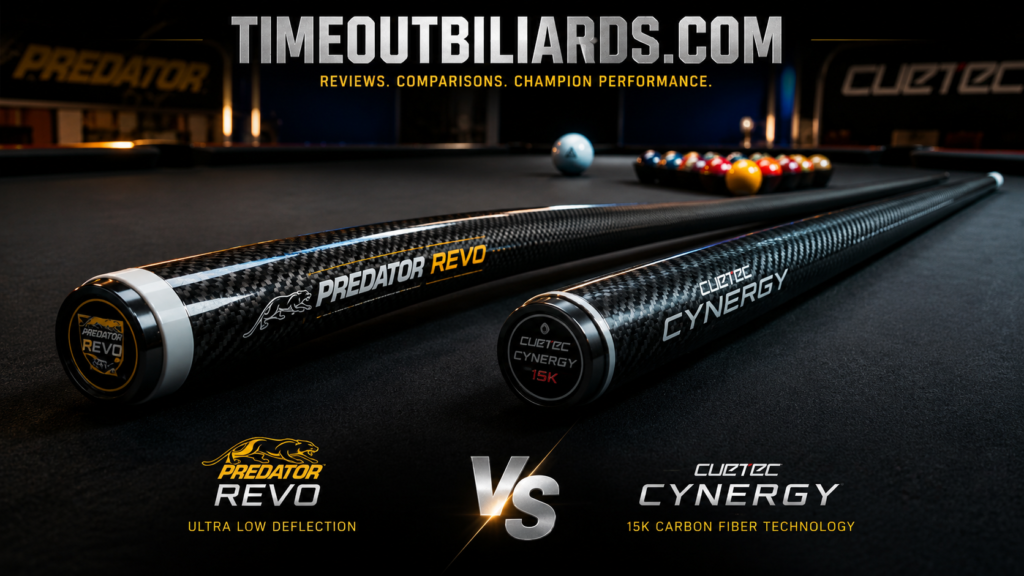
The Predator REVO vs Cuetec Cynergy comparison covers two premium carbon fiber pool cue shafts engineered for low deflection and long-term durability. The REVO delivers the lowest measured deflection in its class through a ferrule-less Vault Plate design and produces a stiff, responsive hit. The Cynergy uses a polyurethane foam core and 15K carbon fiber construction to replicate the feel of a premium maple shaft while maintaining competitive low-deflection performance. Tournament players consistently favor the REVO for precision; players transitioning from wood consistently favor the Cynergy.
The Predator REVO vs Cuetec Cynergy question does not have a single correct answer. The REVO is better for players prioritizing the lowest possible deflection and maximum shot precision. The Cynergy is better for players seeking a softer, wood-like feel and an easier transition from traditional maple shafts. Neither is objectively superior—the best choice in the REVO vs Cynergy decision depends on playing style, skill level, and feel preference.
The Predator REVO vs Cuetec Cynergy comparison represents two distinct engineering philosophies within the premium carbon fiber pool cue shaft category—and understanding those differences is essential before making a buying decision.
The REVO is built for maximum deflection reduction. Its ferrule-less Vault Plate system minimizes front-end mass concentration, which is the primary mechanical driver of cue ball deflection. The result is a shaft that demands precision, rewards experienced technique, and performs with exceptional radial consistency across every rotation.
The Cynergy is built for performance without sacrificing feel. Its polyurethane foam core absorbs vibration at contact, producing a softer, quieter hit that closely mirrors the feedback of a high-quality maple shaft. The 15K carbon fiber weave provides structural rigidity and warp resistance while preserving the tactile qualities that many experienced players rely on.
Both shafts eliminate the warping, humidity sensitivity, and long-term inconsistency inherent to wood construction. The performance gap in this REVO vs Cynergy comparison is real but narrow. The decision ultimately depends on whether you prioritize deflection reduction above all else, or value a more natural feel during the transition to carbon fiber.
| Player Type | Recommended Shaft |
|---|---|
| Tournament Competitor | Predator REVO |
| League Player | Cuetec Cynergy |
| Traditionalist / Feel-First Player | Cuetec Cynergy |
| Maximum Precision Priority | Predator REVO |
| Best Overall Value | Cuetec Cynergy |
| First Carbon Fiber Shaft | Cuetec Cynergy |
| Aggressive English Application | Predator REVO |
| Performance Category | Winner |
|---|---|
| Cue Ball Deflection | Predator REVO |
| Hit Feel | Cuetec Cynergy |
| Sound Profile | Cuetec Cynergy |
| Maintenance Requirements | Tie |
| Long-Term Durability | Tie |
| Overall Value | Cuetec Cynergy |
| Shot Precision | Predator REVO |
| Transition from Maple | Cuetec Cynergy |
| Radial Consistency | Tie |
| Spin Generation | Predator REVO |
Carbon fiber pool cue shafts have moved from novelty to necessity at the competitive level. Within that market, the Predator REVO vs Cuetec Cynergy comparison defines the performance standard. Both are built from carbon fiber composite materials, both reduce cue ball deflection more effectively than any traditional maple shaft, and both are used by professionals and serious league players worldwide.
But the REVO and Cynergy are not the same shaft, and the differences between them matter.
This Predator REVO vs Cuetec Cynergy comparison breaks down exactly how each shaft performs across every measurable and subjective dimension—deflection, hit feel, sound, maintenance, joint compatibility, tip options, and long-term value. Whether you are a tournament competitor, an APA league regular, or a serious recreational player investing in your first carbon fiber shaft, this guide provides the technical depth and honest analysis you need to make the right choice.
Among all carbon fiber pool cue shafts currently available, the Predator REVO vs Cuetec Cynergy comparison consistently surfaces as the most competitive and consequential choice in the category. Both shafts rank at the top across deflection performance, build quality, and player adoption rate. Neither holds a universal claim to the title of best carbon fiber pool cue shaft—but together they define the performance ceiling of the category.
The REVO holds the measurable performance edge in deflection reduction and shot precision. The Cynergy holds the advantage in feel, accessibility, and value. For players comparing the best carbon fiber pool cue shaft options on the market, the Predator REVO vs Cuetec Cynergy decision represents the clearest choice architecture available: maximum performance versus maximum feel compatibility.
“The Predator REVO delivers the lowest measurable deflection among mainstream carbon fiber shafts, while the Cuetec Cynergy delivers the most wood-like playing experience of any carbon fiber shaft currently available.”
The Predator REVO is built around a single defining innovation: the elimination of the traditional ferrule. In a conventional pool cue shaft, the ferrule—the small cylindrical collar that sits between the shaft body and the tip—concentrates mass at the front end. That front-end mass is the primary mechanical cause of cue ball deflection, also called squirt.
Predator replaced the ferrule with the Vault Plate, a proprietary composite plate integrated directly into the carbon fiber shaft body. In the Predator REVO vs Cuetec Cynergy comparison, this design difference is the single most important engineering distinction. The Vault Plate reduces mass concentration at the contact point more effectively than any ferrule-based system, including the ferrule used on the Cynergy. The engineering result is a measurable reduction in cue ball squirt, a stiffer energy transfer at contact, and improved stroke efficiency on shots requiring significant english application.
The REVO is manufactured using a carbon fiber composite layup that produces exceptional radial consistency. Because carbon fiber does not respond to humidity, temperature fluctuation, or mechanical stress the way wood does, every stroke delivers the same structural response regardless of playing environment.
The REVO is available in three diameter specifications: 11.8mm for players who prefer a slender shaft and maximum cue ball control, 12.4mm as the most widely adopted middle-ground option, and 12.9mm for players who prefer the feel of a fuller shaft diameter without sacrificing the performance advantages of carbon fiber construction.
The Cuetec Cynergy approaches carbon fiber shaft engineering from a different direction. Rather than optimizing exclusively for deflection reduction, Cuetec engineered the Cynergy to replicate the feel of premium maple while delivering the structural advantages of carbon fiber. In the context of the Predator REVO vs Cuetec Cynergy comparison, this represents the Cynergy’s foundational design philosophy.
The core of the Cynergy is a polyurethane foam structure. This material absorbs vibrational energy at the moment of cue-to-ball contact and disperses it before it reaches the player’s hand. The practical effect is a softer, more muted hit sensation that veteran players immediately recognize as resembling the feel of a well-broken-in maple shaft. This energy dispersion mechanism is the primary engineering differentiator between the Cynergy and the REVO.
The exterior is wrapped in 15K carbon fiber—a tighter, more densely woven construction than standard carbon fiber layups. The 15K designation refers to the number of filaments per tow used in the weave. Higher filament counts produce a smoother surface finish and more uniform structural properties. This construction gives the Cynergy its characteristic low surface friction and contributes to its warp resistance and dimensional stability.
The Cynergy is available in 11.8mm, 12.5mm, and a 10.5mm variant designed specifically for break and jump applications.
In the Predator REVO vs Cuetec Cynergy deflection comparison across controlled conditions, the REVO produces measurably lower cue ball deflection. This advantage is attributable to the Vault Plate design and its superior reduction of front-end mass. The ferrule-less construction eliminates the primary mass concentration point that causes squirt in both wood and ferrule-equipped carbon fiber shafts.
For most players at most skill levels, the deflection difference between the REVO and Cynergy is small enough that shot-making accuracy will not be the deciding factor. However, for advanced players who apply significant english on nearly every shot—and who have developed precise aim compensation habits around a specific deflection value—the REVO’s lower deflection floor represents a meaningful performance advantage in competitive contexts.
The Cynergy’s deflection performance is fully competitive. It substantially outperforms every traditional maple shaft and matches or exceeds most other carbon fiber shafts on the market. In the REVO vs Cynergy comparison, the Cynergy’s deflection characteristics are not a liability; the shaft simply does not reach the absolute minimum that the REVO achieves through its ferrule-less design.
Both shafts in this REVO vs Cynergy comparison deliver significantly higher radial consistency than wood. Because neither shaft responds to humidity or temperature changes, their structural properties remain constant across playing sessions, venues, and seasons. Shaft recovery speed—the rate at which a shaft returns to its original axis after contact—is comparable between the two products under normal playing conditions.
This consistency is one of the primary reasons professional players have adopted carbon fiber shafts for tournament competition. Equipment that behaves identically in a climate-controlled arena and a humid pool hall eliminates one variable from an already demanding performance equation.
Players describe the Predator REVO as producing a crisp, stiff hit with an immediate, direct feedback response. There is minimal vibration dampening between the contact point and the player’s bridge hand. The REVO transmits stroke energy efficiently, and players who prefer to feel every nuance of contact—including subtle variations in tip placement and stroke speed—typically respond well to this characteristic.
The stiffness of the REVO can present an adjustment challenge for players coming from maple shafts. In the Predator REVO vs Cuetec Cynergy feel comparison, the REVO’s hit sensation is noticeably more mechanical, more immediate, and carries less of the organic resonance that characterizes a quality maple shaft at impact.
The Cuetec Cynergy is engineered to narrow the sensory gap between carbon fiber and wood. The polyurethane foam core functions as a vibration dampening system, absorbing high-frequency feedback at the moment of cue-to-ball contact and dispersing it before it reaches the player’s hand.
“Players switching from maple typically adapt faster to the Cynergy, while players focused on precision often prefer the REVO.”
Players who have competed on premium maple shafts for years consistently report that the Cynergy’s hit sensation is the closest carbon fiber equivalent to that experience. In the REVO vs Cynergy feel comparison, the Cynergy delivers a softer hit, more gradual feedback, and an overall stroke sensation that is less jarring than the REVO. For players whose feel sensitivity is a core part of their game, this distinction is not cosmetic—it is a functional performance variable that affects shot execution at the table.
The acoustic difference in the Predator REVO vs Cuetec Cynergy comparison is audible, consistent, and meaningful to players who rely on sound as part of their stroke evaluation process.
The Predator REVO produces a sharp, high-pitched click at cue-to-ball contact. This sound reflects the shaft’s stiff, low-damping engineering and its rigid carbon fiber resonance characteristics. Some players find this acoustic signature satisfying and precise; others find it distracting, particularly in quiet playing environments or during high-pressure competitive situations.
The Cuetec Cynergy produces a softer, lower-pitched sound at contact—closer to the thud produced by a quality maple shaft than to the crack of the REVO. The polyurethane core absorbs the high-frequency acoustic energy that the REVO transmits freely, resulting in a contact sound that experienced players immediately recognize as more natural.
For players who have spent years interpreting the sound of a maple shaft as a quality signal for stroke mechanics, the Cynergy’s sound profile provides continuity that the REVO does not.
This is the most frequently asked question in the Predator REVO vs Cuetec Cynergy discussion, and the answer is qualified: yes—more than any other carbon fiber shaft currently available.
The Cynergy does not feel identical to a maple shaft. No carbon fiber shaft does. The structural properties of carbon fiber composite materials are fundamentally different from those of maple, and those differences produce perceptible variations in hit sensation even after the polyurethane core dampens the most obvious vibrational distinctions.
What the Cynergy achieves in the REVO vs Cynergy feel comparison is a reduction of the sensory gap between carbon fiber and wood to the point where most players—including many long-term maple shaft users—can transition without significantly disrupting their stroke mechanics or feel sensitivity. That is a meaningful engineering accomplishment, and it explains why the Cynergy is consistently recommended for players who want carbon fiber performance without abandoning the tactile experience of wood.
The Predator REVO 12.4 vs Cuetec Cynergy 12.5 comparison represents the most popular diameter options for each shaft and the most direct head-to-head reference point in the broader Predator REVO vs Cuetec Cynergy evaluation.
The 0.1mm diameter difference is negligible in practical terms. Neither shaft will feel meaningfully thicker or thinner than the other to most players under normal playing conditions.
Where the REVO 12.4 vs Cynergy 12.5 comparison becomes substantive is performance feel. The REVO 12.4 plays stiffer and crisper, with faster energy transfer and more immediate stroke feedback. The Cynergy 12.5 plays softer and more forgiving, with dampened vibration and a more gradual feedback response. Players whose game depends on aggressive spin generation and precise aim correction will generally favor the REVO 12.4. Players whose game prioritizes feel, touch, and shot-making around the table will generally favor the Cynergy 12.5.
Both perform at a level that exceeds what any premium maple shaft can deliver in terms of deflection reduction, radial consistency, and environmental stability.
Beginning players have not yet developed the precise aim compensation habits that make the REVO’s low deflection floor a meaningful advantage. In the Predator REVO vs Cuetec Cynergy decision for beginners, the Cynergy’s softer feedback and more forgiving stroke response provide a more productive learning environment. The Cynergy’s wood-like feel also allows newer players to develop tactile sensitivity without the adjustment burden of a stiffer, more mechanically demanding shaft.
For players competing in APA league formats or similar recreational and semi-competitive environments, the Cynergy is the more commonly recommended side of the Predator REVO vs Cuetec Cynergy decision. The Cynergy’s softer hit and wood-like feel make the transition from traditional maple significantly less disruptive to established stroke mechanics. League players encounter a wider range of table conditions, lighting environments, and playing surfaces than dedicated tournament competitors, and the Cynergy’s forgiving feedback characteristics are better suited to those variable conditions.
“For most league players, the Cynergy provides the best balance of performance, feel, and value.”
At the elite competitive level, the REVO is the more widely adopted side of the Predator REVO vs Cuetec Cynergy choice among professional players. Shane Van Boening, one of the most decorated professional pool players in American history, has competed using Predator equipment. The REVO’s deflection performance and radial consistency make it the preferred tool for players whose shot-making standards leave no margin for equipment inconsistency.
The Cuetec Cynergy is also used at competitive levels, particularly among professionals who prioritize feel and who have developed their game around a softer, more tactile stroke response. At the professional tier, the Predator REVO vs Cuetec Cynergy selection often comes down to individual feel preference and sponsorship relationships as much as measurable performance data.
The transition timeline from a traditional maple shaft varies depending on which side of the Predator REVO vs Cuetec Cynergy comparison you choose, as well as your skill level, practice volume, and feel sensitivity.
Sessions 1–3: Most players notice the reduced deflection immediately. The softer hit feel and quieter sound profile are recognizable as familiar, and many players report feeling comfortable within the first session. Minor aim adjustments may be required on heavily angled cut shots.
Week 1–2: Aim compensation for low deflection becomes more intuitive. Players who were using significant english compensation on maple shafts typically report that their compensation habits simplify rather than change entirely.
Week 3–4 and beyond: Most players report full comfort with the Cynergy within one month of consistent play. Because the feel profile closely approximates maple, the adjustment is primarily mechanical rather than sensory.
Sessions 1–3: The REVO’s stiffer hit and sharper sound profile are immediately noticeable. Players coming from maple shafts often report the contact sensation as jarring or unfamiliar during initial sessions. Deflection differences are significant enough to require conscious aim adjustment on most english shots.
Week 1–2: Players begin developing new aim reference points calibrated to the REVO’s lower deflection. This recalibration period requires deliberate practice and may temporarily affect competitive performance for players in active league or tournament schedules.
Week 3–4 and beyond: Players who commit to the REVO typically report full adjustment within four to six weeks of regular play. The adjustment period is longer than the Cynergy’s but the long-term precision payoff is measurable for players at the appropriate skill level.
In the Predator REVO vs Cuetec Cynergy transition comparison, the Cynergy consistently delivers a faster and less disruptive adjustment period for the majority of players.
Both sides of the Predator REVO vs Cuetec Cynergy comparison offer substantially greater long-term durability than any traditional maple shaft. However, their durability profiles differ in the types of wear players observe over extended competitive use.
Both shafts accumulate chalk residue during play. On the REVO, chalk buildup can slightly increase surface friction if not addressed regularly. On the Cynergy, the 15K carbon fiber weave’s smoother surface finish tends to resist chalk adhesion more effectively, requiring less frequent cleaning between sessions.
Neither shaft is immune to surface scratching from normal handling, case contact, or accidental impact. Scratches on carbon fiber shafts are primarily cosmetic and do not affect structural performance. Neither develops the grain-related surface wear that affects wood shafts over time.
Carbon fiber shafts are more resistant to denting and warping from transportation stress than maple, but they are vulnerable to cracking under high-impact conditions that wood shafts might flex through. Proper case storage remains essential for both products in this REVO vs Cynergy durability comparison.
Under normal competitive use, tip replacement frequency on both shafts is comparable—typically every six to twelve months depending on play volume and tip hardness preference. The primary distinction is that tip replacement on the REVO requires additional care to protect the Vault Plate, which adds a layer of complexity absent from Cynergy maintenance.
After two years of regular league play, both shafts maintain their structural integrity and performance characteristics with appropriate care.
The Predator REVO is available with multiple joint configurations to accommodate a wide range of cue bodies. Standard options include the Uni-Loc Quick Release joint, the Radial joint, and standard thread profiles including 3/8×10, 3/8×14, 5/16×14, and 5/16×18. Players should verify joint compatibility with their specific cue before purchasing, as the REVO’s joint options are fixed at the time of manufacture and not field-convertible.
The Cuetec Cynergy is also available across multiple joint configurations, including Radial, Uni-Loc, and standard thread profiles. Cuetec has historically offered strong aftermarket support and broad compatibility across its Cynergy lineup, making it an accessible option for players whose existing cue bodies use less common joint specifications.
In the Predator REVO vs Cuetec Cynergy joint compatibility comparison, both shafts cover the most common professional and consumer cue body specifications. Players with custom or vintage cue bodies should consult the manufacturer or a qualified cue technician before purchasing either shaft to confirm mechanical compatibility.
The Cuetec Cynergy 15K is the flagship specification in the Cynergy lineup and represents the most refined version of Cuetec’s carbon fiber shaft engineering. In the Predator REVO vs Cuetec Cynergy evaluation, the 15K is the Cynergy variant most directly comparable to the REVO’s flagship configuration.
The 15K designation refers to the 15,000-filament-per-tow carbon fiber weave used in the shaft’s exterior construction. This high-density weave produces a surface that is smoother, more uniform, and more structurally consistent than lower-filament-count carbon fiber constructions. The result is a shaft with exceptional dimensional stability, low surface friction, and a finish that maintains its integrity under regular competitive use.
The 15K Cynergy retains the polyurethane foam core that defines the Cynergy’s hit feel and energy dispersion characteristics. Players who have tested multiple carbon fiber shafts consistently rate the 15K Cynergy among the best-performing options in its price range, particularly for players who prioritize feel and sound profile alongside deflection performance.
For players evaluating their first carbon fiber shaft purchase and seeking a product that delivers competitive performance without requiring significant stroke adjustment, the Cynergy 15K is among the most credible and well-supported options in the current market.
Predator REVO shafts ship from the factory with the Predator Victory tip, available in multiple hardness options. The Victory tip is a quality laminated tip with reliable chalk retention and consistent cue ball response across spin applications.
Tip replacement on the REVO requires care. The Vault Plate beneath the tip is a fixed structural component of the shaft. Improper tip removal—particularly aggressive sanding or cutting techniques that contact the Vault Plate surface—can damage the plate and degrade shaft performance. Players who are not confident in precision tip replacement should have the work performed by a qualified cue technician. DIY replacement is achievable, but the risk of Vault Plate damage must be clearly understood before proceeding.
Replacement tips commonly selected for the REVO include the Kamui Clear Black, which advanced players favor for its spin transfer characteristics and durability under high-english applications.
Cuetec Cynergy shafts ship from the factory with a Tiger Sniper laminated tip—a mid-hardness laminated tip with reliable chalk retention and consistent performance across shot types.
Tip replacement on the Cynergy is more straightforward than on the REVO. In the Predator REVO vs Cuetec Cynergy maintenance comparison, the absence of a Vault Plate analog on the Cynergy means standard tip replacement techniques carry significantly less risk of structural damage. Players comfortable with basic cue maintenance can typically replace Cynergy tips without professional assistance.
Carbon fiber shafts require less maintenance than wood shafts but are not maintenance-free. Proper care preserves both the cosmetic finish and the structural performance of the shaft over time.
Cleaning: Wipe the REVO down with a clean, dry microfiber cloth after each playing session. Oils, chalk residue, and environmental contaminants accumulate on the shaft surface and increase friction during play. Avoid abrasive cleaning materials, which can scratch the carbon fiber surface and alter friction characteristics over time.
Burnishing: Do not use leather burnishing tools designed for maple shafts on the REVO or any carbon fiber shaft. Burnishing compresses wood fibers to smooth the surface—a process that carbon fiber does not respond to and can be structurally compromised by under aggressive application.
Tip Maintenance: Maintain the tip using standard techniques: shaping, scuffing for chalk retention, and replacement when the tip has compressed beyond its effective performance range. Exercise additional care during tip replacement to protect the Vault Plate.
Vault Plate Inspection: Inspect the Vault Plate periodically for signs of damage or separation. If the Vault Plate shows cracking, chipping, or delamination, contact Predator directly to assess warranty coverage and replacement options. The Vault Plate is the most performance-critical component on the REVO and should not be repaired or improvised upon without manufacturer guidance.
Storage: Store the REVO in a padded cue case when not in use. While carbon fiber shafts are not susceptible to warping from humidity or temperature changes, physical impact can cause structural damage that wood shafts—which flex rather than fracture—resist more effectively under certain high-impact conditions.
The Predator REVO vs Cuetec Cynergy decision ultimately comes down to what you need your shaft to prioritize—and how honestly you can assess where your game currently stands.
Both shafts outperform any traditional maple alternative. Both offer warp resistance, radial consistency, and long-term structural stability that wood cannot match. The Predator REVO vs Cuetec Cynergy choice is not between a good shaft and a better shaft—it is between two different performance philosophies, each executed at the highest level of carbon fiber shaft engineering currently available.
“The Predator REVO is the correct choice for players who have already developed their game to the point where equipment precision is the limiting variable. The Cuetec Cynergy is the correct choice for everyone else—and for many advanced players who simply prefer what it feels like to play pool the way they always have. In the Predator REVO vs Cuetec Cynergy comparison, both shafts represent the current ceiling of carbon fiber pool cue engineering. Choose based on where your game is, not where you want it to be.”
In the Predator REVO vs Cuetec Cynergy deflection comparison, the REVO produces lower cue ball deflection. Its ferrule-less Vault Plate design reduces front-end mass more effectively than any ferrule-based system, including the Cynergy’s construction. The difference is measurable but narrow, and most players will not detect it under normal playing conditions without deliberate testing.
The Cynergy is the closest carbon fiber shaft to a premium maple shaft in terms of hit feel and acoustic feedback. Its polyurethane foam core dampens vibration at contact in a way that replicates the softer, more gradual feedback of a quality wood shaft. It does not feel identical to maple, but in the REVO vs Cynergy feel comparison, the Cynergy’s sensory gap to wood is smaller than with any competing carbon fiber product currently on the market.
For players whose game depends on maximum deflection reduction and who have the technical foundation to fully utilize the REVO’s performance characteristics, yes. For league players or those new to carbon fiber, the Cynergy side of the Predator REVO vs Cuetec Cynergy comparison provides better value by delivering competitive performance at a lower price point with an easier and faster transition curve.
Most Cuetec Cynergy shafts are factory-equipped with a Tiger Sniper laminated tip—a mid-hardness laminated tip with reliable chalk retention and consistent performance across shot types.
Predator REVO shafts ship with the Predator Victory tip, available in multiple hardness options depending on the specific model and player preference.
Yes, but the Vault Plate beneath the tip must not be damaged during the process. Aggressive sanding, improper cutting angles, or excessive heat can compromise the Vault Plate and degrade shaft performance. Players unfamiliar with precision tip replacement should consult a qualified cue technician to avoid warranty-affecting damage.
In the Predator REVO vs Cuetec Cynergy comparison for league play, the Cynergy is more commonly recommended. Its softer hit, wood-like feedback, and less disruptive transition from traditional maple shafts make it the more practical choice for most league formats. Most league players report adapting to the Cynergy faster and more comfortably than to the REVO.
Both shafts offer substantially greater long-term durability than wood. Neither is susceptible to warping, humidity damage, or grain-related inconsistency. In the REVO vs Cynergy durability comparison, both shafts maintain their performance characteristics indefinitely under normal playing conditions and with proper storage. Physical impact is the primary durability risk for either product.
In the Predator REVO vs Cuetec Cynergy sound comparison, the Cynergy is noticeably quieter. Its polyurethane foam core absorbs high-frequency acoustic energy, producing a muted thud that closely resembles a maple shaft. The REVO produces a sharper, higher-pitched click that reflects its rigid, low-damping construction.
The Predator REVO typically holds stronger resale value due to Predator’s brand positioning and premium market price point. In the REVO vs Cynergy value comparison, both shafts retain value well compared to wood shafts, which depreciate more rapidly from physical wear and environmental exposure.
Both shafts require minimal maintenance compared to maple. In the Predator REVO vs Cuetec Cynergy maintenance comparison, the Cynergy has a slight practical advantage in that tip replacement carries less structural risk. The REVO requires careful Vault Plate protection during tip work, adding a layer of complexity to an otherwise simple maintenance routine.
The Cuetec Cynergy is easier to retip. Standard tip replacement techniques apply without the additional precaution required to protect the REVO’s Vault Plate. Players who prefer to manage their own cue maintenance will find the Cynergy more straightforward in this regard.
The Predator REVO vs Cuetec Cynergy comparison does not produce a single winner. These are not competing products so much as they are competing answers to the same engineering question: what should a carbon fiber pool cue shaft optimize for?
The REVO answers that question with deflection reduction. It is the most technically advanced low-deflection shaft available, and it delivers that performance with a precision and radial consistency that no wood shaft can match. Players who compete at the highest levels and whose game is built around aggressive english application and exacting aim compensation will find no better tool in the current market.
The Cynergy answers that question with accessibility. It delivers carbon fiber performance—low deflection, warp resistance, radial consistency, energy dispersion—without requiring players to abandon the tactile experience they have built their game around. It is the correct choice for the majority of players transitioning from wood, for most league formats, and for anyone whose feel sensitivity is a core competitive asset.
In the Predator REVO vs Cuetec Cynergy comparison, neither shaft is the wrong choice. Both represent the current standard for carbon fiber pool cue shaft engineering. The question is not which shaft is better—it is which shaft is better for you.
Choose the REVO if maximum deflection reduction is your primary competitive priority and you have the technical foundation to adapt to its feedback. Choose the Cynergy if feel, transition ease, and overall value are your primary criteria. Either way, you are choosing a shaft that will outperform any maple alternative you have ever played with—and that will keep performing at that level for as long as you play the game.

Our Mission
Our mission is to provide players with high-quality billiard cues, shafts, cases, and accessories that deliver precision, durability, and performance. We aim to be a trusted destination for pool players across the USA looking for reliable equipment to improve their game and enjoy billiards at every level. 🎱